Populous architect Al Baxter and Stephen Byron on the proposed stadium site. Photos: Ian Bushnell.
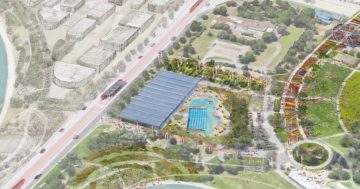
The architectural team for the proposed city stadium believes the facility will enhance the Commonwealth Park precinct, including the Canberra Aquatic Centre and Floriade.
More details have also emerged about the design features the team will explore, including a retractable roof and field.
Canberra Airport has appointed global stadium design firm Populous to develop plans for the proposed covered, all-events 25,000/36,000-seat stadium on Catholic church land at Regatta Place, next to Commonwealth Park.
Airport boss Stephen Byron, Populous senior principal and former Wallaby Al Baxter and members of the Canberra business consortium backing the proposal visited the site on Wednesday (14 October).
Concerns have been raised about what the proposal may mean for the pool, which is meant to replace Canberra Olympic Pool when it closes to make way for the Convention and Entertainment Centre project, and for Commonwealth Park, particularly Floriade.
But Mr Baxter, Canberra-born with a son at the Brumbies, said the project would not be developed in isolation from its surrounds.
Although it was early days, Mr Baxter believed there was enough room on that side of Commonwealth Park to keep the pool.
“There is certainly an opportunity to have a stadium and pool,” he said.
“That has to be tested, but we think that is an exciting opportunity for this site.”

The Archbishop’s House, which the stadium backers hope to acquire.
Airport boss Stephen Byron said the ACT Government was keen to address the pool issue and the team wanted to meet pool users soon.
“Part of that is us working hand in glove with Infrastructure Canberra on this question of the pool. Can it be co-located and Al’s done some work to look at the possibilities of that, and we’ll share that with Infrastructure Canberra,” Mr Byron said.
Mr Byron acknowledged that “a bed or two” of Floriade on the site’s eastern edge would be affected.
“But I think there’s an opportunity for this stadium and all the facilities around it, and if it included the aquatic centre, to really enhance the experience for Floriade,” he said.
Mr Baxter said the stadium could be sited as close as 30 metres to Commonwealth Avenue to maximise the site’s opportunities, and the team would seek a win-win situation where the amenity and access would benefit Floriade and other events in Commonwealth Park.
Mr Byron said the team would not shy away from the challenges and would talk to all stakeholders, including the community, the football codes and concert promoters.
“We’re going to listen to all the problems, we’re going to hear all the concerns, we’re going to analyse them, we’re going to resolve them, and we’re going to find a way to move forward and get this job done,” he said.
Populous designed the Christchurch stadium, which is being used as a reference point for the Canberra proposal. Populous hopes a Canberra stadium can be built for a comparable price of $530 million.
Estimating a realistic cost is in the Populous brief, but Mr Baxter said Canberra, from a construction point of view, was not inherently different from Christchurch and had the advantage of being close to Sydney and Melbourne, where the major infrastructure groups and workforce skills were based.
Canberra also did not have to worry about earthquakes.

Mr Baxter and Mr Byron look at early concept plans for the site.
The team will also look at design features such as a fixed or retractable roof, whether a roof casts shadows, a retractable pitch and the orientation and ventilation to ensure grass can grow.
“As a firm, Populace is really looking forward to working with Steve and the team testing the site, on making sure it fits for Canberra’s unique climate, for the site itself, and for the community,” Mr Baxter said.
He said that while Christchurch was flat, the sloped terrain at this site could be used to advantage to bring people in at upper levels.
The team would also look to maximise existing infrastructure, such as car parks and pedestrian paths.
Mr Byron stressed that the stadium would be an all-weather, all-event facility capable of hosting major concerts, increasing its use and making it more viable.
He said the goal was to put Canberra on the world stage.
“By having a roof and making it an all-weather stadium and having the concerts, you not only change the mathematics and the feasibility from an operation of the stadium point of view, you introduce new revenue streams; you get it to be used more for non-football events,” Mr Byron said. “This is where the economic impact comes.”

Mr Baxter said Kai Tak Stadium in Hong Kong was designed as a sports stadium, but it hosted far more music and cultural events than it did sport.
“We have 60 events a year and only 10 to 15 of those are sporting events and the rest are cultural events,” he said.
“That really drives the use of the stadium, and certainly, we hoped to be able to design something here which would have a similar impact.”
Mr Baxter said boosting the 25,000 capacity to 30,000 for Test matches through temporary seating would also be in the mix.
Mr Byron said the team should deliver design and feasibility studies, including a firm cost, in four to six months for governments to consider.
He said the ACT Government’s response so far had been positive.