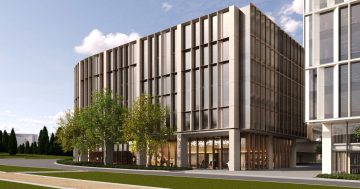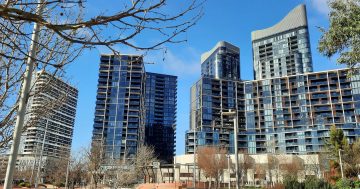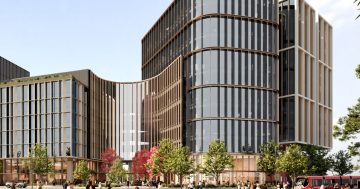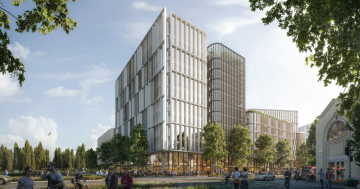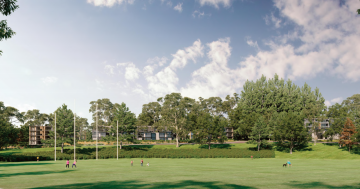

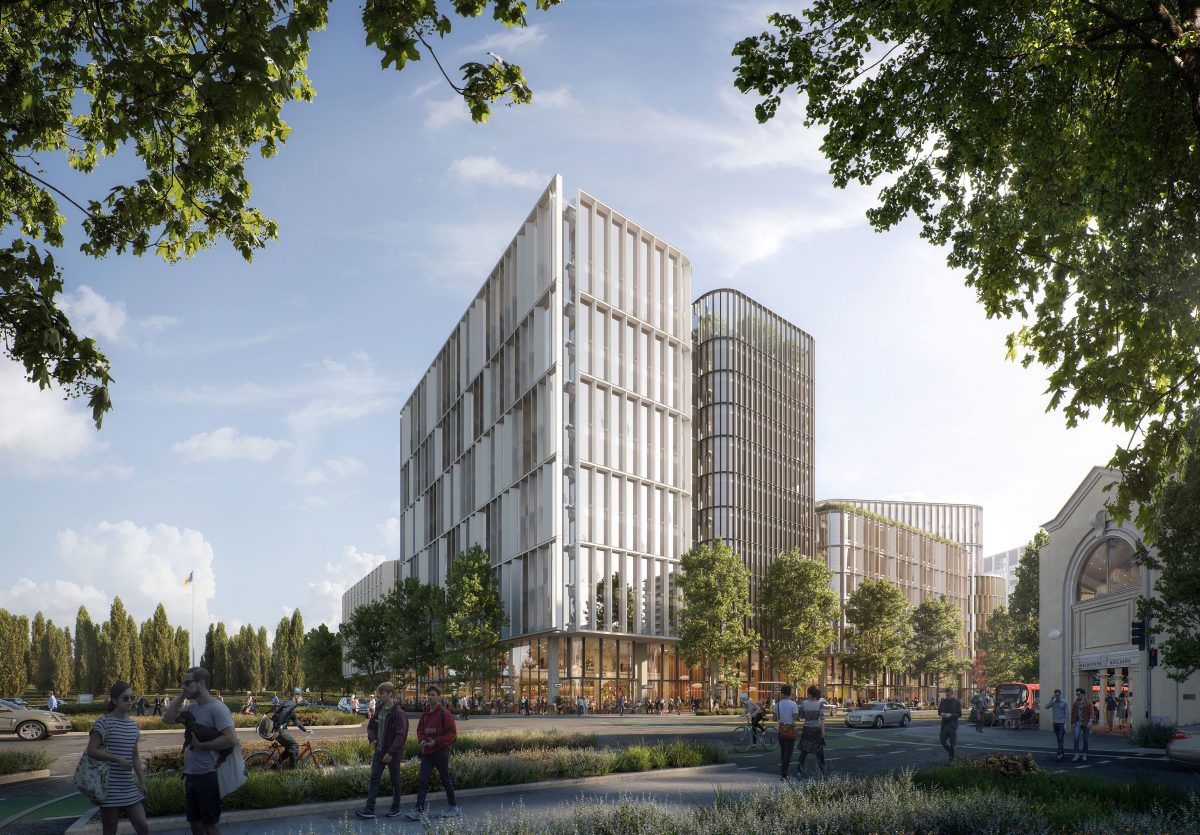
What Capital Property Group has planned for the former Law Courts carpark. Would 32 storeys be better? Image: JPW.
Is the building height limit imposed by the National Capital Plan doing more harm than good in the city?
A submission on the latest Works Approval application to the National Capital Authority for Capital Property Group’s London Central project argues that the RL617 limit (the level of the grassed roof of Parliament House) of about 12-14 storeys is creating perverse outcomes.
Retired architect Jack Kershaw says the rule, designed to protect sightlines and the preeminence of Parliament House, is forcing developers and architects to design squat buildings that reduce open space and still block views.
“‘If you can’t be brilliant, be neat and tidy’. That adage seems to characterise this developer’s [Snow Group] approach to architecture around City Hill,” Mr Kershaw says.
“But is ‘neat and tidy’ good enough for the extremely important subject precinct, opposite the iconic Melbourne Building, next to the ACT Courts, and at the gateway to the National Triangle?”
Mr Kershaw says that the developer is so constrained by NCA planning rules and driven to provide the maximum permitted floor space that what results is “squat and amorphous subject development with very high site coverage”.
He suggests that the gateway corner of Northbourne and London Circuit should instead host taller and more slender towers up to 32 storeys.
“Decision makers should be thinking of the bigger picture, by including that matching east-side land, for and in a contemporaneous development, with an increased height limit, forming a ‘gateway’ development to the National Triangle at the southern end of iconic Northbourne Avenue,” Mr Kershaw says.
“A resultant tall twinned-structure development could extend no higher than, say, just below the base of the actual flag on Capital Hill (to satisfy that symbolism), ie, about 80 metres above the grassed roof of Parliament House, putting the new buildings’ rooftops at about RL 697 metres, thus making each office building about 32 storeys in height.”
These would result in a much smaller footprint than that proposed for London Central, with “attractive slender towers, much more desirable on-site landscaped public open space, and important clear views of the Law Courts complex and the future Lyric Theatre”.
Mr Kershaw says the idea is not new, having first been presented in 1987 to the National Capital Development Commission by his then employer on New Parliament House, Concrete Constructions Pty Ltd, part of the Concrete Holland Joint Venture, proposed under the broader City Hill precinct master plan designed by DJAS Architects.
Canberra’s building height limit is an ongoing and controversial issue for planners, architects, developers and community groups.
Last year, local urban planning consultancy Purdon, which is responsible for submitting many of the ACT’s major development applications on behalf of its clients, set the hares running with a survey to test community views on higher building heights.
Purdon said building height preferences varied, even within its own team, but it generally supported a sustainable Canberra – one that grew up rather than out and preserved access to open space and natural areas.
“We support performance-based assessments of building heights and would welcome increased building heights in Canberra’s future in combination with good siting, design and planning outcomes,” it said.
Purdon’s Dan Stewart said the survey aimed to understand community aspirations and tolerances for building heights in Canberra’s centres, as well as residents’ perceptions of the future roles of the CBD and town centres, and the reasons for and against taller buildings.
But at least one community group labelled it a self-serving exercise in a blatant bid to shift public opinion on building heights.
The Property Council agrees with Mr Kershaw’s point that taller buildings would leave more open space.
ACT & Capital Region Executive Director Ashlee Berry told Region that RL617 had been hindering the city’s progress and affecting the viability of projects.
“It’s time to seriously look at RL617 and the perverse impact this rule is having on the design of our city,” she said.
“As our population grows and we need to deliver more homes and amenity, the way to maintain open spaces and public realm is to allow buildings to be taller.”
Ms Berry said arbitrary height limits significantly lower than those of other capital cities meant the city’s footprint was larger than most, and made it harder and harder for projects to stack up.
“Having a sensible discussion about height limits in the National Capital Plan would allow for more amenity, in well-located areas, providing options for developers to go up rather than out,” she said.