24 June 2026

Tax and housing policies are social glue to hold Canberra together, says Barr

| By Ian Bushnell
Join the conversation
31
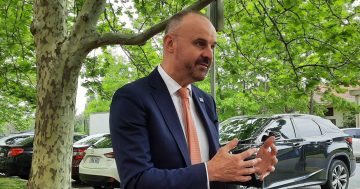
Chief Minister Andrew Barr at the Local Government Association

Chief Minister Andrew Barr at the Local Government Association: A compact city is a cohesive city. Photo: LGA.

The ACT’s housing and tax policies were aimed at maintaining social cohesion at a time when it was under increasing strain, Chief Minister Andrew Barr has told the Local Government Association.

Speaking at the LGA’s National General Assembly Urban Forum at the National Convention Centre on Tuesday (23 June), Mr Barr said that Canberra, like many cities across Australia, was facing multiple challenges and an unforgiving public.

Mr Barr said the question was not simply about how growth was managed, but about how local government held communities together as cities changed.

Only a week after One Nation leader Senator Pauline Hanson delivered a provocative speech to the National Press Club, Mr Barr did not refer to her by name, but ticked off all the big issues on her hit list – housing, migration, infrastructure and cost of living.

READ ALSO Hanson's vision is a reactionary nightmare but Andrew Barr believes communities can be inoculated

He also referenced a UK TV drama, Tip Toe, that explores how quickly social cohesion can break down.

It may not be as bad here as it was in the UK or US, Mr Barr said, but what the show portrayed was all too familiar.

“When people feel left behind, they don’t sit quietly. They look for explanation, and increasingly, those explanations are simple, emotional, and often wrong,” Mr Barr said.

“Uncertainty becomes grievance. Loneliness becomes anger, and that reshapes how people see institutions, policy, and each other.”

Mr Barr said local government sat on the front line of these policy fault lines and was itself under financial pressure.

He framed the ACT’s deliberate decisions to pursue a compact city, reform its tax system and continue to invest in services as means to achieving an end that not only maintained social cohesion but sustained it.

The housing target of 30,000 new homes by the end of 2030 or around 2.5 per cent growth in housing stock each year, was faster than predicted population growth, so there could be more supply, choice and affordability.

Tax reform was about removing inefficient taxes, such as stamp duty, to remove barriers to home ownership, encourage market mobility and free up stock.

“We are now around two-thirds of the way through a 20-year phase-out of stamp duty and transition of revenue collection to our municipal rates base,” Mr Barr said.

He said stamp duty locked people into homes that no longer suit them and locked others out entirely.

“It makes the housing system less responsive, less fair and less efficient,” he said.

There were social benefits to this, as well as the limiting of urban sprawl and the encouragement of infill development.

Mr Barr said that when people could move, they stayed connected to jobs, services and their communities and when they could not, they fell behind.

He argued that a compact city was a cohesive city because it strengthened communities, enabled more efficient use of infrastructure, and provided greater support for public transport.

But people did not like change, and this was where leadership mattered.

READ ALSO ACT Budget: No stamp duty for all first home buyers, plus 'missing middle' tax cuts

Mr Barr said governments had to be honest about the trade-offs, saying that without new housing supply, affordability worsened; without housing density, opportunity spread out of reach; and without deliberate change, tension grew.

These pressures were structural and would shape cities for decades.

“So the question is not whether we face them. It is whether we lead through them,” Mr Barr said.

“We know the environment we are operating in. Budgets are tighter. Expectations are higher, and the margin for error is smaller.

“But that does not reduce the task. It sharpens it.”

Mr Barr said local government had a unique role not just as service providers, but as stewards of place and, increasingly, stewards of cohesion.

“That means being honest about change, planning for it clearly, and bringing communities with us,” he said.

“Because the test of our cities will not just be how much they grow, but whether people still feel they belong.

“And if we get this right, there is a different story available to us – growth that builds connection, change that strengthens communities and cities where people do not turn away from each other, but towards each other.”


Free Daily Digest

Want the best Canberra news delivered daily? We package the most-read Canberra stories and send them to your inbox. Sign-up now for trusted local news that will never be behind a paywall.
Loading
By submitting your email address you are agreeing to Region Group's terms and conditions and privacy policy.

Join the conversation

31
All Comments
  • All Comments
  • Website Comments
LatestOldest

This article reminds me so much of Hans Christian Andersen’s “The Emperor’s New Clothes”.

The leader of our forever government can’t see that other Australians are disillusioned by the party he belongs to, and it’s national leader.

And while there is always some degree of separation between jurisdictions, it could be prudent for the leader if a forever government to be aware of the fragility of politics and how being within an insular bubble, doesn’t entirely project him from a threat that might engulf his entire party at a national level.

Capital Retro1:14 pm 26 Jun 26

The only “social glue” in the ACT is the stuff that Labor/Green government condones sniffing of.

Gregg Heldon11:15 am 26 Jun 26

I’m sorry, but I can’t take anything Barr says seriously.
How does he know what social cohesion Canberra has, when he increasingly spends less time here.
How much does he actually care about the stuff up with the Phillip Pool, or the neglect of neighbourhood ovals? Because leisure facilities do bring social cohesion and the building of communities.
And……
And……
And…… the list could go on, but I won’t.
Barr has lost interest in his job. Probably happened awhile ago but can’t resign because, let’s face it, who could you trust in Labor to take the reins? Berry? Steele? Stephen-Smith? Between the three of them, they couldn’t organise a pre school fete.
The ACT is in such a state fiscally, that when Parton and Co take over in 2028 (please! Hopefully) that they’ll be on a hiding to nothing to make any improvements to the ACT in their first term.

Talk about “political spin”. This article is full of it!
The whole argument about replacing Stamp Duty with higher Rates, and how that is good for housing affordability etc is a crock.

Affordability issues aren’t restricted to one-off upfront costs such as Stamp Duty. Home ownership affordability includes the ongoing costs of ownership, and that obviously includes Rates, Insurances, Land Taxes, if applicable (which are charged at 150% of your Rates), Water, Electricity, Repairs and Maintenance, Interest Rates and so on.

Stamp Duty is a one-off tax. Rates is a forever tax! A tax that keeps in taxing.

The ACT Government wants to move from Stamp Duty to Rates, for one reason; it’s easier to raise revenue.

Unlike Stamp Duty, Rates are not impacted by the Commonwealth election cycle, the impact of….say CGT or NG legislation.
As we found with the Health Budget last year, Rates can used to raise money to cover unexpected budget shortfalls.
By restricting land releases, the Government can limit Supply, which puts a floor underneath land values and maitain the revenue raised via Rates.

If transitioning to Rates was such a good thing for housing affordability within the broader community, surely the government would have allowed it’s constituents the choice when purchasing property? Pay Stamp Duty or higher Rates. People could then make a decision based on what was good for them.

The Local Council has failed as “stewards of place and cohesion”. Parts of Canberra have benefited from Barr’s indulgence while other have markedly deteriorated. Ideology and political expediency is a poor substitute for policy. Barr’s connection to the ratepayers of the ACT has been non-existent in recent years as he has lost interest in the wellbeing of Canberrans. He should recognise this and resign or at least keep out of the way until the next election.

Bunch of union hack clowns running the ACT Government 🤡

Time to bin them !

This is the klutz that wants ACT more like Sydney, his own little Utopia, oh & doesn’t like talking with old people.

HiddenDragon9:02 pm 24 Jun 26

Name the next tram into service Incitatus and the portrait of delusion will be complete.

Laughable Mr Barr. You’ve butchered tax reform.

“Tax reform was about removing inefficient taxes, such as stamp duty, to remove barriers to home ownership, encourage market mobility and free up stock.”

In dollar terms, which is all that matters to ratepayers when they get their rates bill or have to cough up tens of thousands in conveyance duties to buy a house, you’ve just about doubled your tax take on the average house sale since reform commenced. You haven’t removed the barrier, you made it bigger, you haven’t encouraged mobility, youve reduced it. All you have done is made those things slightly less worse than a theoretical counterfactual state of the world that has no relevance. The overwhelming majority of home buyers and ratepayers are poorer for your butchered implementation of what was originally worthwhile tax reform.

Social cohesion breaks down when other peoples money runs out.

Sounds like a Monty Python sketch.
This from a Government where interest payments on borrowings will soon reach $1 billion a year.

Its funny that this is the claim, yet a large portion of the over expenditure leading to the current government debt levels has been for non essential services or policy choices that could have been delivered cheaper with different options.

Its a very poor attempt by Barr to excuse his own lack of leadership.

Really!? It’s all about paying for the ‘blessed’ Tram!

David Watson2:56 pm 24 Jun 26

The sentiment is sound however the direction we are heading is downhill at a great rate of knots.

Scott Nofriends2:22 pm 24 Jun 26

Mr Barr, you make it too easy for us to not forgive you.

Is your claimed inefficient tax distraction worse than your actual inefficient spending of money you don’t have? How’s your payroll tax and the levies on top of that looking? More blah blah Barr inefficiency. Curb your vanity projects and deal with public sector waste on your watch. You will not be remembered for greatness, it will be for dumb decisions and dumb debt. As for being a leader, self-praise is no praise – few would follow you through an open door!

Daily Digest

Want the best Canberra news delivered daily? Every day we package the most popular Region Canberra stories and send them straight to your inbox. Sign-up now for trusted local news that will never be behind a paywall.

By submitting your email address you are agreeing to Region Group's terms and conditions and privacy policy.