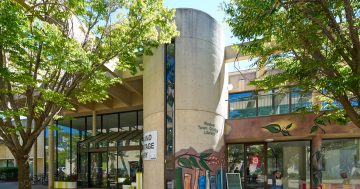
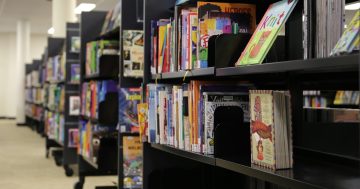
What do you want from your local library — books, longer opening hours, new technology or more community spaces? Photo: Michelle Kroll.
Canberra’s libraries have become an unlikely political battleground, with reduced opening hours sparking petitions, Assembly motions and, last week, the censure of a government minister.
Now the debate is moving beyond when libraries should open to what they should actually offer.
Could Canberrans borrow a telescope instead of buying one? Use a 3D printer or podcast studio at their local branch? Borrow tools and household equipment? Or enter a library after hours when no staff are there?
ACT Greens municipal services spokesperson Andrew Braddock is asking Canberrans to put forward ideas for the future of the city’s libraries, including after-hours self-access, smaller neighbourhood library points, spaces for making and repairing things, and becoming a ‘Library of Things’.
“Imagine finishing work late and still having somewhere safe and free to study. Borrowing a telescope with your kids. Using a 3D printer. Recording a podcast. Borrowing something you only need once instead of buying it,” Mr Braddock said.
“That might sound like the library of the future. In plenty of places, it is already the library of today.”
The ideas are already being tried elsewhere.
Melbourne libraries offer makerspaces with 3D printers, laser cutters, embroidery machines and podcast recording equipment, while Adelaide’s library network provides equipment including 3D printers, digital drawing tablets, photo scanners and green screens.
Monash Public Library Service has a Library of Things, where members can borrow practical items such as induction cooktops, cake tins and hand tools.
Mr Braddock believes Canberra should consider similar models.
“ACT libraries could include better after-hours access, smaller neighbourhood library points, spaces to make and repair things, and Libraries of Things where people can borrow useful equipment instead of having to buy it,” he said.
The push comes after months of debate about the state of Canberra’s library network.
More than 3500 people signed Mr Braddock’s petition calling for investment in libraries, while the Legislative Assembly passed a motion calling on the government to pause the removal of Sunday opening.
That fight escalated last week when City and Government Services Minister Tara Cheyne was censured 13 votes to 10 over the government’s decision to proceed with reduced library hours. Opposition Leader Mark Parton accused the minister of having “ignored” the earlier Assembly motion. Ms Cheyne defended her handling of the issue, citing the operational pressures facing the library network.
Those pressures extend well beyond opening hours.
An independent review of Libraries ACT found problems with staffing, rostering and workplace culture, including mistrust between frontline staff and management. It was commissioned after concerns about repeated unplanned closures, poor staff morale and whether the existing service was sustainable.
But the debate over the future of libraries is also increasingly about what role they should play in their communities.
A national Libraries as Social Cohesion Hubs initiative gives some indication of how far that role can extend.

Across nine months, 115 public library services and 10 university libraries delivered 744 programs aimed at strengthening community connections and reducing isolation.
The programs reached families, seniors, First Nations people, culturally and linguistically diverse communities, people with disability and young people, with more than 180,000 engagements recorded.
That shifts the conversation away from libraries simply being places to borrow books.
They can be free places to study or work, learn a skill, meet other people, access technology or use equipment that may otherwise be unaffordable.
And that is the conversation Mr Braddock now wants Canberra to have.
“If we want libraries that remain relevant for the next generation, we need to think beyond books and opening hours and build services around how people actually live, learn, and connect,” he said.
After months of political argument over closing library doors, Canberrans are now being asked what they would like to see behind them.
Readers can send their ideas to Mr Braddock at Braddock@parliament.act.gov.au or join the conversation on Canberra Greens Facebook and Instagram pages.