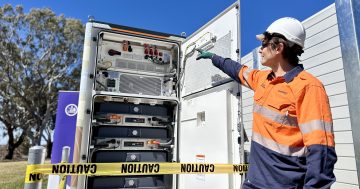
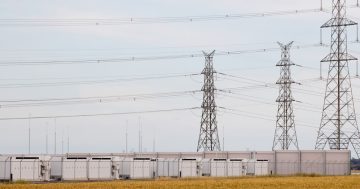
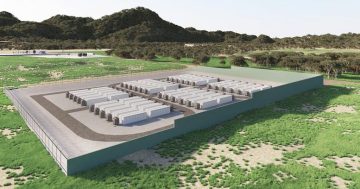
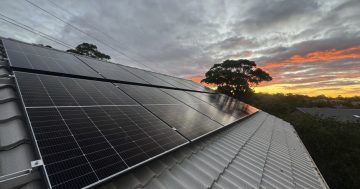
Evoenergy is the provider for the ACT’s three neighbourhood-scale batteries in Dickson, Casey and Fadden. Photo: James Coleman.
Thousands of Canberra households are now storing their own solar power, with new data revealing which suburbs are leading the charge.
More than 4500 home batteries have been installed across the ACT under the Federal Government’s ‘Cheaper Home Batteries’ program, according to figures released as the latest neighbourhood-scale battery was officially switched on.
The 450 kWh battery at Dickson’s Hawdon Place is the third and final community battery funded through a joint Commonwealth and ACT government project, joining installations in Casey and Fadden.
But while those batteries help share solar energy to around 200 homes in their area, the new data shows many Canberrans are increasingly installing their own storage at home – and maybe not in the suburbs you’d expect.
The ACT suburbs installing the most home batteries
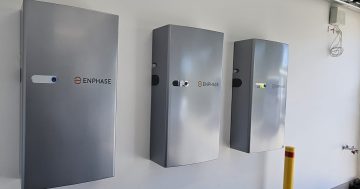
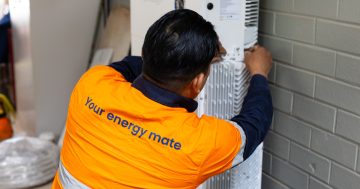
The Cheaper Home Batteries program allows Australian households, businesses and community organisations to receive a discount of around 30 per cent on the upfront cost of installing a range of small-scale battery systems between 5 kWh and 100 kWh.
Since its launch on 1 July 2025, more than 250,000 batteries have been installed across the country.
Late last year, as uptake was so rapid, the Australian Government boosted funding from $2.3 billion to $7.2 billion over the next four years, to add more than 2 million home batteries and 40 GWh to the grid.
The new postcode-level figures show the ACT’s strongest uptake of home batteries has actually been in traditionally family suburbs and outer areas, rather than the inner city.

The new Dickson battery is fed by 45 homes so far. Photo: James Coleman.
Across the territory, 4529 batteries have been installed under the Cheaper Home Batteries program.
The biggest cluster sits in the Belconnen district, including Dunlop, Macgregor, Holt, Florey, Latham, Flynn, Melba, Higgins and Charnwood, with 504 batteries installed.
Inner-north suburbs, including Watson, Lyneham, O’Connor, Ainslie, Downer, Dickson and Hackett, recorded 281 installations.
In the Tuggeranong area, suburbs such as Calwell, Chisholm, Isabella Plains, Theodore, Bonython, Richardson and Gilmore accounted for 265 batteries.
Federal Energy Minister Chris Bowen said the data showed the clean energy shift was happening in the suburbs.
“This is what the clean energy transformation looks like when it is working for Australians. It is practical, it is household-focused, and it is being led by the suburbs and the regions,” he said.
Local MP Andrew Leigh added that batteries are catching on in Canberra “faster than arguments about the best public servant coffee spot”.
“Thousands of homes and businesses are now bottling their own sunshine and shaving down their power bills.”
What Dickson’s new battery will do
The Dickson project fits in alongside the other neighbourhood batteries in Casey and Fadden, each capable of powering 100 homes for two hours when called upon.
For now, it is powered by solar energy from about 45 nearby homes and can store up to 450 kWh.
Bowen said the community batteries are designed to store excess rooftop solar during the day and release it later, helping households use cheaper power at night and reducing pressure on the electricity grid.
“We need batteries big, medium and small, and this one’s a medium-sized battery,” he said.

Chris Bowen, Suzanne Orr and Andrew Barr at the unveiling of the Dickson battery. Photo: James Coleman.
The provider, Evoenergy, says the locations were chosen for their “proximity to existing electrical infrastructure and local constraints”, and all passed assessments by the ACT Environment Protection Authority for noise, along with ACT Fire & Rescue for safety.
The Dickson installation is partly funded by the Federal Government’s ‘Community Batteries for Household Solar’ program, which aims to roll out 400 community batteries nationally.
It was meant to be here in March 2025, but Bowen said the government had “some challenges in finding the right provider” during the tender process.
What’s next for the ‘Canberra Big Battery’
Bowen said the Federal Government would “see how demand unfolds” for the three ACT neighbourhood batteries before committing to help fund any more.
So far in the ACT, there are nine smaller ‘behind-the-meter’ batteries at various government sites, including at Belconnen Parks Depot, Kambah Depot, Allara Depot and the Cotter Depot, as well as the Chifley Community Hub and the Gungahlin Family and Child Centre.

Each of the batteries are decorated in different Indigenous artwork. Photo: James Coleman.
But the real big contributor will be the $300 million grid-scale battery at Williamsdale when it’s switched on later this year. This will be able to inject 250 megawatts into the ACT’s grid when needed, or enough to power a third of Canberra for two hours during peak demand.
“Across the board, what we’re seeing is an increase in capacity to store the renewable energy that we generate here in this city and in our region,” Barr said.
“We drink water every day because we store it for when we need it, and we can store renewable energy as well,” Bowen added.
“That’s exactly what we’re doing. This is the third [neighbourhood] battery for the ACT, it’s one of 109 now operating across Australia. So this is a good day.”