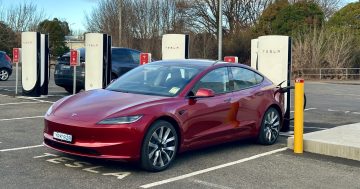
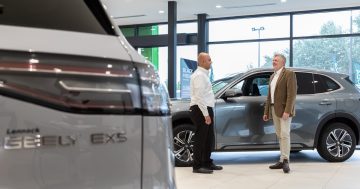
The 2026-27 ACT Budget included changes to vehicle registration fees and motor vehicle duty rates. Photo: James Coleman.
The ACT Government says its latest budget measures strike a balance between cost-of-living relief and environmental responsibility.
On one hand, it has delayed planned increases to vehicle registration fees until 2027–28, giving motorists a reprieve from rising annual costs.
On the other, it has legislated higher motor vehicle duty rates for high-emission, non-electric vehicles from February 2027, arguing the move will encourage greener transport choices.
At first glance, that sounds sensible. But when you look at how people actually buy cars, the policy begins to unravel.
The fundamental problem is that the ACT is offering relief in one area while increasing costs in another – and the larger cost is the one consumers notice most.
For most households, registration fees are not the deciding factor when purchasing a vehicle. The real financial hurdle is the upfront purchase price. That’s where stamp duty has the greatest impact. It is paid immediately, often alongside finance costs, insurance and rising vehicle prices.
So, while the government can point to delayed registration increases as cost-of-living relief, it is simultaneously maintaining – and in some cases increasing – the tax burden at the very moment people are trying to upgrade their vehicle.
The contradiction becomes even more apparent when it comes to electric vehicles.
The ACT’s duty structure is now based on both emissions and vehicle value. While zero-emission vehicles are treated more favourably than many petrol or diesel alternatives, they are no longer exempt from duty. At the same time, any vehicle valued above $80,000 attracts the highest duty tier on the portion of the purchase price above that threshold.
That might sound reasonable until you consider the reality of today’s EV market.
Many of the electric vehicles Australian families are increasingly considering – including larger SUVs, long-range models and a significant number of European and premium offerings – sit above the $80,000 threshold.
In other words, a buyer choosing a zero-emission vehicle can still find themselves paying the highest rate of duty.
If the goal is to accelerate EV adoption, this makes little sense. The biggest barrier to EV uptake remains upfront cost. Tax policy should be reducing friction at the point of purchase, not adding to it.

Raffy Sgroi argues the ACT’s latest motor vehicle initiatives won’t result in cost-of-living relief or reduced emissions. Photo: Supplied.
The unintended consequences don’t stop there.
The ACT’s planned increase in duty rates for higher-emission petrol and diesel vehicles from 2027 assumes buyers will respond by switching to electric alternatives. Some will. But many won’t.
For households under financial pressure and for small businesses operating on tight margins, the more likely response may be to postpone buying a new vehicle altogether and remain in the secondhand market.
That creates a significant emissions problem.
Older vehicles, particularly those manufactured before 2010, tend to be among the highest real-world polluters on Australian roads. They are generally less fuel efficient, lack modern emissions controls and often become more expensive to maintain as they age.
By making newer vehicles more expensive to purchase, governments risk extending the life of these older cars and increasing their value in the used market. The result is slower fleet turnover and a slower reduction in overall transport emissions.
This is the uncomfortable reality often missing from the EV debate: while electric vehicles represent the future, replacing older, high-polluting vehicles with newer, cleaner alternatives delivers immediate environmental benefits today.
A modern petrol or diesel vehicle is materially cleaner and more efficient than the vehicle it replaces from 15 or 20 years ago. Policies that discourage those upgrades can actually delay emissions reductions rather than accelerate them.
The result is a tax system that leaves consumers feeling penalised regardless of the choice they make.
Buy an EV and you may still face significant duty costs. Buy a petrol or diesel vehicle and you’ll pay even more.
Either way, the tax burden grows.
That starts to look less like an incentive framework and more like a revenue framework.
If the ACT genuinely wants to reduce emissions while helping households manage cost-of-living pressures, the policy settings need to better reflect consumer behaviour.
That could mean reintroducing targeted EV duty relief, adjusting the $80,000 threshold for zero-emission vehicles, and creating stronger incentives for motorists to replace older, high-polluting vehicles with cleaner alternatives.
Because the reality is simple: the clean choice needs to be easier to buy.
Otherwise, the ACT risks achieving neither of its stated goals of making life more affordable or meaningfully reducing emissions.
Raffy Sgroi is an active member of MTA ACT and MTA NSW and is Car Mechanical Services CEO. She has served as a senior advisor to governments on safety protocols and regulatory compliance for the past two decades.