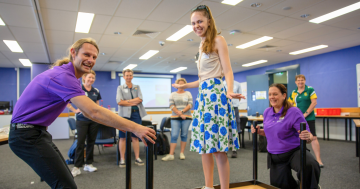

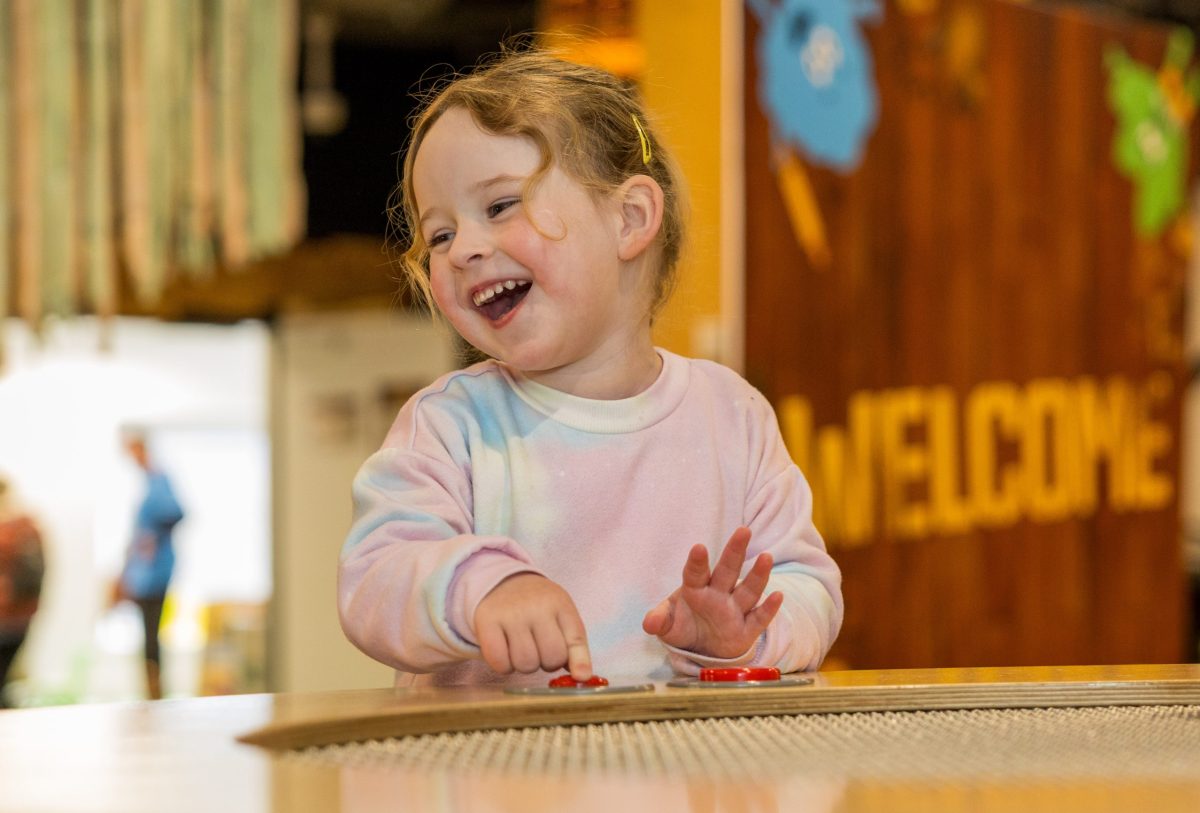
What looks like play is where curiosity and the STEM “ways of thinking” start to take shape. Photo: Questacon.
By the time children start school, their relationship with STEM is already forming.
If that surprises you, you’re not alone. Early learning and STEM expert Ilyse Resnick says one of the biggest misconceptions about STEM is that children only engage with it later, once they have the language and attention span to learn formal concepts.
“STEM is an acronym for science, technology, engineering and maths. But another way to look at STEM is as ways of thinking, knowing, and doing,” she explains.
“It’s about curiosity, hypothesis testing, experimenting, decoding the world, and figuring out ‘what will happen if I do this?'”
Those skills begin developing in infancy. When young children sort toys, knock down towers, line up objects, or test cause and effect, they are laying the foundations of STEM thinking.
For parents and carers, recognising those moments can be empowering, and that is exactly what Questacon’s early learning programs are designed to support.
Questacon’s early learning spaces start from the assumption that young children are “natural scientists,” already deeply engaged in STEM learning as they try to make sense of the world.
Mini Q, for instance, is Questacon’s gallery for children aged zero to six, designed to embed STEM thinking through playful, age-appropriate experiences.
Away from the crowds of older visitors, exhibits are designed around children’s developmental needs and accommodate height, motor skills and attention, with prompts to help parents and carers engage alongside them.
Parents can see how a one-year-old’s experience differs from a six-year-old’s, even when interacting with the same exhibit. They can also observe how babies and toddlers test cause and effect: drop something, hear the noise, watch for a reaction, then try it again.
These aren’t random behaviours – they’re foundational cognitive skills that later show up in formal STEM disciplines,” Ms Resnick says.
“Take sorting, for example. A child who groups toys by colour or shape is learning to observe attributes and classify objects based on shared characteristics.
“That’s the same core skill biologists use when they classify species into mammals, reptiles or birds. Patterning builds on this further as children learn to recognise and create repeating sequences — a skill strongly linked to later success in mathematics. These skills are not isolated; they build on each other and lay the groundwork for more complex learning later on.”
Questacon’s Little Explorers’ Days are designed to help families nurture that learning through guided, hands-on experiences created specifically for children aged zero to six.
The goal isn’t to rush children through milestones, but to scaffold their thinking and keep curiosity alive.
Starting STEM early matters for more than academic outcomes.
Research consistently shows that early childhood experiences shape children’s identities as learners, including who they believe STEM is ‘for’. Positive experiences can help counter stereotypes and build confidence, particularly for girls and children from groups historically underrepresented in STEM.
There’s also strong evidence that investment in early learning delivers greater returns than later intervention.
“When we look at a child’s success in STEM, we sometimes use the ‘leaky pipeline’ analogy, meaning there are multiple leaks where kids can fall out over time. Early positive experiences help keep them in,” Ms Resnick says.
“That’s preferable because once children disengage, it’s far harder, and more resource-intensive, to draw them back in.”
That’s why Questacon’s programs begin in the earliest years and continue throughout childhood, from Little Explorers’ Days right through to school programs and the Science Circus for older children.
For parents looking for meaningful, engaging activities for young children, Little Explorers’ Days offer just that.
“Early STEM learning isn’t about turning every child into a scientist or engineer,” Ms Resnick says.
“The skills developed through STEM — critical thinking, resilience, creativity, and problem-solving — are transferable across every aspect of life. Whether children go on to pursue STEM careers or not, these competencies support success at school, at work, and as engaged citizens.”
Little Explorers’ Days are on Thursday, 5 February, and Friday, 6 February, from 9 am to 5 pm at Questacon. For more information, visit Questacon.