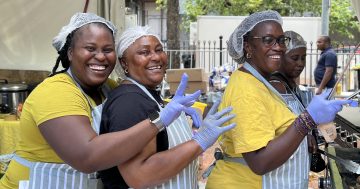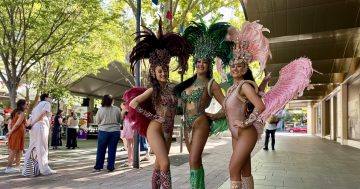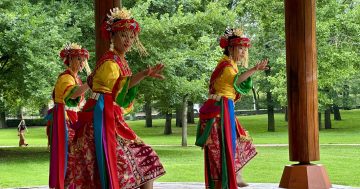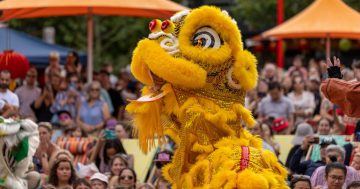

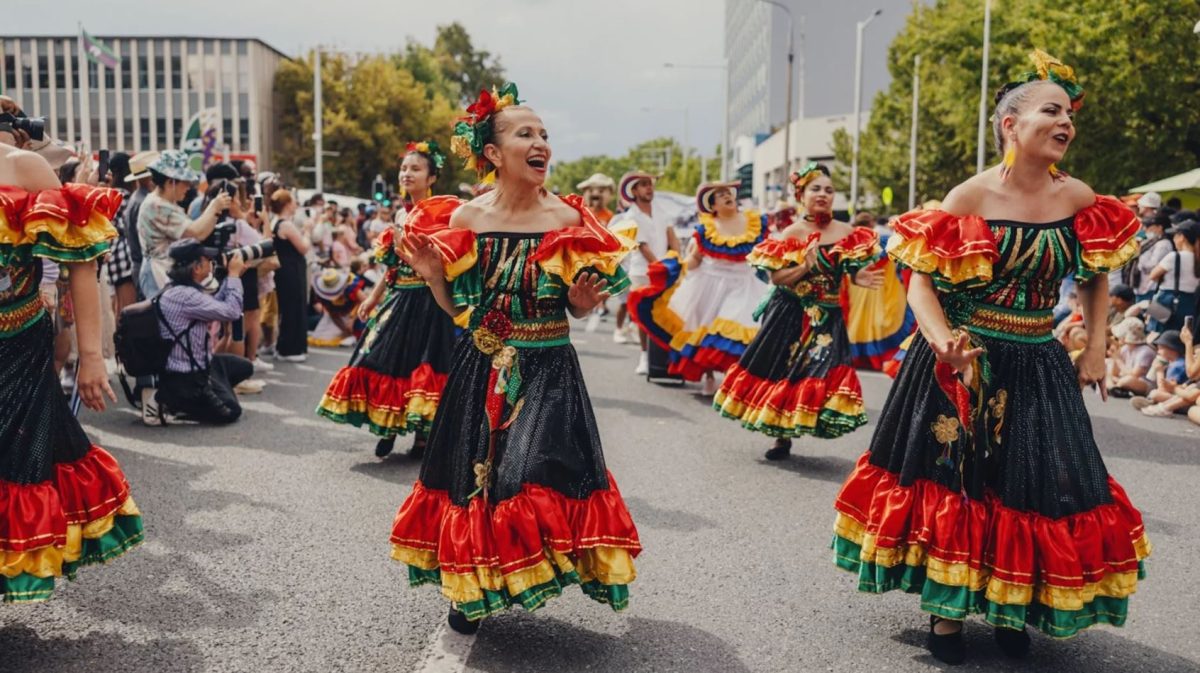
Canberra’s Multicultural Festival has grown well beyond its humble beginnings. Photo: Events Canberra.
I have lived in Canberra long enough to remember when the Multicultural Festival was a modest gathering of around 20 community stalls in the late 1990s.
It was small, intimate and driven almost entirely by volunteers who wanted to share food, music and stories.
There was little sense then that it would become one of Australia’s largest multicultural celebrations or a defining feature of Canberra’s civic identity.
The festival once again took over the city centre this past weekend. What began with a handful of stalls has grown into an event featuring over 250 food and cultural stalls and hundreds of performances, attracting well over 400,000 visits.
It is now one of Canberra’s most recognisable public events and a powerful statement about who we are as a city.
From my perspective as a longtime Canberra resident, an economist and community leader, the festival is far more than a colourful weekend: it is a social and economic institution that has quietly reshaped Canberra.
The tourism and economic benefits alone are significant. The festival draws interstate and international visitors, filling hotels and short-stay accommodation, boosting restaurants and cafés, and encouraging visitors to extend their stay to experience Canberra’s national institutions and local attractions.
Conservative estimates indicate the festival injects approximately $20 million into the ACT economy each year through visitor spending on accommodation, hospitality, transport, and retail.
This initial spending has a multiplier effect, circulating through local supply chains and generating additional income, business activity and tax revenue well beyond the festival weekend itself.
For many visitors, the festival is no longer an add-on to a parliamentary visit but the primary reason to come to Canberra.
Employment benefits are equally tangible. Each year, the festival directly supports around 200 staff across event production, staging, sound and lighting, security, cleaning, transport and logistics. Indirectly, another 300 roles are supported across hospitality, tourism, retail and small businesses, benefiting from the surge in visitors.
The total employment impact is therefore roughly 500 jobs, including casual, temporary and full-time equivalent weeks.
For young people, students and new arrivals, the festival provides accessible entry points into paid work and valuable skills development.
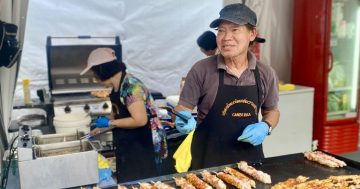
The festival also provides a critical platform for small businesses and community enterprises, particularly those run by migrants and refugees.
For food vendors, performers and artisans, the weekend can represent their most important commercial opportunity of the year. It allows businesses to test ideas, build customer bases and generate income that sustains them long after the tents are packed away.
Beyond economics, the festival has become one of Canberra’s most effective mechanisms for building social cohesion. Sharing food, music and stories in a public space breaks down barriers that policy statements and slogans cannot.
Over time, these everyday encounters normalise diversity and build familiarity and trust. Children grow up seeing cultural differences as ordinary rather than threatening. Adults discover common ground where they once assumed distance.
The festival has also played a quiet but important role in strengthening interfaith relationships.
Communities of different faiths stand side by side not in debate but in shared celebration. In a global climate where faith is often politicised or misunderstood, Canberra offers a simple counternarrative by allowing people to meet each other first as neighbours.
For migrant and refugee communities, public recognition of culture sends a powerful message of belonging. It says identity does not need to be hidden or diluted to be accepted. That matters in a city where almost one in three residents comes from a culturally diverse background.
Growth, however, brings challenges that must be addressed honestly.
Participation is not equally accessible to all communities. Smaller or newer groups often struggle with rising costs, administrative requirements and limited organisational capacity.
If multiculturalism is to be meaningful, opportunity must not be determined by resources alone.
There is also a risk that culture becomes reduced to performance. Food and dance are joyful and important entry points, but they should not be the only story.
The festival must continue to create space for deeper engagement with history, lived experience and the contemporary challenges faced by multicultural communities.
Environmental sustainability, accessibility and safety require constant attention as the event grows. And in an era of increasingly polarised debate about migration and identity, multicultural spaces can become contested.
The festival must remain a place of respectful encounter rather than ideological posturing.
From its beginnings of around 20 stalls to its current scale and significance, the Canberra Multicultural Festival mirrors Canberra’s own evolution. A single story or background no longer defines this city.
Our public events, institutions and leadership must reflect that reality, not just once a year, but every day.
As we enjoy this annual event, we should also recognise what it represents.
It shows that when we pull together, we can create something truly special. It reminds us that Canberra is a place where people from all walks of life can have a fair go, and where sharing food, music and stories helps us hit it off across cultures.
It’s a celebration of a city that knows how to put its best foot forward.
Mainul Haque OAM is a Canberra resident, economist, community leader and former ACT Multicultural Ambassador.