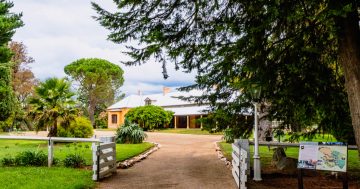
The row of 12 almond trees at Lanyon Homestead. Photo: Dom Northcott.
Visitors will soon be able to see the ACT’s oldest almond trees – even if being the ACT’s oldest almond trees means they’re no longer making almonds.
‘Harvest Day Out’ returns to Lanyon Homestead on Saturday, 21 March, opening the historic property’s gardens to the public for a day of tours, workshops and demonstrations.
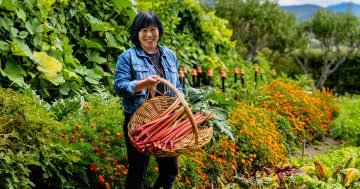
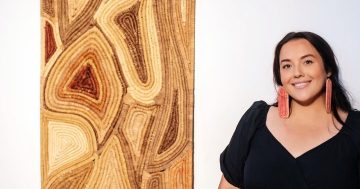
The program includes a curated mix of hands-on activities, including jam-making and weaving workshops, practical talks on how to grow the best leafy greens in your own garden, and tours of the property.
But one of the highlights is tucked towards the back of the property: a row of almond trees that have been standing there for more than a century.
It was touch-and-go whether they’d survive.
The trees trace their story back to Charles Weston, the chief horticulturalist responsible for shaping the way Canberra looks today. Between 1911 and 1926, Weston led the greening of the fledgling capital, planting more than 6 million trees of all different species.
Among them were 12 almond tree seedlings.
Weston knew exactly where they should go. If anyone could make such an exotic tree work in the region’s harsh climate, it was Catherine Cunningham at Lanyon Homestead.
By then, the property was already bursting with produce. Apples, pears, pumpkins, chillies, strawberries, rhubarb and olives were growing across the grounds – along with medlars (French for ‘dog’s bottom’, and if you see the fruit, you’ll understand why).
And that’s not even counting the flowers. Irises, roses, dahlias and chrysanthemums filled the gardens, many cut and sold in bunches at shows across the region.
The 12 almond seedlings were planted near the sheds, just above the high-water mark of the Murrumbidgee River.
And more than a century later, they’re still there. A little twisted and gnarly, and no longer producing almonds – but all 12 survived, making them easily the oldest almond trees in the ACT.

The trees are too old to be producing almonds anymore. Photo: Dom Northcott.
But they’re far from the oldest plantings at Lanyon.
Sam Thompson has been researching the gardens’ history on behalf of ACT Historic Places, which manages the homestead and its grounds for the ACT Government. For the past month, he’s been digging through records, uncovering old photos and intriguing stories along the way.
One example towers over the right side of the house: the Bunya trees planted in 1885, on the same day Australia’s ‘father of federation’, Henry Parkes, happened to be visiting. Parkes even noted in his diary how Catherine Cunningham was busy in the garden with the new plantings.

The gardens at Lanyon Homestead will open to the public for Harvest Day Out on 21 March. Photo: Dom Northcott.
Another story started decades later.
In the 1960s, shortly before the Commonwealth Government acquired the property for heritage reasons, former US president Lyndon Johnson and his wife visited the homestead. They planted two dogwood trees on the front lawn.
Even if those trees didn’t survive and were later replaced, the plaque remains – along with Lanyon’s bragging rights of hosting a US president.
For the Cunninghams, most of the garden had a practical purpose. With a large family and a workforce to feed, they planted almost anything that might grow.
Many plants trace their ancestry back to seeds and seedlings brought to Australia on the First Fleet. Others arrived in Sydney through trade routes connected to merchants such as Robert Campbell, before being sent by train to Queanbeyan and collected by horse and cart.
“Trade with Asia and India was huge back then,” Dr Anna Wong from ACT Historic Places says.
“At its peak, a ship was coming or going in Sydney once every 10 minutes.”
Different crops also rose and fell with the times. Strawberries became popular during World War I, when fundraisers would sell Devonshire tea to raise money for the war effort.
For a time, the property even grew hops and brewed rum, which Dr Wong says earned the nickname “fire water”.

Sam Thompson is researching the history of the Lanyon Homestead gardens. Photo: Dom Northcott.
She says there are still lessons to be learned in the gardens today.
“People are looking for ways to grow their own food, reduce waste and reconnect with knowledge that has been passed down for generations. Lanyon Homestead’s history is the perfect place to explore these ideas because these practices have always been part of life here.”
And if the almond trees have a rival for seniority, it’s the walnut tree growing nearby.
It’s believed to be the oldest planting on the property – and it may soon get a new generation. ACT Historic Places is exploring propagating the tree at Yarralumla Nursery so its offspring can be planted elsewhere around Canberra.
Just like Weston would have envisioned.
Harvest Day Out will be held at Lanyon Homestead on Saturday, 21 March, from 10 am to 3 pm. Entry is free, but bookings are required for the tours, talks and workshops.