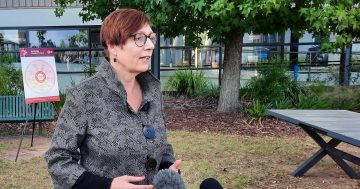
Cinziana Tozzi credited the ERAS program for her more positive surgery experience at The Canberra Hospital. Photo: Claire Fenwicke.
A Canberra Hospital surgery-preparation program will soon be available to more patients after five years of improving recovery outcomes.
The Enhanced Recovery after Surgery (ERAS) program supports Canberra Hospital patients undergoing elective caesareans, hysterectomies, colorectal surgery, lung resections, breast reconstructions, major vascular surgery, and major head and neck surgery.
Major urology surgeries are expected to be added to the program this year, with hopes to expand to brain and cardiac surgeries in the future.
ERAS clinical director Dr Andrew Deacon admitted the support should be standard practice, but it had been difficult to implement evidence-based best practice through every step of a patient’s journey in a coordinated way.
“It’s really easy in a large medical system to have silos that are all separated from each other that don’t talk that much,” he explained.
“So the ERAS program is trying to break down some of those barriers that we, as an institution, throughout Australia, throughout the world, have placed between these silos, to try and coordinate the care that people are receiving in a better way.
“This should be the standard of care for everybody, and it takes a long time to change culture, and so this is, hopefully, over time, changing the culture of the hospital.
“I really hope that in 10 years we will no longer need an ERAS program because this has just become the way we do business, and it’s completely standard.”
The program has been operating for five years and, in 2025, recorded its highest level of participation, with 1013 eligible patients involved.
Across its lifespan, admissions to the Intensive Care Unit have dropped by 46 per cent, and medical complications by 50 per cent.
The median length of stay for vascular surgery patients has decreased by one day, colorectal patients stay for about eight days rather than 10, and extended stays of more than 14 days have decreased by 36 per cent.
Cinziana Tozzi is one person who’s reaped the benefits.
She had knee surgery in 2018, and she felt scared and unprepared.
“[The medical staff] explained it … you did your blood test, went in, they told you what was going to happen, and that was it,” she said.
“It’s not that [what] the staff did was wrong, but I think you needed just a little bit more information, just to help you with your nerves. I tell you, it gets scary when you’re going in for surgery.”
More recently, she had colorectal surgery and accessed the ERAS program.
She underwent physiotherapy and exercise sessions in the weeks before her surgery and met with dieticians, nurses and speech pathologists.
They created a personalised plan to best prepare her both for surgery and her recovery.
“They go through everything, and there’s no prejudice, whether your religion, your culture or anything. Everyone respects everything,” Mrs Tozzi said.
“I found it very helpful because I did feel [more] at ease after knowing that they’ve explained everything to me, as well as what to expect in the surgery.”
Dr Deacon said having patients recover more quickly and leave sooner had ripple effects across the hospital.
“We have more capacity to handle emergency surgery, and [more] emergency beds, so that means that we can hopefully relieve some pressure on the emergency department,” he said.
“As [more surgery groups] come on board, we really hope that we see the same improvements in care for these patients that we have for the other surgical groups that are already involved.”
High-risk ERAS patients can also access free nicotine replacement therapy to support better outcomes.
Health Minister Rachel Stephen-Smith said the program is having a real and measurable impact on patient wellbeing and hospital demand.
“ERAS is helping patients get back on their feet sooner, with fewer complications and shorter hospital stays,” she said.
“[And] by reducing complications and getting patients home earlier, ERAS is freeing up hospital beds so we can care for more people.
“It is good for patients and good for the health system.”
Mrs Tozzi had no complaints about the process.
“I would recommend it to anyone who has to go through surgery and is allowed to go through this program,” she said.