Retired Navy veteran and medicinal cannabis user Josh Hynes wants to see the law change so he can drive without fear of prosecution. Photo: Supplied.
Josh Hynes spent eight-and-a-half years serving his country as a naval officer before being medically discharged for physical and mental health issues acquired while on the job.
The 39-year-old was first prescribed medicinal cannabis about two years ago, on the recommendation of his psychiatrist, to help with his treatment-resistant depression and musculoskeletal pain.
“Sleep for me was a big problem, but with the CBD oil and a bit of THC, I was finally able to get a really good sleep,” Mr Hynes said.
CBD is the non-psychoactive compound extracted from the plant and doesn’t need a prescription. Medicinal cannabis contains THC, the cannabis compound that causes a ‘high’.
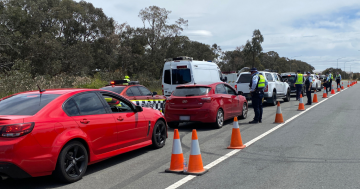
Mr Hynes has stopped taking his medicinal cannabis for the past few months over fears he could be criminalised and lose his licence as his prescribed medicine returns a positive roadside drug test.
“It says on the bottle, if you’re affected, don’t drive, and so I take it the night before, feel a bit affected and tired, but it wears off in a couple of hours,” he said.
“It has zero effect on my ability to drive or cognitive function [the next day] … but the consequences of losing my licence mean I can’t take my kids to school and do what I need to do as a father.”
Mr Hynes found it incredibly upsetting that he’s unable to take the medication that’s proven to work for him, all because it’s treated differently under the law.
“I have been trusted to drive warships and with national security,” he said.
“You’re not going to go to jail or lose your licence if you’re taking the pain medication prescribed by your doctor, but you can if you’re taking [medicinal cannabis].”
It’s this legal discrepancy the ACT Greens hope to fix.
Deputy leader Andrew Braddock recently introduced an amendment bill to give medicinal cannabis users a statutory defence if they return a positive roadside drug test for THC.
A committee inquiry is considering the suggested changes to determine whether they’re the right fit for the ACT.
Mr Braddock said some concerns had already been raised with him regarding how the scheme would work.
“Police are concerned about how they are meant to verify, [for example] at 3 am on a Saturday morning and it’s raining, whether a prescription in front of them is legit or not,” he said.
“I’m very open to a conversation in terms of [finding] a way that we can help the police in a way that also respects people’s private medical information.”
Mr Braddock said there had been some community concern about how police would be able to distinguish between a medicinal cannabis user and a recreational user who might be trying to avoid a fine.
He explained the bill still allowed police to exercise their own discretion.
“If the police, on presentation of the evidence like a script or a letter from the doctor, have anything that gives them a reasonable suspicion that [the driver] might still be impaired, whether it be falling asleep at the wheel, slurred speech, the smoke wafting out of the car as you pull up … it automatically flips over and they can still be charged with [impaired] driving,” Mr Braddock said.
“That is a subjective test, and I totally acknowledge that … however, I still believe that this legally prescribed medicine should be treated the same as other legally prescribed medications.”
Independent Kurrajong MLA Thomas Emerson previously sponsored a petition calling for drug driving reform for medicinal cannabis patients.
In response, Attorney-General Tara Cheyne said such a change would only be pursued if it was “supported by comprehensive evidence” and if such laws had “proven to be effective in other jurisdictions”.
“It is the ACT Government’s view that there is not yet a body of evidence capable of supporting an understanding of driver impairment following THC use, as is the case for alcohol,” she wrote.
“The current scientific consensus is that there is no means to consistently assess how specific amounts of THC impact any individual’s driving ability.”
Mr Braddock disagreed.
“Some of the scientific evidence [out there] in terms of the actual impairment that happens from medicinal cannabis [shows the impact] is exceedingly low,” he said.
“There are no examples of anyone who’s a road fatality caused by medicinal cannabis. There’s no evidence out there in terms of it will get you above that level of 0.05 level-style risk, as compared to blood alcohol content.”
Given that NSW has recently announced legislation to establish a registration-based system with three-strike warnings, Mr Braddock said this was an opportunity for the ACT to put forward its own model.
And for the Territory to live up to one of its favourite mantras: that it’s the most progressive jurisdiction in the country.
“I would argue that that’s propaganda. Yes, I agree that sometimes, as a small jurisdiction, it’s easier if other jurisdictions have gone first, but I believe if you want to say you’re in the most progressive jurisdiction, then why are we trailing behind NSW, for God’s sake?” Mr Braddock asked.
“While I fully respect the Attorney-General saying this is not a priority for us at this time, from what I’ve heard from those who actually utilise medicinal cannabis, they’ve been waiting a long time in order to be able to safely drive while also using the medication that’s been provided to them by their licensed practitioner.
“We are talking about veterans, mothers with endometriosis, seniors with arthritis, cancer patients and those sorts of things.”
As for Mr Hynes, he wanted to emphasise that this wasn’t about taking away medicinal cannabis users’ responsibility to not drive while impaired.
“This isn’t about an exception; this is about harmonisation with existing policy,” he said.
“We’re not blazing [up] and driving cars around … it’s not this demon drug that people make it out to be.”
Submissions close for the inquiry into the Road Transport (Alcohol and Drugs) Amendment Bill 2026 on 10 August.