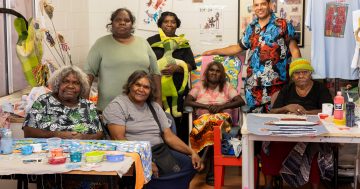
Pauline Minmila Wangin, Pitjantjatjara people, Betty Tjulpukuna Campbell, Pitjantjatjara people, and Emma Singer, Pitjantjatjara people, in Mimili, South Australia, 2022, with their work Kapi (Water) 2022, © the artists / Mimili Maku Arts / APY Art Centre Collective, Photo: Mimili Maku Arts and APY Art Centre Collective. Photo: Rohan Thomson.
Scheduled to open in 2023, the Ngura Puḻka – Epic Country exhibition was postponed for three years in response to claims of excessive interference with the painting of the works by non-Indigenous studio assistants.
From the outset, I have been uncomfortable with the controversy, as for me, it smacked of colonialism, where a non-Indigenous audience was making a demand of ‘complete authenticity’ in First Nations Art.
No one would dream of turning to Patricia Piccinini or Ron Mueck to demand exactly which bits they made and which were made by their fabricators.
The prevailing rule of thumb over the past century or so is for the artist to sign off on the final product, frequently done in the form of a signature, and if the artist is happy that this is her work, concept or idea, then it is an authentic work by the artist.

Jeannie Minunga, Yankunytjatjara people, Kay Finn, Pitjantjatjara/Yankunytjatjara peoples and Myra Kumantjara, Pitjantjatjara/Yankunytjatjara peoples, in the APY Art Centre Collective studio on Kaurna Country/Adelaide, South Australia, 2022, with their work Nganampa Ngura – Our Country 2022, © the artists / Umoona Arts / APY Art Centre Collective, image courtesy APY Art Centre Collective. Photo: Andy Francis.
As far as I am aware, all of the artists in the Ngura Puḻka exhibition are happy with the final product, and we should respect their decision rather than pretend that we are their colonial overlords and set our own rules about what we deem authentic in some sort of ethnographic production.
Such colonial attitudes do carry with them a whiff of racism.
In addition to the original 24 large paintings designed for the 2023 exhibition, a further six canvases have been commissioned in the interim. They are being magnificently displayed at the NGA, with cameo displays of their holdings of desert art shown in adjoining galleries.
The exhibition itself is spectacular. It consists of 30 huge canvases that celebrate Country and the Tjukurpa (formerly known as Dreamings) that belong to this Country.

APY Women’s Regional Collaborative, Ngura Puḻka – Epic Country 2022 © the artists / APY Art Centre Collective. Photo: APY Art Centre Collective.
The project was established as a bold initiative by senior First Nations artists and collectives from the Aṉangu Pitjantjatjara Yankunytjatjara (APY) Lands, Coober Pedy and Tarntanya/Adelaide, in South Australia.
It is probably the most ambitious First Nations community-driven art project ever attempted, and in this, it is a coup for the National Gallery. This is also possibly the most exciting artistic development to emerge from the desert since the Papunya paintings in the early 1970s.
The paintings have a boldness, monumentality of scale and sense of visual excitement.
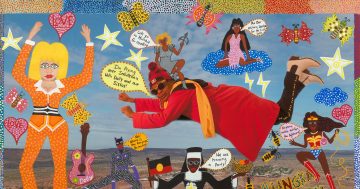
In all, there are about 50 artists involved, and they present a rollcall of some of the most famous names in APY art from Kaylene Whiskey to Barbara Moore, Betty Chimney and Raylene Walatinna, Betty Kuntiwa Pumani, Betty Muffler and Maringka Burton, Kunmanara (Nellie Ngampa) Coulthard, Margaret Richards and Matjangka Nyukana Norris.

Betty Muffler, Pitjantjatjara people, Maringka Burton, Pitjantjatjara people, Ngangkaṟi Ngura (Healing Country) 2022 © the artists / Iwantja Arts / APY Art Centre Collective. Photo: APY Art Centre Collective.
What is exciting about this exhibition is that it pushes the boundaries of what we consider as traditional Central Desert art from explosive concentric circles of colour, pulsating fields of colour, simmering fields and a haze of dots to the beautifully subtle sea of greys and pale tones in the work of Betty Muffler and Maringka Burton or the floating sea of subtle interlocked shapes in the work of Matjangka Nyukana Norris.
Many of the pieces are collective endeavours rather than the work of a single artist, something one becomes acutely aware of when visiting the communities and seeing a whole group of people sitting around a canvas, working on it from different directions.

Barbara Moore, Anmatyerre people, Ngayuku Ngura (My Country) 2021, © the artist / Tjala Arts / APY Art Centre Collective, image courtesy APY Art Centre Collective. Photo: Andy Francis.
Ngura Puḻka is an exhibition of great risk-taking, where the APY Art Centre Collective has taken matters into their own hands in an endeavour to break the mould of what was expected from their art and to attempt something that is new, bold, unexpected and on a monumental scale.
In this, they have succeeded, and every visitor to this remarkable exhibition will discover their own unique piece of unforgettable visual excitement from Australia’s Central Desert.

Installation view, Ngura Puḻka – Epic Country, National Gallery of Australia, Kamberri/Canberra, 2026. Photo: National Gallery of Australia.
Ngura Puḻka – Epic Country is on at the National Gallery of Australia, Canberra, from 11 April to 23 August, daily from 10 am to 5 pm. Admission is free.