

27 November 2025

Think your super's safe? It's not. The Treasurer's found another way to get your nest egg

| By David Murtagh
Join the conversation
60
Jim Chalmers

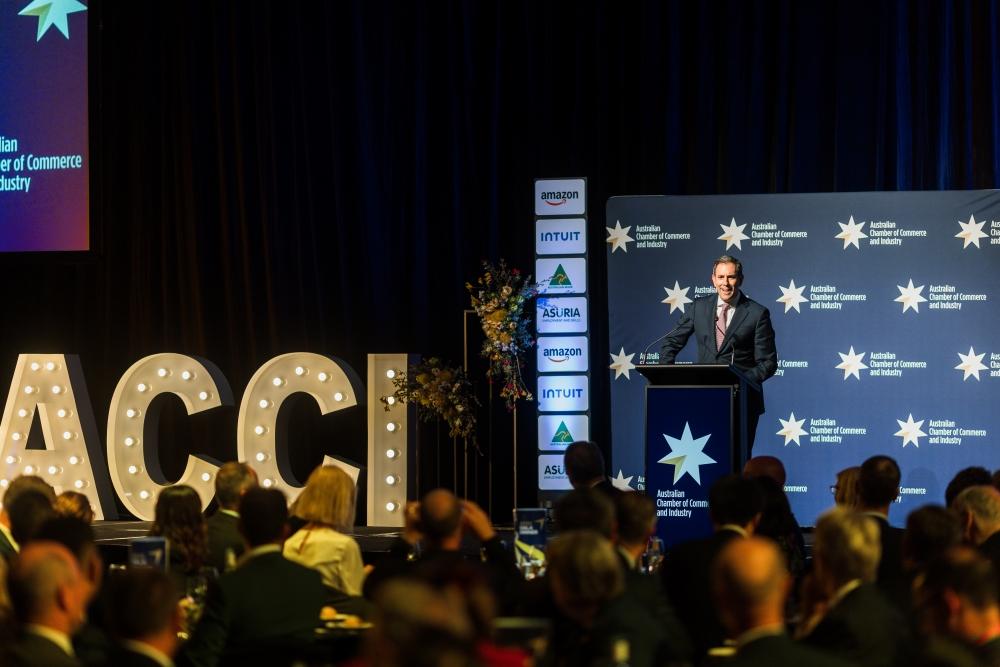
Dr Jim Chalmers at ACCI’s Gala Dinner 2025 – the scene of the crime. Photo: ACCI.

Treasury and the Treasurer might have retreated from their battle to tax unrealised gains on superannuation, but the war to grab as much of your super as they can continues. Jim Chalmers has said as much. And because of undisciplined spending and extravagant promises, the Albanese Government has no choice. They’re out for as much as they can get.

It wasn’t meant to be this way.

When superannuation became mainstream in the early to mid-80s, it was barely taxed. It helped get workers on board – when you tell them they have to give up some of their income today on a promise of a nest egg on the never-never, you’d better sweeten the pot. So Hawke and Keating did.

As the pool of funds has grown and grown, though, federal governments of both stripes have looked at that giant pot of dosh as not just your retirement fund that you are forced to contribute to, but a lifeboat to plug nest egg-sized holes in their budget. So, every few years, the rules are changed, and not in your favour (they never are, but you knew that already).

The government doesn’t feel guilty about it, of course, because superannuation’s taxed at a ‘concessional rate’, so the argument can always be made that they’re just making the system ‘fairer’ (again, never in your favour).

At this stage, you’ve probably realised that should a politician ever say they’re doing something for ‘fairness’, it’s a warning you’re about to get robbed … and in a way, you have been. But in a way, they’re right.

Because superannuation has tax advantages over other investments, it is susceptible to ‘abuse’ and is therefore often abused.

This brings us back to the government and your super (and don’t ever forget, it is your super – not theirs).

READ ALSO There’s more to Parliament than Question Time

There’s about $4.3 trillion in super at the moment and it is growing at an astounding rate.

Just one per cent of that $4300 billion total is a whopping $43 billion. The Treasurer would love to get some of it. The more the better.

But he has a problem.

Practically every person of voting age has super, so if he goes after the big pot, he can piss off a lot of people all at once. Which is why in the past few years the Treasurer has sought to ease his Budget pain (caused by overspending, not undertaxing, BTW) by hitting small groups with big balances in the hope he can ride out their complaints and spread some love with their money to salve concerns that the rest of us will be next.

Remember, when he said he would go after unrealised gains of ‘the rich’ with balances above $3 million? One appeal of that since-ditched policy was that it would almost certainly not affect you – just 0.5 per cent of people would be affected in the first few years, and those people probably vote Teal anyway, so why would Dr Jim care?

But his greed hasn’t abated even though they ditched that tax grab.

They’ve found another way to get their paws on your loot, which is arguably far worse.

READ ALSO Law passes to make bosses pay super the same time as wages

If you had nothing better to do last week, you might have caught Dr Jim’s speech to the Australian Chamber of Commerce and Industry.

Buried in the 2700-words of self-praise, Dr Jim told us he still wants our money.

“Treasury is starting a new round of consultation on the superannuation performance test. We’ve made it clear we’re open to considering responsible changes that maintain very high standards and the super funds’ responsibilities to members, which is why we’ll ask industry and experts for their ideas.

“Treasury will stand up an industry working group to help find consensus. The goal is to refine and strengthen the performance test to make sure it isn’t creating unnecessary obstacles to investment, particularly in key areas like housing and energy.

“It’s about better aligning and unlocking investment that also boosts productivity, while maintaining a robust test and a primary focus on member returns.”

Translation: renewable energy (and hydrogen – God help us) and housing aren’t attractive investments for super funds at the moment because they’re investment dogs and a bottomless pit of pain for the government, so he wants your super to go to sub-par investment vehicles to get the government out of a hole entirely of its own making.

Essentially, he wants your retirement future to pay for promises he and his boss made to get re-elected – promises regarding housing and renewables that they knew they couldn’t afford but made anyway.

And yes, they are bad investments.

Renewables rely on tax breaks, cheap loans, subsidies and forcing customers to buy renewable energy. Without all that, they would fail.

‘Housing’, such as build-to-rent schemes, relies on government subsidies we’re never told about because the deals are ‘commercial in confidence’.

Here’s the test: if renewables and housing were good investments, Dr Jim wouldn’t need to change the rules. Money without subsidies would be flooding in at breakneck speed. But they suck (technical term).

That’s why they need government money (aka, your money), but that hasn’t been enough – so they’re looking for ways to get more of your money and hope you don’t notice.

But it’s about to get worse.

To make these unattractive investments attractive to your super fund, they’re going to pour your tax money into the target sectors to justify using more of your super money in those sectors. They’re not investments, they’re money-go-rounds.

No wonder we’re going broke. And we deserve to.

Free Daily Digest

Want the best Canberra news delivered daily? We package the most-read Canberra stories and send them to your inbox. Sign-up now for trusted local news that will never be behind a paywall.
Loading
By submitting your email address you are agreeing to Region Group's terms and conditions and privacy policy.

Join the conversation

60
All Comments
  • All Comments
  • Website Comments
LatestOldest
Andrew Cooke7:02 am 12 Nov 25

There’s a lot of words and allegations but very little in the way of fact

Yes, governments current and past, have been quick to suggest that Superannuation could be the funding source of many a project.

The problem of course is that Superannuation funds have a fiduciary duty. They need to act in the best interests of those whose money they are managing.

Funding government projects are not the responsibility of Super funds.

I expect that many Australians are not aware of the potential tax consequences for any independent adult beneficiary that inherits our Super. You guessed it. The greedy claws of the government wants 15% of your Super, plus Medicare. If your money was in cash, the government would get nothing.

Never trust a government who has it’s eyes on your money.

Given no government functions without money-printing and taxation Colin Wood’s comments are risible. The fiduciary duty of super funds is legislated by government not scattered by fairy dust.

Try reading chewy14’s reply further down, on what is really happening, that which Colin Wood does not want to understand through his blind anti-government prejudice.

Hercules Morse5:22 pm 11 Nov 25

Fact: Industry funds can already invest in highly profitable but longer term (often unlisted, very illiquid) assets. Not sure where their difficulty lies.
Opinion: Chalmers wants funds to invest in less profitable assets and not be held accountable because in doing so they aren’t acting in the members’ interests, they are acting in his interests.
Fact: I’m SMSF and wouldn’t touch them with a barge pole.

The Opinion part is false, although it is true that Hercules Morse does not know where the difficulty lies, but comments on it anyway.

What Hercules Morse does or does not with his SMSF is of no concern to anyone but fund members and the ATO.

David Austin2:27 pm 11 Nov 25

Anyone who thinks super isn’t subject to massive sovereign risk has rocks in their head

Wise of you, David Austin, not to invest in anything at all including cash deposits, although even the cash in your hand is government-issued currency.

If you do hold any asset of any form, then in context your comment is sky-is-falling silly, mad enough to make Chicken Little jealous.

Capital Retro5:43 pm 11 Nov 25

I never touch shares but when interest rates fell to record lows I did some foreign currency trading which worked out OK.

For some reason, the big four banks now longer provide that service. And investing in FX is not covered by the government deposit guarantee not that it would be helpful if our foreign creditors sent in the bailiffs.

Well that is a lot of words to explain the author has no idea of what he’s talking about.

The super funds themselves have been calling for changes because the current rules make it more difficult to invest in highly profitable but longer term investments.

You know, investments that actually benefit members and reflect the entire point of Super.

There is nothing about reducing returns or flexibility for individuals to continue choosing to invest their money wherever they want.

Once again, vested interests and ideological warriors whinging because they can’t argue the facts.

Hercules Morse5:20 pm 11 Nov 25

Fact: Industry funds can already invest in highly profitable but longer term (often unlisted, very illiquid) assets. Not sure where their difficulty lies.
Opinion: Chalmers wants funds to invest in less profitable assets and not be held accountable because in doing so they aren’t acting in the members’ interests, they are acting in his interests.
Fact: I’m SMSF and wouldn’t touch them with a barge pole.

Hercules Morse highlights perfectly the inability to understand the issue and to be led by the ideological spin.

But I’m sure he’s read and fully understood the government’s investigation into the operations and impact of the recently implemented performance test and the options being considered to improve it based on industry and stakeholder feedback.

Fact: None of the options being considered involve the government wanting funds to invest in less profitable assets or investment classes.

Capital Retro9:46 am 11 Nov 25

Chalmers has been studying Latin American politics because given the majority Labor has there will never be another chance to do this:

https://www.abc.net.au/news/2008-11-08/argentina-passes-pension-nationalisation-bill/198904

No wonder people are queuing up to buy gold.

Why Capital Retro, I never realised you see Australia as ruling the world. You are presuming Americans, Poles, Chinese, Indians have rushed to buy gold on the recognition that a not-socialist government in Australia is not proposing any nationalisation of anything. Amazing.

Capital Retro12:28 pm 12 Nov 25

I really don’t know what you are inferring about Australia ruling the world, Axon.

The closest we may get to this is Australia becoming an as yet defined: “renewable energy super-power”.

As I said, Labor have to once only opportunity to nationalise private super and I can imagine the huge bureaucracy that will be created that will created giving more votes for Labor.

We think differently my friend.

So do these people: https://www.theguardian.com/business/2025/oct/22/gold-price-australia-thousands-queuing-sydney-bullion-store

Thank you, David, for bring this topic up to a wider audience so they are aware of what Labor is getting up to with our Super.
I feel more and more like it’s time to start that Generational Wealth Transfer with my Super to give to next generation a much earlier than planned leg up.

It’s a very good point you make David, if some of these things weren’t mandated by the government they’d never be funded. Though in the case of housing, you’d think the business case for investment was pretty clear.

And this paragraph must be some of the truest words written here:

“Renewables rely on tax breaks, cheap loans, subsidies and forcing customers to buy renewable energy. Without all that, they would fail.”

Well spoken.

As for the Treasurer, well nobody should be subsidising such incompetence.

They are only ‘true’ words if facts actually back up your claims. Which they do not.

But you don’t like facts – hate them as much as you hate calculating percentages.

Backing up those claims is hardly rocket science. Most people know this stuff and don’t need evidence. But for those who don’t, here you go:

Types of renewables support

* Rebates and tax credits: Programs like the Australian government’s Small-scale Renewable Energy Scheme (SRES) reduce the upfront cost of residential and business solar systems by creating certificates that can be sold. Other schemes offer direct rebates for items like home batteries or energy efficiency upgrades.

* Cheap loans: Government bodies, such as the Clean Energy Finance Corporation (CEFC), provide financing to help overcome market barriers and make renewable energy projects more viable. Some government programs also offer cheap loans directly to homeowners for electrification projects.

* Subsidies: Subsidies can take the form of direct cash transfers or tax exemptions, and they are used to support renewable energy production.
https://energyfactcheck.com.au/2025/04/22/do-renewable-energy-projects-get-more-government-subsidies-than-other-energy-projects/

* Other forms of support: Government support extends beyond direct subsidies to include regulatory support, the removal of legislative barriers, and information sharing, which can help drive the growth of new energy sectors.

It’s why everyone is fleeing from net zero.

Good idea on your part to refer to these, Penfold:
“the fossil fuel industry currently receives billions in subsidies”
“fossil fuel industry continues to receive significant, often hidden, subsidies that prop up its operations.”
“These subsidies, both explicit and implicit, are critical in sustaining fossil fuel industries despite growing pressures for decarbonisation.”
“[renewables are] still playing catch-up in terms of long-term, sustained support to the mature fossil fuel industry”

One reason for some budget-quantified incentives is the urgent need to stop carbon pollution from fossil fuels, pollution which Penfold is on record here as saying contributes to human-forced global warming. This is not a matter of who’s got the biggest subsidy, it is about our future, which is why most people under 50 vote for progress rather than stasis on climate issues, hence tending centre-left rather than absurdly to the right.

It is why practically every country, and industry here, continue to pursue renewable energy with emissions reduction.

Thanks Axon. It sounds like you’re relying on this treat:

“Government subsidies for coal or gas industries tend to be tax credits or breaks, of which the Federal government’s Fuel Tax Credit Scheme is the biggest. In 2023-24, this cost $9.6 billion. Other tax breaks include the Aviation fuel tax break and the Petroleum Resources Rent Tax, which account for a further $1.99 billion”.

The greens mouthpiece the Australia Institute who provided this hasn’t the best reputation for, shall we say, “climate issue facts”.

The PRRT, for example, is a tax, not a subsidy. In fact they completely contradict their own published material:

https://australiainstitute.org.au/post/what-is-the-prrt/

Ooops. If you want a further laugh, actually read the content. The supposed “subsidy” part is because …. wait for it …. companies can deduct expenses before the tax is calculated. Oh gosh, that sounds much like any standard tax system.

Got anything else ?

Penfold, your premise is wrong so the rest fails, aside from its irrelevance.

You run away from the fact that I wrote, “This is not a matter of who’s got the biggest subsidy” in these paragraphs:
“One reason for some budget-quantified incentives is the urgent need to stop carbon pollution from fossil fuels, pollution which Penfold is on record here as saying contributes to human-forced global warming. This is not a matter of who’s got the biggest subsidy, it is about our future, which is why most people under 50 vote for progress rather than stasis on climate issues, hence tending centre-left rather than absurdly to the right.

It is why practically every country, and industry here, continue to pursue renewable energy with emissions reduction.”

Got anything at all? Ever?

I neglected to point out in my response to Penfold above the rather obvious fact that the quotes I offered are all directly from the reference provided by Penfold himself.

His references rarely mean what he pretends they mean.

Axon this might come as a surprise but the quotes I provided back come from the same reference. Feel free to address them.

Btw the question of the “biggest subsidy” is meaningless. If renewables are indeed cheaper – as you keep telling us – why do they need subsidisation at all ?

I referred to something you authorised by reference without demur, Penfold. Live with it.

Your misrepresentations are merely routine, and your question demonstrates your lack of reading. I am not here for your remedial assistance once accurate points are made.

Renewables are proven cheaper at wholesale and retail levels and for future energy builds. You have failed to rebut these facts every time they have been raised, for the obvious reason of truth.

That the transition is supported by budgetted incentives for lower emissions has already been clearly stated, with Penfold himself in favour, unless he suddenly disagrees with himself.

“One reason for some budget-quantified incentives is the urgent need to stop carbon pollution from fossil fuels, pollution which Penfold is on record here as saying contributes to human-forced global warming. This is not a matter of who’s got the biggest subsidy, it is about our future, which is why most people under 50 vote for progress rather than stasis on climate issues, hence tending centre-left rather than absurdly to the right.

It is why practically every country, and industry here, continue to pursue renewable energy with emissions reduction.”

Pengold seemingly struggling once again with basic economics.

Not understanding how incentives can affect the rate of investment, even when the underlying investment is itself profitable or cheaper than alternatives.

Not according to the facts Axon. All that money Bowen throws at them yet investment is “falling off a cliff”.

“No wind projects at all reached financial close over the period.”

“Key transmission projects like the VNI West and Marinus Link are delayed and are experiencing cost overruns. The permitting and grid connection process remains tedious, and social licensing issues are causing significant delays and cost overruns for big projects.

https://reneweconomy.com.au/renewables-investment-falls-off-cliff-as-no-new-wind-projects-reach-financial-close-in-first-half-of-2025/

Daily Digest

Want the best Canberra news delivered daily? Every day we package the most popular Region Canberra stories and send them straight to your inbox. Sign-up now for trusted local news that will never be behind a paywall.

By submitting your email address you are agreeing to Region Group's terms and conditions and privacy policy.