

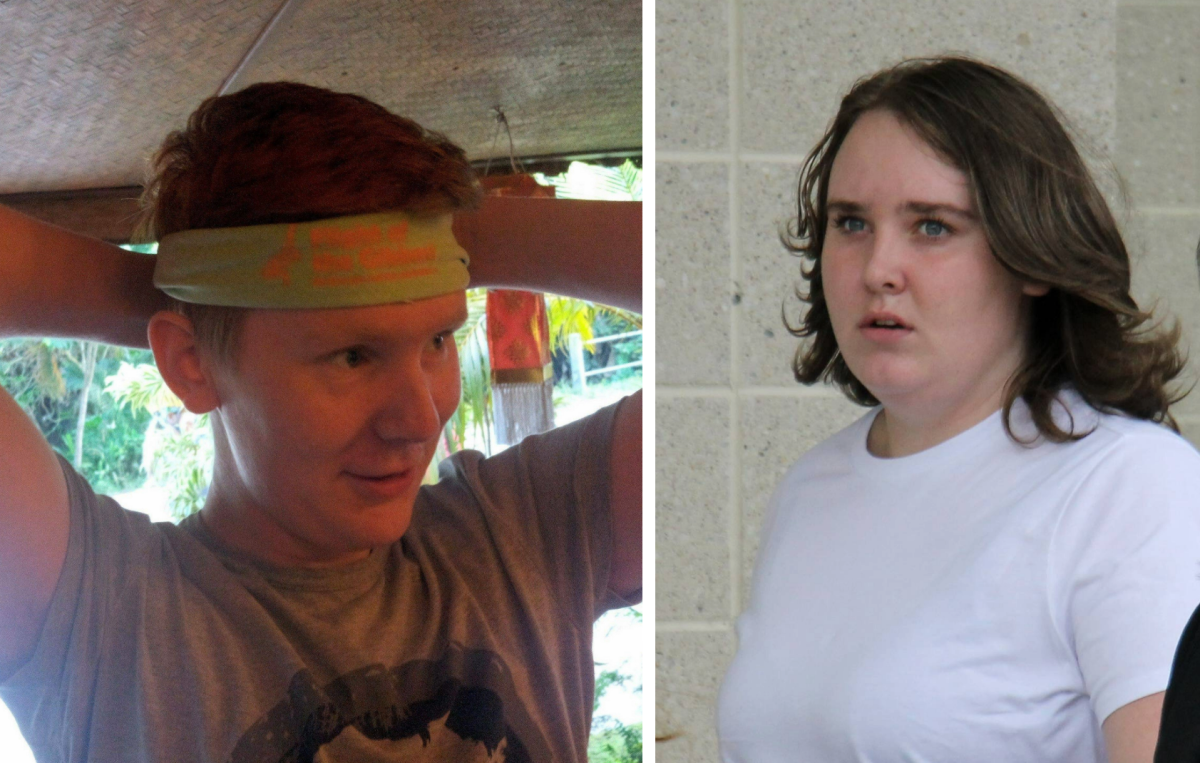
The ACT Appeal Court has reserved its decision on whether to reduce Shakira May Adams’ (right) 14-year sentence for killing Matthew McLuckie (left) in a 2022 car crash. Photos: Tom McLuckie/Albert McKnight.
Concerns about the AMC’s inability to properly house and care for killer driver Shakira Adams were raised almost two years ago by her victim’s father.
Ms Adams’ legal team is appealing her 14-year prison sentence for causing the death of Matthew McLuckie on Hindmarsh Avenue on 19 May 2022.
As part of the appeal, the court has been urged to consider her experience behind bars.
Ms Adams is being segregated in the AMC’s management unit as she can’t be safely housed in general accommodation – potentially a breach of her human rights – as she’s judged to be at “high risk of exploitation” by other inmates.
“She hasn’t received any physiotherapy and hasn’t received an exercise physiologist,” her barrister Kristin Edwards SC told the court.
“At this stage, there isn’t a concrete plan to provide her with that structured therapy.”
Ms Adams has an acquired brain injury as a result of the crash.
Matthew’s father, Tom McLuckie, raised concerns about the AMC’s capacity to deal with persons with needs and disabilities (among other concerns) in an email to Attorney-General Tara Cheyne and (now-former) Corrections Minister Dr Marisa Paterson on 14 November 2024.
“Marissa [sic], can you give an assurance that if Ms Adams is found guilty of manslaughter, that the AMC is capable of fulfilling its role in her detention given the denial of liberty is the punishment for such crimes under our legislation, or that appropriate imprisonment could be sought in NSW?” he asked.
“The suitability and function of the prison system is an obligation of the executive and government, and our judiciary should not be making allowances in sentencing just because the AMC and corrective services is currently a shit show after years of under-investment.”
Mr McLuckie received a response from Ms Cheyne (on behalf of both ministers) on 12 January 2025.
In it, Ms Cheyne assured him ACT Corrective Services was “well equipped” to manage detainees with complex care needs, and that there were options through Justice Health Services’ Custodial Mental Health Services or the ACTCS Supports and Interventions Unit (SIU).
“ACTCS works in collaboration with Justice Health Services (JHS) to provide detainees with quality health care to a standard equivalent to that available in the community, and to ensure the health care needs of all detainees are identified, and timely support is provided,” Ms Cheyne wrote.
She outlined support included oversight, one-on-one counselling and psychological intervention, and support for detainees with complex behaviour.
SIU has a complex care coordinator position and allied health assistants, and ACTCS also has a disability liaison officer.
“These positions actively encourage, empower and support psychosocial therapeutic goals of detainees through direct individual and group interactions,” Ms Cheyne wrote.
“Should a detainee have any physical limitations, these are considered as part of accommodation placement assessments.”
The effectiveness of the AMC’s delivery of mental health services to detainees was audited in 2022, and a 2025 update marked the agreed recommendations as completed.
Three separate Healthy Prison reviews have also raised concerns.
The 2025 review called on the ACT Government to publish a strategy within 18 months around “accommodating detained people with complex needs arising from health, disability, limited mobility, and advanced age that currently cannot be suitably accommodated at the Alexander Maconochie Centre”.
Mr McLuckie said it was “devastating” that Ms Adams’ conditions in custody were now part of her sentence reduction appeal.
“I believe the severity of the crime a prison sentence should be accepted. But the fact the AMC is such a shit show, it is simply incapable of providing any suitable level of care, health care, skills training, [means her legal team can argue this],” he told Region.
“The justice system in its entirety has, for years, been underfunded. This is from policing to the DPP, to the court and also Legal Aid. It demonstrates [the ACT Government] will prioritise vanity projects rather than invest in a core tenet of society.”
Mr McLuckie said the ACT Government had “admirable” policy intent, but appeared incapable of adequately following through with delivering the services and functions it promised the community.
“The only thing they have been ‘proven, practical and progressive’ … at delivering is rhetorical deniability of failure,” he claimed.
“They have turned that into a fine art … gaslighting through refusing to answer questions. We have systemic issues with the justice system. We get responses of people fear-mongering, being hysterical and [that] we are a safe city to live in.”
The Corrections Management Act 2007 and Information Privacy Act 2014 prevented an ACT Government spokesperson from responding to a range of questions put forward by Region about why Ms Adams hadn’t been given access to the care she needed.
They also noted the ongoing court proceeding made it inappropriate to comment on matters subject to legal proceedings.
The spokesperson stated both ACTCS and JHS undertook “comprehensive” physical and mental health assessments and developed care plans based upon a detainee’s admission to the AMC.
“ACT Corrective Services and Justice Health Services work collaboratively to provide appropriate care and access to health services based on individual clinical needs. This can include medical, mental health, nursing, dental, physiotherapy, occupational therapy and other allied health services where clinically required,” they said.
“Accommodation decisions are based on individual assessments and consider a range of factors, including the safety, wellbeing and needs of detainees, as well as operational requirements.”

















It would be great if you connect me to these families. I am the writer of the series. You can mail… View