24 March 2026

Transport minister rejects cheaper fares because buses might get too full

| By James Coleman
Join the conversation
124
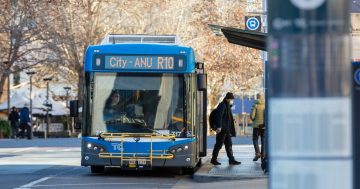
Bus at bus stop

The Canberra Liberals are calling for 50-cent fares across the city’s public transport network. Photo: Michelle Kroll.

Transport Minister Chris Steel says there are no plans to cut bus fares during the current fuel crisis, warning cheaper tickets could overwhelm Canberra’s public transport network.

The comments come as fuel prices surge, with diesel topping $3 per litre and regular unleaded sitting around $2.50 in the ACT. The Canberra Liberals are pushing for relief measures, including cheaper public transport, to ease pressure on motorists.

“Since the start of March, the average price of petrol and diesel across the Territory has risen by 28 per cent and 44 per cent respectively, meaning Canberra motorists have paid an additional $10-15 million to refuel,” a motion from Canberra Liberals leader Mark Parton states.

Mr Parton is calling on the Prime Minister to temporarily cut the federal fuel excise, which currently adds 52.6 cents per litre. At the territory level, he wants a trial of 50-cent fares across the Transport Canberra network to encourage more people onto buses and light rail.

The proposed trial would run from 6 April, or as soon as practicable, until 30 June, with monthly reporting on usage data.

Mark Parton, MLA.

Mark Parton’s motion is expected to pass with amendments from the ACT Greens. Photo: Michelle Kroll.

The idea has support from the ACT Greens, who are pushing to scrap fares entirely during the fuel shortage. The party argues the cost could be covered by a 25 per cent tax on gas exports.

“I’m hopeful that today the Assembly will pass my amendment to seek free public transport for the duration of the fuel supply crisis,” ACT Greens transport spokesperson Andrew Braddock said.

“We’ll also be doing our part to take the pressure off demand for fuel. It’s the billion-dollar gas companies who profit of this crisis and pay less tax than Australians pay for beer.

“It’s time that Australia’s big gas corporations pay for better transport options and not everyday people struggling to put food on the table.”

ACT Senator David Pocock is also expected to push a similar proposal at the federal level, calling for free public transport nationwide.

READ ALSO ACT puts brakes on 50c fare push ... unless the PM gets on board

Transport Minister Chris Steel acknowledged the strain on households, suggesting some people consider working from home or switch to electric vehicles.

“Jumping onto public transport as well, which is a really affordable option for people to use,” he said.

But Mr Steel rejected the idea of heavily discounted fares, warning the system may not cope with a sudden spike in demand.

“You’ve got to balance capacity in the network. If we had everyone jumping on board tomorrow, we would have completely full buses around the clock.”

Mr Parton said that the argument ignored years of government efforts to boost public transport use.

“We want to help people in the cost of living crisis, but let’s also finally get some people to just move over that threshold and say, ‘You know what, I haven’t been on the bus for 15 years. I’m going to try it’.”

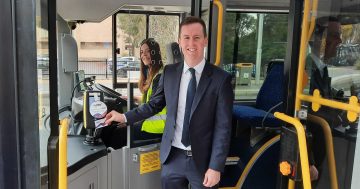
ACT Minister for Transport Chris Steel at Woden Interchange yesterday. Photo: Ian Bushnell.

Mr Parton said the policy had been costed at a “relatively modest” $2-3 million through to the end of June.

Mr Braddock also pushed back on concerns about overcrowding.

“The Labor Transport Minister Chris Steel said that he’s worried cheaper public transport fares would lead to full buses,” he said.

“I welcome full buses because it means less congestion on our roads, less emissions, and households saving thousands of dollars in transport costs. If we have full buses, we can then work to address the Labor Government’s underinvestment in buses.”

Similar policies have been trialled interstate.

In Queensland, 50-cent fares were introduced in August 2024 and later made permanent after the government said commuters saved almost $200 million and trips rose by 16 per cent to 96 million within six months.

READ ALSO Fare Free Friday heralds new era for public transport system

In the ACT, fare reductions have also been tested. A year-long trial of fare-free Fridays ended in December 2025, followed by free travel on Friday and Saturday evenings until late February 2026.

Within eight weeks, patronage rose by about 10 per cent, although the government noted the figure may be understated if passengers failed to tap on and off.

Later data showed a 24 per cent increase in public transport use by May 2025 compared with the previous year, potentially lifting daily trips from about 85,000 to more than 100,000.

Transport Canberra executive manager Judith Sturman said at the time it was clear Canberrans were “voting with their feet”.

“More people travel every Friday for sure, and also all the businesses benefit as well from people who are able to travel into town,” she said.
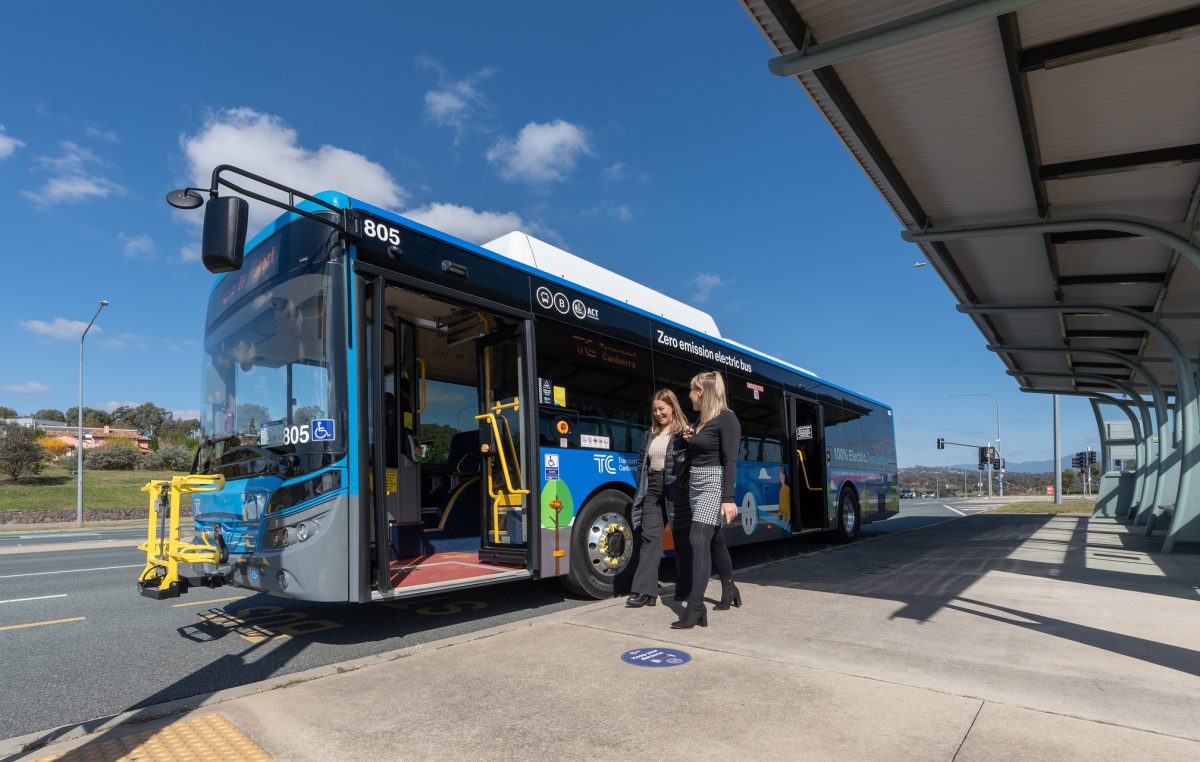
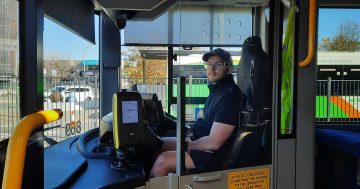
The government says the frequency of buses needs to be addressed before fares are reduced. Photo: Transport Canberra.

The government is still evaluating those trials, but its focus remains on improving services rather than cutting fares.

“The government’s priority is to increase the frequency of public transport services and deliver on our election commitments – not cut revenue – to be able to fund better bus services,” Mr Steel said last year.

The network is already under pressure due to construction works along Commonwealth Avenue and in Civic, as well as recent timetable changes that reduced some Rapid bus services while introducing longer buses on busy routes.

After complaints and a petition, the government agreed to reinstate the R2 and R3 services to Belconnen, but said broader improvements would take more time.

Mr Parton is due to present his motion to the ACT Legislative Assembly later today.

Free Daily Digest

Want the best Canberra news delivered daily? We package the most-read Canberra stories and send them to your inbox. Sign-up now for trusted local news that will never be behind a paywall.
Loading
By submitting your email address you are agreeing to Region Group's terms and conditions and privacy policy.

Join the conversation

124
All Comments
  • All Comments
  • Website Comments
LatestOldest
Leon Arundell1:36 pm 02 Apr 26

The government expected Fare Free Fridays to increase the 46,000 public transport trips we make each Friday by less than 8%.
It’s also less than 1% of the three quarters of a million car trips we make each day.
We’ll never know the actual result, because of the failures of MyWay+.
[This corrects another comment, in which I incorrectly said that the government expected Fare Free Fridays to only add 100 trips each Friday.]

Leon Arundell1:08 pm 02 Apr 26

The government estimated that Fare Free Fridays would increase public transport trips each Friday by about 100. That’s not even one passenger per bus.
A better argument against making public transport free is that it would only affect 100 of the 750,000 trips that we make each day.

Leon Arundell1:47 pm 02 Apr 26

Correction: The government estimated that Fare Free Fridays would increase public transport trips each Friday by 8%, or about 3,700 passengers. That’s not even 4 passengers per bus trip.

I’m not convinced that ticket pricing is the reason people don’t make use of PT. For example they trialled fare-free-friday and it doesn’t seem like it was a success. What comes first? Improved services to grow patronage or improved patronage to motivate improving the services? I suspect it’s a little both. So best to get out there and show you need PT!

Carl Sciberras3:50 pm 25 Mar 26

It’s just shifting problems elsewhere, eg in Sydney they want people to use public transport but the rail network is already busting a the seams daily. And carriages are already packed at peak hour. Unreal and unrealistic

I don’t understand all the fuss – speak to any bus driver and they’ll tell you there are a lot of people already riding for free.
But Transport Minister Chris Steel shows how out of touch he is again by suggesting you can alleviate the strain on households by switching to electric vehicles. In other words, if you’re struggling to pay an extra $50/week in fuel costs, you should solve this by forking out $30,000+ for an electric vehicle. He apparently doesn’t realise not everyone is getting an MLA wage each fortnight (most of us are instead paying for it).

Why is Andrew Braddock going after gas companies, as if they have anything to do with petrol or diesel prices (it might have been a thing in the 1980s, but there aren’t a huge proportion of cars running on gas these days)? Why is he trying to penalise AGL, BOC, Elgas etc.?

Hey Minister, that thought of about everyone just buying an EV, as opposed to introducing 50 cent bus fares, with the large number of new brands flooding the country, it might be a bit of a lucky dip, as to which ones survive.

https://www.news.com.au/technology/motoring/motoring-news/xpeng-and-ford-evs-hit-trouble-with-trueev-ausev/news-story/1b69cffeaa4ac57f1bcecb38245f6f0a

Brigadier General Von Vanker Man9:35 pm 24 Mar 26

I can comment on Bangkok. They put their heavy rail in the air which runs Hitachi going along at 130km/h, slower for freight. They have medium in the air rail and now a driverless monorail which is suspended in the air, plus their subway. Since then traffic flow has improved dramatically and smog in the burbs has disappeared to the point of what Sydney achieves it not better.

Had a Thai friend over who is an infrastructure engineer and when I showed her the tram, she said why not in the air and also noticed the already chipped and cracked concrete for the tracks. She wanted to know the cost and I stated that all up close to a billion dollars, that is from gunners to the bridge at the lake. She was astonished. I said it may be high material costs and labour. She stated that she has worked on new sections in Japan and Korea which were far cheaper and not mixed with traffic using a unionised workforce of Japanese and Korean nationals respectively.

This must be a joke, surely? It is something only the Liberals and Greens would hatch trying to keep their faces in the news now they are in a coalition in opposition. In a city as prosperous as Canberra with some of the highest wages in the country the Liberals and Greens are proposing rate payers fully subsidise public transport travel by offering 50 cent fares.

The ACT’s transport scheme offers some of the most generous and lowest fares in the country. This includes free periods of travel, daily caps and significantly reduced off-peak travel. Students and concession holders currently receive discounted fares and ACT Senior Card holders receive free travel at all times.

Not surprising the ACT’s Business Council is also supportive, sh*t scared the ACT government is going to introduce new working from home arrangements with the current oil crisis. Backing their Liberal mates in their sneaky efforts to undermine WFH measures and force public servants back into the office with rate payers subsidising worker travel.

And the dopey Greens are following along oblivious!

Hey Jack D.
Despite the higher than average incomes within Canberra, it’s important to remember that a high average doesn’t mean that everyone is paid well, simply that higher income earners across the board, hide the number of those who work in lower paid professions. Our son, is one of them and he doesn’t own a car.

The question really is who is the likely beneficary of a 50 cent fare?

Now I could be wrong here Jack, however, my gut is telling me that many of the higher paid in this city, are probably not the target market for public transport.

Your statement that ACT Senior Card holders receive free travel at all times, is incorrect. It’s only Seniors older than 70 years who receive free travel, all the time, Seniors younger than 70 years, are charged Concession Fares during Peak Hour services.

To paraphrase the Minister;
50 cent fares would result in full buses, go buy an electric car instead.

Gregg Heldon3:05 pm 24 Mar 26

The Minister for Half-Arsedness, Chris Steele says no. So it must be a good idea, or at least one worth considering.

Come on Chris. Give it a try. If a few buses are crowded that will be a measure of success.

The buses are already overcrowded because they cut way too many services last month because they don’t have any accurate usage data because the MyWay+ system implementation was such a disaster.

chrisjeanemery2:55 pm 24 Mar 26

The whole massive automotive industry is against public transport.

Isn’t the concept of public transport under the current Local Council to get people to use buses and the TRAM instead of cars. Is Steel thinking this through or are full buses and people using public transport not the main idea?

Why should switching from cars to public transport be additionally subsidised when there is already switching pressure from increased car cost? Busses and light rail are already cheaper than a car.

Any other random subsidies you would like for your personal convenience?

Leon Arundell1:56 pm 24 Mar 26

Encouraging us to cycle would help us cope with high fuel prices. We have as many bicycles as we have cars.
Many of our bikes need lights, mudguards, a luggage rack and a service, to make them practical for commuting. A government subsidy, to make those improvements, would be an excellent investment. It would cost about the same per bike as the current subsidy for a fortnight of public transport commuting by one person. It would boost local businesses that support cycling.
If one person commutes by bike one day per week, then over a year they might save a hundred litres of fuel and get thousands of dollars worth of health benefits. Those health benefits will cut the costs of the Territory’s health system. The reduction in health system costs might more than cover the cost of the subsidy.

People can get a 3% loan subsidised by the ACT government to buy an electric car, but not an electric bicycle.

Get out of here. Those things cost jack all to buy – how about you just go and purchase them.

Leon Arundell6:53 pm 24 Mar 26

Get out of here. The average polluting bus trip costs only about $15. How about people just pay the cost of their bus travel, instead of asking the government to increase its operating cost subsidy beyond $10 per trip?

Chris Steel – another of Andrew Barr’s mistakes

Gee, you wouldn’t want buses full of people. That would be a public inconvenience!

Google St. Edward’s Hospital, The Compassionate Society.

mongoose38001:21 pm 24 Mar 26

Mark Parton and his half thought out ideas to gain popularity. If I’m not mistaken wouldn’t cutting fuel excises just fuel inflation and then flow on to increases everywhere else.

You are mistaken, because increased fuel excise adds to CPI.

Effectively that would be a tax cut which encourages spending when we already have capacity constraints, thus inflationary.

The price increase arising from supply constraints on oil fuels encourages switching to electricity for appliances, HVAC and transport, improving our energy independence. This lessens impact of future supply shocks and also reduces the ability of other nations to impose such constraints on us.

Reducing fuel excise would reduce the price of fuel. That’s the opposite of inflation.

For about 5 seconds flat. As the Scomo experiment showed, the oil/fuel companies passed it on to begin with, but the savings were quickly hoovered up as prices rose a few weeks later. In short, just subsidising the profits of the oil/fuel companies through the Commonwealth Government.

What next though, Mary Taylor? What are the economic consequences of that short term sugar hit?

Why subsidise fossils anyway? There is more than enough of that happening already.

Axon, as I indicated, the excise it in itself inflationary; consumer expenditure on fuel includes the excise, and it adds to the CPI figures.

Is anyone suggesting every second home goes out and buys a new EV? That would create an inflationary spike.

Matt Watt you wrote “increased fuel excise adds to CPI”. Who increased the fuel excise? The excise is a fixed amount adjusted bi-annually for inflation, not a rate or proportion like GST (even so, if the price of butter goes up will you complain that someone raised the GST and demand it be removed?). This is not comparable with tax.

As I sought to suggest to Mary Taylor, cutting fuel excise to “reduce inflationary impact” has a few downstream effects: effectively the government pumps more money into the economy while supply constraints remain (and its own revenue falls); wholesalers and retailers capture profits as discussed by JS9; restoration of excise later leads to an artificial jump in inflation (cf withdrawal of electricity bill subsidies).

I do not recall proposing that every second home goes out to buy a new EV. I am waiting on an argument for a subsidy to ICE vehicles, cutting excise, rather than allowing economic pressures and changes to flow from the supply shock, and that is a matter of fuel price not the fixed excise.

OMG- are you seriously suggesting the excise/tax (I don’t quibble on labels) is some artificial charge parallel to government?

Fuel is generally price inelastic. Therefore, the excise is inflationary.

I will keep it more brief. You said “increased fuel excise adds to CPI”.
The fuel excise did not increase, thus negating your premise. Price inflation involves an increase. The fuel excise did not increase.
Are you following?

I am still waiting on an argument for a subsidy to ICE vehicles by cutting the fixed fuel excise.

Yes, I told you that yesteray, that it increases bi-annually by adjustment for inflation.

What has that to do with the rise in price of fuel owing to the attacks on Iran, subsequent to the January adjustment? Fuel excise is not proportional to fuel price thus when fuel price increased, fuel excise did not.

I am still waiting on an argument for a subsidy to ICE vehicles by cutting the fixed fuel excise.

Nobody has claimed that the excise has increased as a result of the issues in Iran, so I suggest you put that straw-man argument to one side.

Yet the excise clearly exists, and it contributes to Australians’ cost of living pressures. Cutting or suspending the excise is an option to provide financial relief to Australians – not just drivers, but everyone who consumes products shifted along supply chains.

Finally, reducing or suspending a tax/excise is *not* a subsidy.

So what was the point of your comment “increased fuel excise adds to CPI” in the context or rising fuel prices triggered by a price shock in Iran?

Your second paragraph says taxation exists. Gee, thanks, though I am still waiting on an argument for a subsidy to ICE vehicles by cutting the fixed fuel excise? You have made no argument. You may as well have said “suspend income tax”, unreasoned and valueless.

If you imagine cutting an excise or tax does not provide an incentive or comparative subsidy for the previously taxed goods then I suggest as politely as I may that you start again in high school, maybe earlier.

You keep using the word subsidy. Reducing a tax/excise is not a subsidy in a traditional sense.

A subsidy would be for the government to contribute to the payment of petrol, either overall or pre-excise. I mean, a consumer shouldn’t feel that they are being subsidised by government simply because government doesn’t take 100% of their income, which is the natural extrapolation of your stance.

I’ll bet you adhere to The Australia Institute’s false claim that student university debt is a tax, too.

Someone said providing the temporary discount on the excise would add to inflation, and I made the point that it would have the opposite effect, at least in the short term because petrol and diesel are generally price inelastic and the overall cost (including excise) adds to CPI. The Australian population is unable to simply swap out their petrol or diesel vehicles for EVs overnight, and I can’t help those who fail to recognise that consideration.

I’m quite unsure what argument you are trying to make, beyond trolling anyone who doesn’t support continuing the extant government policy. Feel free to continue that, but it doesn’t help address the increased cost of living pressures and economic dampeners.

Daily Digest

Want the best Canberra news delivered daily? Every day we package the most popular Region Canberra stories and send them straight to your inbox. Sign-up now for trusted local news that will never be behind a paywall.

By submitting your email address you are agreeing to Region Group's terms and conditions and privacy policy.