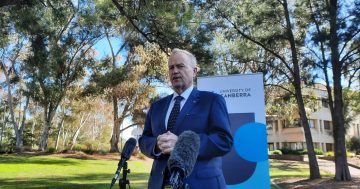
The campaign is aimed at people wanting to find their path and feel part of a community. Photo: University of Canberra.
The University of Canberra will launch a $2.7 million marketing campaign that pitches it as flexible and a caring place of study dedicated to student needs.
The U Can campaign is based on research commissioned by the University in 2025 that explored the current state of the sector and the attitudes of prospective students. It is supported by six case studies.
It will be the first significant shift in brand positioning for the University in over a decade and will mark an incursion into metropolitan markets such as Sydney.
Creative agency Born is behind the campaign, which will involve multiple channels from 6 April including television, social media, digital screens and Out of Home (OOH) formats including billboards, bus wraps and street signage.
Previewing the new campaign, vice-chancellor Bill Shorten said the university was going after people of all ages and walks of life from across the country to offer a place where they could find their path, study flexibly and have a sense of belonging.
“We want to take people from the regions, we want to take people who are first in family [to go to university], we want to take people who mightn’t think they’ve got the marks or the connections, who might be a bit nervous about coming to bigger cities,” he said.
“We want adults who, when they left school, didn’t think about university, it wasn’t for them, but now are wondering, could they come back and study?”
Mr Shorten said many universities had lost their social licence by becoming big businesses and Australians were questioning the value of a degree.
But Australia needed its universities to be thriving, productive places that developed the potential of the nation.
“If this country’s to survive in a complicated changing global environment, universities have to be sources of national sovereignty through our learning and scholarship,” he said.

UC vice-chancellor Bill Shorten is determined to shake up the sector. Photo: Davey Barber Five Foot Photography.
The campaign will underline many of the points Mr Shorten has been making about higher education since joining UC.
These include recognition of prior experience so a degree can be completed more quickly and at less cost.
Mr Shorten said the campaign sent a message of hope and opportunity to prospective students as real people, particularly those in the regions.
“We think you are equal to anyone else in Australia and at UC we can give you that learning city experience, but in a place which is not alienating, which is not creating loneliness and isolation, but where we see the person and not just see them as some sort of accounting entry for a profit on a balance sheet of a big university,” he said.
While UC enrolments have risen, Mr Shorten was not resting on that. “I think we can do more,” he said.
The case studies are each based on the stories of UC alumni and students that illustrate real-life circumstances including those who have have overcome significant obstacles to attend the university.
One of the featured stories is that of entrepreneur Dion DeVow, a First Nations man and UC alumnus.
“As a former student and proud alumnus of UC, sharing my story brought me full circle,” he said.
“It gave me a chance to reflect on my journey, and it felt like giving back to the community that shaped me.
“Broad representation in advertising matters because it ensures people see themselves. When we include diverse stories, we create a sense of belonging and open doors for others to feel they too can be part of the story.”