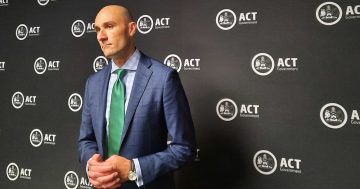
CPSU ACT regional secretary Maddy Northam appeared before a committee inquiry into the Territory’s fiscal sustainability. Photo: CPSU.
The public service union has accused ACT Government departments of skirting hiring rules and ridiculed the tens of thousands of dollars spent on contractors during a hearing examining the Territory’s fiscal sustainability.
The ACT Government has enterprise bargaining agreements and a policy to move towards a permanent public service instead of using external providers.
But Community and Public Sector Union ACT secretary Maddy Northam said the government was still issuing hundreds of contracts for ongoing work that public servants should carry out.
“The government is paying big money to these private companies … but [the public service job-level equivalent] is not getting the big bucks that this company over here is getting,” she told the Select Committee on the Fiscal Sustainability of the ACT.
She gave the example of recruitment for board positions and executive members.
There are selection committees (or selection advisory committees) embedded in the government to assess applications to work in the ACT public sector.
But Ms Northam presented several examples of money spent on hiring external, private companies to recruit higher-level positions.
These included:
- $75,900 to recruit the Digital Canberra director general
- $53,400 to select the CIT board
- $46,000 to recruit an Education Directorate deputy director general
- $39,600 apiece to recruit two CMTEDD deputy director generals ($79,200 in total).
Others available for viewing on the Tenders ACT website include $44,880 for the City Renewal Authority board search, $33,000 for the JACS deputy director general, and $143,000 for the City and Environment Directorate director general and two deputy director generals.
Ms Northam described the situation as “ridiculous”.
“That, to me, is a waste of money,” she said.
“We have got in-house capacity, why on earth are we going out and spending that sort of money rather than investing back in our services?”
Ms Northam argued that one issue with hiring contractors meant that once their time was up, vital knowledge was then walking out the door, and sometimes the role being delivered by the external contractor wasn’t filled at all.
She pointed to the newly established Digital Canberra directorate as an example.
“Unfortunately, we haven’t got the workers … instead, we’re paying really large sums to private contractors, who come in for a short period of time with their expertise, do a project, and then they go.
“None of that knowledge is staying in the service.”
CPSU ACT lead organiser Jordan Piggott added that many ICT members across various areas who were meant to move into the Digital Canberra directorate still hadn’t been embedded.
That’s despite the machinery of government changes happening over a year ago.
“Our members are still, in a lot of cases, in the dark about when and where they’re going,” Mr Piggott said.
Another issue raised by the union members was the alleged manoeuvring by public servants to get around new clauses in the Fair Work Act.
As of 6 December 2023, the Act restricted fixed-term contracts to a maximum of two years (including renewals) or two consecutive contracts for the sale role.
It was intended to stop a practice of people being continuously offered new fixed-term contracts rather than permanent roles.
But Ms Northam claimed managers were being told that, when a person reached their third contract, that they had to be let go, despite this breaching the anti-avoidance provisions of the Act.
“[There’s a situation where] you’ve got the very highest level of the public service, they feel like they’re torn,” she said.
“They’ve got the FMA on one hand, [where] they’ve got people saying ‘you’ve got to keep your budget like this’.
“And on the other hand, you’ve got the Fair Work Act, the Work, Health and Safety Act, and they’re saying: ‘I’m going to breach one of them, and which one do I pick?'”
(The FMA, the Financial Management and Accountability Act, was replaced by the Public Governance, Performance and Accountability Act in 2013.)
Mr Piggott said this was happening with short-term contracts, not project-based roles.
“These are frontline services that are there every day … [but] they’re just funded in the short-term, and that is often enough to get past all the provisions in the [Fair Work] Act,” he said.
Ms Northam gave the example of the biosecurity team within ACT Parks and Conservation.
Given the roles are funded year to year, the workers aren’t permanent.
“Some of them are being told their jobs are too specialised to be converted to permanent work,” she said.
“These are the issues we’re coming up [against] over and over again, and it all comes back to the way that their funding comes through.”
ACT Government representatives weren’t pushed on any of these issues when they appeared at the hearings in a later session, but they were grilled about how they would achieve promised savings across the public service.
Shadow Treasurer Ed Cocks argued there would have to be staff cuts of between 7 and 11 per cent across the forward estimates.
Treasurer Chris Steel disagreed, stating the recent budget review identified $282 million in savings (excluding hospitals and schools) across the entire government.
“[This] will be achieved by constraining the rate of growth and expenditure across a range of agencies and directorates, as well as looking at expenditure re-prioritisation and rebasing,” he said.
“There’s a whole-of-government effort that’s going on to achieve that … it’ll be a multi-year effort.”
Mr Steel acknowledged the ACT’s rate of full-time equivalent growth had been “very high” in recent years, and would not continue at that level.
“The public service is still expected to grow, just not at the same level,” he said.
“Restraining employee expenses is critical; it’s obviously a very large portion of the input cost to delivering services in the Territory.”