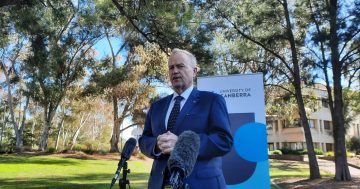
An Auditor-General review of UC’s financial governance arrangements said the way past budgets were created was ‘high-risk’. Photo: University of Canberra.
A specialist University of Canberra program designed to achieve a “rapid and significant increase” in student numbers has been dissolved into ‘business as usual’ after failing to meet its goals.
An ACT Auditor-General report found the Education Transformation and Growth (ETaG) program, agreed to in late 2022, contained a “considerable up-front cost” but didn’t deliver on its aim to increase student numbers from 11,277 equivalent full-time student load (EFTSL) in 2022 to 15,600 EFTSL by the end of 2027.
“The assumptions about increased student numbers were too optimistic, and the expected increase in revenue did not materialise,” ACT Auditor-General Ajay Sharma said.
“The high-risk budgets required the UC to take drastic and significant action to reduce expenditure to address the financial viability of the institution.”
This “drastic” action was the October 2024 announcement that more than 200 jobs would be made redundant as part of efforts to save $50 million from recurrent expenditure by the end of 2025.
The business case for the ETaG Program put estimated costs for the first three years at $54.9 million, and it was expected to be self-sustaining by 2025.
It also identified not meeting growth targets and “the possibility that if course actions are not producing target results, staff with specialist skills will no longer be needed and can’t be relocated” as key risks.
But mitigation strategies included a dedicated marketing spend to promote student growth, a regular review process, employing staff on three-year fixed-term contracts during the program’s initial phase (with decisions on converting those roles to full-time to be made as part of the program’s third review), and diversifying student types.
Work on the program began in mid-2023, and new units and courses were launched in 2024.
A May 2024 briefing paper noted that the “ambitious growth assumptions” for student numbers and revenue hadn’t been realised, and that the program’s end date needed to be pushed to 2030.
The $33.5 million expenditure initially planned for 2023 and 2024 would likely be revised down to $15.6 million.
The 2025 budget (submitted to UC Council in March of that year) noted “significant strategic project expenditure” in programs such as ETaG and the associated Digital Master Plan had been justified by expected EFTSL increases and, by association, student revenue.
“The combination of exogenous factors and unrealistic growth assumptions has resulted in growth in costs unaligned to growth in revenue,” it stated.
It predicted that student EFTSL for 2025 would grow to 12,215.

ETaG program revised student numbers and net revenue. Image: ACT Auditor-General.
The Auditor-General’s report noted that three assumptions during budget creation have the greatest impact on revenue and expenses: student revenue, salaries and other income (accommodation).
It found UC’s approaches to calculating salaries and other income were reasonable, but the assumptions used to estimate student revenue for 2024 “did not hold true to the actual results achieved”.
“The UC experienced shortfalls in its student load targets for 2024 due to a range of factors that led to an overestimation of student numbers,” it stated.
These included accidentally combining separate load plans to arrive at the total EFTSL.
“The UC has not sought to quantify the impact of the two separate load plans and is therefore unable to specify how much of the overall EFTSL variance was related to the two load plans and how much was a result of the other external factors,” the report noted.
“In response to the draft proposed report, the UC advised that quantifying the impact of the separate load plans would not have been a prudent use of planning resources at the time.”
A UC spokesperson told Region that ETaG was “folded into business as usual and existing budgets, to ensure continuity for the delivery of our online courses.”
“This supports our commitment to offer UC students maximum flexibility,” they said.
The Auditor-General made four recommendations regarding financial governance arrangements, all of which the university accepted.
But UC added a caveat that it didn’t agree that the 2023 and 2024 budgets were ‘high risk’.
“The 2023 and 2024 budgets were considered and approved by the University Council based on the best available information at the time,” it stated (emphasis by UC).
“The associated risks were understood, transparent and monitored through established governance processes … the underlying assumptions used in both budgets were reasonable and evidence-based when adopted, and Council fulfilled its oversight responsibilities appropriately.
“The ‘high risk’ characterisation appears to reflect hindsight.”
It’s cold comfort for those people who lost their jobs.
“Staff consistently highlighted concerns with the ETaG Program but were repeatedly ignored,” National Tertiary Education Union ACT division secretary Dr Lachlan Clohesy said.
“Its botched conception, approval and implementation led directly to careers ending as well as damage to people and the university.”
Dr Clohesy also voiced concerns about the program’s apparent successor.
“We’re concerned that UC hasn’t learned the lessons of ETaG,” he said.
“UC’s Block Model is the next bright and shiny new initiative that will involve an upfront cost.”