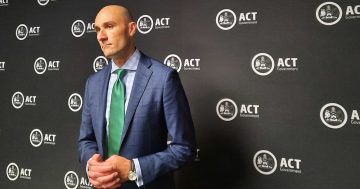
CPSU ACT regional secretary Maddy Northam (front) warned voluntary redundancies in the Health and Community Services Directorate would adversely impact vulnerable Canberrans and the wider community. Photo: CPSU.
Warnings are already sounding that Canberra’s most vulnerable are going to be even worse off if voluntary redundancies are taken up at the Health and Community Services Directorate (HCSD).
The ACT Government agency announced on Thursday (1 October) that 65 positions would go across its more than 1500-strong workforce.
“[This is] to ensure that we are able to continue operating within our available budget,” HCSD Director-General Kareena Arthy said.
“We will be assessing applications carefully to ensure the directorate retains the workforce knowledge and capability to ensure we meet our important statutory obligations.
“We’re taking this action now to ensure we are on a sustainable financial footing while we continue to provide essential services for Canberrans.”
Ms Arthy wouldn’t confirm which areas within the directorate would be targeted by the program, but said it would be open to all staff.
“I have no expectation at the moment about where we will have the EOIs come from,” she said.
Some executives are excluded from the program.
HCSD’s budget papers foreshadowed the directorate was 45 full-time equivalent positions in excess, which is how it reached the 65 figure.
While forced redundancies have been ruled out, management offered no clarity on what happens if voluntary departure targets fall short.
But Ms Arthy had this message for people accessing HCSD’s services.
“People who are going through the child protection system and getting domestic violence support … their programs and their support services will remain the same,” she said.
“We’re undertaking a process where we’re going to be assessing every application on its merits, and we’ll be looking at the impacts on service delivery, impacts on workload, before we make any decision about whether to accept [an EOI].”
“One of our core criteria of the assessment is looking at the impact of service delivery capability and we will be taking that into account when making the final decision.”
Community and Public Sector Union ACT regional secretary Maddy Northam said any job cuts would affect some of Canberra’s most vulnerable people who rely on these public sector workers.
“We’re talking about youth workers, child and youth protection workers, Child and Family Centre workers supporting Thriving Kids, and Housing ACT staff,” she said.
“The consequences of this decision will ripple through Canberra in the worst possible way, with our members worried that if these jobs cuts go ahead, the consequences for the community could be dire.”
Ms Northam said she was deeply concerned about the impact this program would have on workers who remained at the directorate.
“The Barr Government must reverse this decision and start investing in public sector work so our members can continue to deliver services that are vital to the health and wellbeing of Canberran communities,” she said.

Bimberi Youth Centre workers undertook strike action as negotiations on pay and conditions continue. Photo: CPSU.
One service under the HCSD is the Bimberi Youth Justice Centre.
Workers took strike action on Tuesday (29 September) as they sought recognition and payment for unpaid time.
Ms Northam said some workers were losing hours of pay a week.
“Bimberi youth workers are required to complete essential security and equipment checks before they can reach their posts, yet they are not paid for that time,” she said.
“These workers are simply asking to be paid for the work their employer requires them to do.”
After 12 months of bargaining, the government proposed a 10-minute allowance, later upping the offer to 20 minutes.
The union has also requested a meal allowance, a condition that has thus far been rejected.
The Pegasus Economics report into the 2026-27 budget outlined that employee expenses were the “largest single component” of ACT Government expenditure, representing about 40 per cent of the total cost.
It warned voluntary redundancies would cost the government money in the short term.
“Only one new measure [in the budget papers] – a fund to assist agencies with voluntary redundancies – explicitly addresses whole-of-government expenditure reform,” it stated.
“That measure is forecast to add to expenses in the first three years and only generate savings in 2029-30.”
Opposition leader Mark Parton has questioned why public service staff should be the ones expected to take a package for the HCSD to remain within a budget it couldn’t control.
“This is yet more upheaval before Christmas,” he said.
“Machinery-of-government changes, hiring pauses and redundancies have already hit the [public] service. Labor restructures, spends on consultants and new programs, [and] then cuts the people who deliver the work.
“Voluntary redundancy does not make a staffing cut any less real. Canberrans will feel it in longer waits and thinner services.”
The ACT Greens have called on the government to release a full breakdown of the roles to be affected and an explanation on how the changes would impact essential community service delivery.
The EOIs opened today and will close on 8 November.
Offers are expected to be made in early to mid-December.