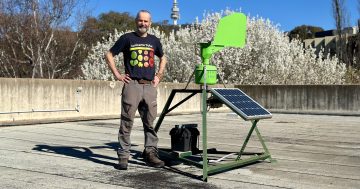
Dr Simon Haberle is in charge of the Canberra Pollen Monitoring Centre – and he says this spring could bring a “cocktail” of pollens. Photo: James Coleman.
It’s looking like it’ll be a rough start for hay fever sufferers this spring, but relief could be on the horizon.
That’s the message from Professor Simon Haberle, director of the Canberra Pollen Monitoring Centre at the Australian National University (ANU).
He says a “cocktail” of different pollens is on the cards this spring.
When asked what it means for hay fever sufferers, Professor Haberle says it depends on the climate.
“There’s good and bad in this scenario,” he tells Region.
“This coming season – because it’s forecast as being an El Niño period – we anticipate that the grass pollen in particular will be average or below average.
“That’s good news for Canberrans … there could be quite a bit of variability.”
Professor Haberle says there could be an early peak to the circulation of grass pollens this spring.
“This year there’s a forecast for El Niño, which I think will not only bring warmer temperatures but much drier periods as well.
“We anticipate that the grass growth period will probably be stronger (early on) but the grass will die off fairly early – potentially it will reduce the impact of grass-related hay fever.”
That could mean life gets easier for hay fever sufferers and asthmatics as the year goes on.
“What we are anticipating, given the warmer temperatures … [is] that there’ll be a strong burst of grass pollen that usually starts in that last week of September to early October,” he says.
“That’s the pollen that most people suffer hay fever symptoms from.
“That could be a bit early, but we’re waiting to see what the data tells.”

Ryegrass is among the plants releasing pollen as the weather warms – and it can blow “from many tens of kilometres away into the city”. Photo: Damien Larkins.
The bush capital is also affected by “a lot” of tree pollen, including cypress pine, birch, casuarina and “a whole range of other tree types”.
Most trees will start to flower in the coming weeks, though some, like pinus and cypress pine, have already begun (you can thank them for the yellow dust on your car over the past few days).
Professor Haberle says that their pollen production is expected to continue until summertime arrives.
“Even though we’ve got a drier period, the tree can continue to produce a high degree of tree pollen,” he says.
“Unlike the grass, they don’t tend to dry off … [They’ll release] quite regular and large amounts of pollen. They’re less impacted by La Niña and El Niño, relatively, than the grasses.”
Professor Haberle predicts there will be an “average or perhaps below average risk” of Canberra recording ‘extreme’ pollen amounts this spring.
“The worst days – the most extreme pollen days – are when we have strong northwestly or westerly winds coming into Canberra.
“That’s when we see these big extreme days when people start to suffer and feel the effects of hay fever.”
Canberra Pollen posts information to its Twitter/X page on daily pollen counts and forecasts for Canberra.