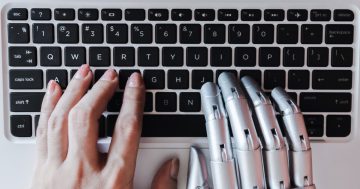
Australia needs to be able to defend itself against the dangers of AI, warns the Australian Signals Directorate. Photo: Phonlamai Photo.
Australian Signals Directorate director-general Abigail Bradshaw has called for an “early warning system” to protect the nation against the potential harms of artificial intelligence.
There are too many AI bot agents on the internet to calculate and organisations would have to spend “enormous” amounts to update vulnerable tech systems to effectively counter them.
But AI should be embraced because of its defensive capabilities to protect the nation.
Speaking at the Australian Strategic Policy Institute’s (ASPI) Sydney Dialogue in Canberra this week, Ms Bradshaw said Australia had to be in a position to defend itself against this powerful technology.
But that power could and should be used to Australia’s advantage, if protections are put in place now.
“What we are missing at the moment, which we have in a cyber context but we don’t yet have it formalised in an AI context, is an early warning system,” she said.
Collating and analysing individual AI ‘incidents’ would help identify where future risks lie.
She said Australia’s defenders needed capabilities similar to those available to cybercriminals and state-sponsored attackers from overseas.
More than a thousand employees of leading AI companies recently called on the US Government to slow down the development of the technology.
But Assistant Science Minister Andrew Charlton told the ASPI conference that Australia had to drive its own response to AI.
“I am not in favour of leaving it to the companies, and I’m not in favour of leaving it to the superpowers,” he said.
It comes as OpenAI vice-president of global policy, Ann O’Leary, said her company was open to working more closely with Australia.
OpenAI wants to train its AI models here, but is concerned about the Federal Government’s insistence on protecting local copyright.
“We are deep in conversation with the Australian government about these questions,” she said.
“You have caught our attention.”
Those comments led Nationals leader Matt Canavan to label them blackmail and said Australia should not take the bait.
“I don’t think we should negotiate with people who want to blackmail us like this,” Senator Canavan said during a media interview on Tuesday (15 September).
“A whole reason we want to potentially house these models is that we would be partnering with what has been a friend or an ally, and I don’t think friends or allies make these kinds of threats.
“I don’t think OpenAI will get very far with such rhetoric or language. We should protect Australian copyright.
“We should protect Australian artists. That should be non-negotiable.”
But Deputy Prime Minister Richard Marles downplayed the suggestion that OpenAI is threatening to cut investment in Australia over the copyright issue.
“We do want to see our country take this opportunity,” he said.
“It’s a historic opportunity for our nation, but we need to be doing it in a way which protects rights holders, and that means news organisations; it means creatives, but actually, I think you can do both.”
The Greens are insisting Labor does not give in to international demands to weaken the rights of Australian creators.
“A weakening of copyright laws, letting big tech take the work of Australians for free; it’s just abhorrent,” Greens senator Sarah Hanson-Young said.
“It shouldn’t even be a question, but clearly there are some within the Albanese Government who are not being as strong as they should be.
“Why on earth would the Albanese Government even entertain the idea that big tech and AI could get that for free?”
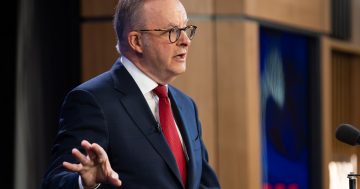
Anthony Albanese joined the debate by the end of Tuesday, saying his government was working closely with frontier AI companies for Australia’s benefit.
“We do that by making sure AI works in Australia’s interests, because AI is not neutral,” the Prime Minister said.
“And we must make sure that we use the capacity that we have to ensure that artificial intelligence reflects Australian values; that it works for people, that it enhances rather than undermines our democracy.
“That it helps to build our future economic resilience and backs our jobs, that our creative industries are protected, and that the process of using AI is not high energy bills or gas or water.”