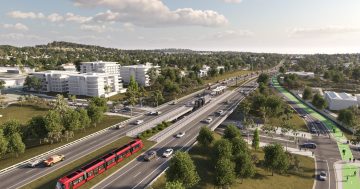
The Woden roundabout and surrounds are set to become a new high-density neighbourhood. Photo: ACT Government.
Sometime in the 2030s or 40s, one of Canberra’s best-known traffic landmarks and its northern approaches will be transformed into a new high-density, mixed-use neighbourhood serviced by rail, road and bus, and connected to bike and pedestrian paths.
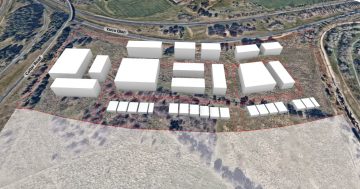
Dubbed North Woden, it will extend the Woden Town Centre and comprise unleased land within and around the current large roundabout at the junction of Yarra Glen, Yamba Drive and Melrose Drive, which has kept traffic flowing for almost 60 years.
The Suburban Land Agency says the North Woden Development Opportunity has reached a critical stage, and it and the City and Environment Directorate are seeking a consultant to conduct a feasibility study into the ambitious plans.
The tender documents reveal the scale of the plans, the challenges involved, including flood-prone Yarralumla Creek, and how the light rail route through North Woden is far from settled.
The Woden roundabout is already slated to become a signalised intersection as part of light rail Stage 2B, but plans for development of the land are less well known, and may be a surprise for north-facing residents in nearby apartment towers.
A fly-through of how the new Yarra Glen intersection might work, released as part of the Light Rail Stage 2B draft Environmental Impact Statement last July, does not show any development.
The SLA’s vision for the area sees the roundabout “replaced by a new neighbourhood centred on an enhanced and flood-resilient Yarralumla Creek; through traffic bifurcated and slowed, creating a pedestrian-friendly public domain that knits Curtin and Hughes together; and an attractive mixed-use district providing a high-amenity environment for living and working”.
To achieve this, it is proposed that Adelaide Avenue and Yarra Glen be “humanised” as a multi-modal boulevard, with bus and light rail stops, an interchange, residential and commercial development, and walking paths.
“It is intended to create a high-amenity environment with walkable grid public domain network, within an urban town centre and along a flood-resilient Yarralumla Creek,” the SLA’s character statement for North Woden says.
It doesn’t say how high the buildings will be, but the fact that North Woden will be part of the Southern Gateway, within the Town Centre, and that the development is mixed-use, indicates it would not be low-rise.
The feasibility study will need to consider transport impacts, light rail Stage 2B, Yarralumla Creek, and the Southern Cross Club’s high-rise residential precinct under development on the former pitch’n’putt land on the roundabout’s south-eastern flank.
The North Woden site was the scene of Canberra’s deadliest flood disaster, which claimed seven young lives in 1971, so mitigating the flood risk will be vital to establishing a new neighbourhood there and securing the transport corridor, including the light rail line.
This is to be achieved through targeted improvements to the channel by reshaping, naturalisation, and lowering the riparian zone, and by increasing the waterway area, the feasibility study brief says.

The extent of the North Woden development area. Image: ACT Government.
The new neighbourhood will be based around transport options and require changes to the road network and traffic flow, as well as new paths.
This will require a connection between Yamba Drive and Melrose Drive, and with Yarra Glen in an “efficient manner”.
The successful consultant will investigate the options for doing this and the cost.
Development options will also need to provide “good accessible links” to the proposed light rail station and route.

The study brief indicates that the light rail route through the North Woden area depicted in the LRS2B Project Environmental Impact Study is not fixed.
“The SLA is working with iCBR and other areas of government to investigate LRS2B Project routes through the North Woden area,” it says.
“The consultancy will be involved in providing key design information to support the investigation and potential adjustment of the LRS2B Project route shown in the EIS to enable the ACT agencies to collaboratively agree on the route that meets all agencies’ objectives.”
The tender has been released as an Expression of Interest, from which the government will select three or four suppliers to proceed to a second-stage Request for Tender (RFT).
This EOI will close on 16 April 2026, with a shortlist expected to be identified by 30 April, a tender issued in early May, and a contract awarded in July.