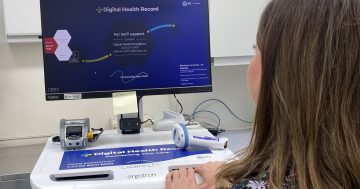
It’s been four years since the ACT Government began rolling out the Digital Health Record, but Opposition Leader Mark Parton says new questions are cropping up. Photo: Lottie Twyford.
Recently, the government wanted a good-news day: more Canberra GPs would be linked to the Digital Health Record. Patients would get better continuity of care. That part is welcome. Doctors should see the public hospital story behind the person.
What the government did not want was the other half of the week: a contract it cannot explain, a cabinet process the Auditor-General (and now a committee report) has now put in doubt, and a public service at the top in transition with two heads of directorates resigning in the span of a week.
That is not a communications glitch. It is what dysfunction looks like when a government has been in power so long it treats scrutiny as an inconvenience.
The Auditor-General previously found the then ACT Health Directorate’s procurement and invoicing controls on the Digital Health Record hosting contract were weak. Invoices were paid without work orders or purchase orders. Documentation of what had actually been delivered was inadequate.
More than $16 million in consumption-based payments under the NTT DATA Business Solutions (NTT) arrangement lacked reasonable assurance that the services were received, or that the correct price was paid. The deed started at $66 million. It grew to $110 million.
That is not sloppy filing. It is a system that spent public money and then could not prove what it bought.
The Public Accounts and Administration Committee has now said that failure could point to a larger pattern of mismanagement across the DHR project.
The former Auditor-General went further.
The more important issues, he said, are the governance of the overall project, how it was put together, and the information provided to cabinet.
The invoicing failures are significant.
“From the information that we have available to us so far, the more important issues go to the governance arrangements that apply to the overall project, the way in which it was put together and the way in which the information was provided to cabinet … there are more significant things to come,” then ACT Auditor-General Michael Harris told the Standing Committee on Public Accounts and Administration (13 October 2025, p 16).
Read that again. The independent umpire is not only saying the paperwork was a mess.
He is saying the story ministers may have been given is the bigger problem.
So, when the story and numbers that reach cabinet cannot be trusted, that is not a technical defect. It is deception by omission, a cleaned-up blowout dressed up as a managed project.
Cabinet is supposed to be where ministers see the real cost before they own it. The government’s own Handbook says papers must state the Budget impact for years ahead, and that Treasury must assure those figures before a paper is lodged. It says ministers must not commit expenditure without cabinet authority.
If claimed savings rose as costs rose, as the former Auditor-General described, then cabinet was not being asked to decide. It was being asked to nod.
That is chaos with a letterhead. Health cannot acquit the invoices. The project cost almost doubles. The offsets move to keep the books looking tidy. The new minister spruiks a slow DHR Link expansion and says nothing about the report that landed the afternoon before. The Head of Service, the Cabinet Secretary who sits in the room and signs the decisions, turns over in the same week.
Labor calls this delivery. It is a government talking over its own wreckage.
Canberrans are entitled to ask a blunt question: what else is this government hiding?
We do not need to pretend DHR Link is the enemy. Sharing records with consent is good policy. Announcing that expansion while burying the contract record is bad government. A ministry that cannot produce a work order should not get a standing ovation for a portal.
The next test is documentary, not rhetorical. When was cabinet told the NTT deed had grown to $110 million? Were the benefits inflated as the costs inflated? When will the further work on DHR governance be made public? If those answers are clean, table them. If they are not, stop calling silence with “nothing to see”.
This city has watched procurement fail in more than one directorate. Operation Kingfisher was a different contract. The lesson is the same.
Process is how the public knows a government paid for what it received and decided on what it was actually told. When that process breaks, you do not get reform. You get another announcement, another excuse, and another week of hoping nobody reads the footnote.
Better care and honest cabinet papers are not competing goods. A government that wants credit for the first and darkness for the second is not misunderstood.
It is asking Canberrans to trust a system that has already shown it cannot tell them the truth.
Mark Parton is the leader of the Canberra Liberals and Leader of the Opposition.