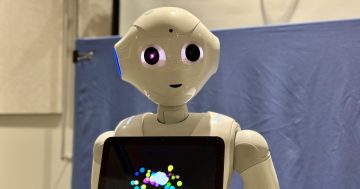
University of Canberra PhD researcher Nipuni Wijesinghe is developing a framework to help robots understand context and adapt their behaviour in different social settings. Photo: Supplied.
A human walking into a library instinctively lowers their voice. Put the same person in front of a crowd to give a speech and they will speak louder, move differently and command the room.
A robot, however, may not know the difference.
It might be perfectly capable of completing the task it has been programmed to do, but understanding where it is, what is happening around it and how it should behave is another matter.
University of Canberra PhD researcher Nipuni Wijesinghe is trying to bridge that gap by developing a framework that could teach robots something humans largely take for granted – how to read the room.
“Robots these days … have a static social presence,” Ms Wijesinghe said.
“They don’t know where they are in. They don’t get the context, so they behave in the same way using the same volume, same voice, and same movements.”
Her work recently earned her $2000 as runner-up in a research pitch competition, where she challenged audiences to think beyond whether robots can successfully perform a task to whether they can understand the people and environment around them.
The distinction could become increasingly important as robots move out of factories and warehouses and into hospitals, aged-care facilities, classrooms and workplaces.
Ms Wijesinghe, from the Faculty of Science and Technology, is part of the University of Canberra’s Collaborative Robotics Lab, where engineers work alongside researchers from psychology, design and other disciplines.
Conversations between those different fields helped shape her research.
Humans continually adjust their behaviour according to their surroundings, often without consciously thinking about it. Ms Wijesinghe wants robots to eventually be capable of making similar adjustments.
Her aim is not to develop the intelligence for one particular robot, but rather a general framework that could eventually be incorporated into different types of machines.
“So it could be a healthcare robot, or it could be a care robot in aged care, or it could also be like a companion robot … or even in a classroom,” she said.
The consequences of getting the context wrong can range from socially awkward to potentially serious.
Ms Wijesinghe gives the example of a robot assisting during surgery. It might know precisely which instrument it is supposed to hand to a surgeon and when. But if something unexpected happens, a human nurse can recognise that the situation has changed and react; a robot trained simply to follow its instructions may continue doing exactly what it was programmed to do.
“Robots will just follow whatever they’ve been trained on doing. They don’t know how to adapt,” she said.
“Even though something has gone wrong there … that could mean the life and death of that patient.”
Another example is an aged-care companion robot.
If a fire alarm suddenly sounded, a context-aware robot could recognise that the environment had changed, alert the person it was assisting and respond accordingly. A machine focused only on its routine task might not understand the significance of the alarm.
For Ms Wijesinghe, the challenge is particularly important because completing tasks may not be enough for people to accept robots into their everyday lives.
Trust will matter. “If there is a gap in trust or if people are not trusting robots, then … even though the robot is performing all these tasks perfectly, it’s not going to end up well,” she said.
“So far we’ve been so fixated on making sure the robots do all these tasks very well, we’ve forgotten about the social aspect.”
She expects interactions between people and robots to become far more common over coming decades, making it important to solve these problems before robots become commonplace in social environments.
Her proposed framework essentially asks a robot to do three things: sense what is happening around it, identify the context from that information, and then change its behaviour accordingly.
The first requires sensors – effectively giving the robot its own ways of seeing and hearing its surroundings.
The second is teaching it to interpret those signals. Ms Wijesinghe has already developed an audio-based system designed to identify context.
Once the robot knows what kind of situation it is in, the third stage – which she calls “adaptive presence expression” – determines how it should behave. That could mean changing its voice, movements, head position or the way it navigates through a space.
But there is another complication: humans don’t all respond to robots in the same way. “What one human likes will not be what another one likes,” Ms Wijesinghe said.
Her framework therefore incorporates human feedback so a robot’s behaviour can continue to change. Her research uses people’s eye gaze as one indication of whether they are paying attention to and engaging with the robot.
The individual parts of the research have already been developed and tested, and Ms Wijesinghe said her work on the context module, framework and adaptive behaviours had been peer reviewed and published.
Now in the final year of her PhD, she is working to bring those components together into one end-to-end system that can be tested with people and, ultimately, used across different robots.
She hopes to complete the research next year. For all the technology involved, the problem she is trying to solve is remarkably human.
We don’t simply listen to what somebody says or watch what they do. We notice where we are, what is happening, how others are reacting and change our behaviour accordingly.
If robots are going to work beside us, Ms Wijesinghe believes they will have to learn to do something similar.
Because the robot of the future may know exactly how to do its job. The harder challenge will be teaching it how to behave while doing it.