15 April 2026

What happens with light rail on other side of Parliament House matters too, says residents group

| By Ian Bushnell
Join the conversation
42
Light rail vehicle parked at Alinga Street station

Light rail to Woden will mean big changes around Parliament House. Photo: Michelle Kroll.

While most of the attention on Light Rail Stage 2B has been on if or how the line will run from Commonwealth Avenue to State Circle, the Deakin Residents Association is highlighting issues on the other side of Parliament House that may be slipping under the radar.

On Sunday, 26 April, the DRA will conduct a walking tour of areas that will be impacted by the preferred State Circle route, which Transport Minister Chris Steel recently doubled down on.

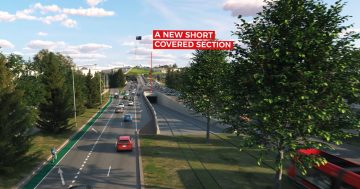
The DRA says few realise that the State Circle route includes a cutting through the Parliament House bushland to the top of Adelaide Avenue, where a new set of traffic lights on State Circle will be installed, which will add to southbound delays on the key thoroughfare.

READ ALSO Light rail faces another test in the 'Valley of the Shadow of Death' on Adelaide Avenue

DRA president George Wilson said preceding this would be another set of lights on State Circle where the line leaves the roadway, impacting traffic headed for the city.

He said what had been proposed for the western side of Parliament House had been largely ignored.

“They’re going to have to move a huge pile of dirt, dig up the whole system,” he said.

“It’s virtually a cutting that has to go through there to get from the road level on State Circle to the road level on Adelaide Avenue.”

That would mean a lot of trees to be bulldozed in one of the key features of the award-winning design for Parliament House, Dr Wilson said.

“There’ll be one set of traffic lights for vehicles travelling east on State Circle and another one for vehicles travelling south on Capitol Circle, which is the inner one just before it joins the top of Adelaide Avenue,” he said.

“The last thing we need is a build-up of traffic right back around Capital Circle.

“There’s absolutely very little knowledge of what has been planned, and very little understanding of the damages to the most important building in the nation or the environment of the most important building in the nation.”

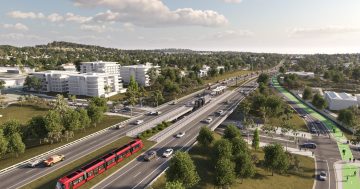
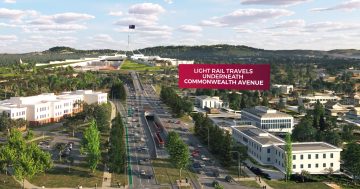
This illustration from the Stage 2B EIS shows the cutting and traffic lights to be installed. Image: ACT Government

Dr Wilson said light rail would always be a slower journey time from Woden to the city, but this was likely to increase travel times further.

He said once the line meets Adelaide Avenue, a new bridge would need to be built across State Circle, followed by another bridge down the avenue over Hopetoun Circuit, and then overbridges and bridge adjustments at Kent Street and Carruthers Street.

“The amount of engineering works that’s involved in this is just mind-bending,” Dr Wilson said.

“It’s not like the route to Gungahlin, which was through basically empty land.”

The DRA estimates that these works will push the project’s cost to $6 billion or $7 billion.

It has always taken a position against building light rail to Woden on cost grounds, arguing instead for electric buses and a cycleway, and that autonomous vehicles will supersede fixed technology.

Dr Wilson said it was old technology and the densities required to support it would never exist along the route.

“There are only three tram stops in Deakin, and most of them are hundreds of metres away from where people live,” he said.

“The idea that you can develop Adelaide Avenue the way they’ve developed Northbourne Avenue is nonsense.”

The DRA had no preference for either route, they both ended up with the line going down Adeliade Avenue through Deakin.

READ ALSO Inside the plans for new light rail tunnel

Dr Wilson said the idea of the walk was to allow the community to gain a greater understanding of exactly what was being proposed and the impacts.

“If people want to find out more about it, then we’ll be drawing to their attention what is proposed because we think it’s completely untold at the moment,” he said.

Two walks are on offer, starting at Surveyors Hut at 10 am. One is a shorter return route of about 1.5 km to the area proposed for traffic lights at the top of Adelaide Avenue, with associated tree loss near The Lodge, and the other is an extended walk of about 3 km, continuing around the Parliament House perimeter bushland.

To confirm attendance and take a short survey, visit Google Docs.

Free Daily Digest

Want the best Canberra news delivered daily? We package the most-read Canberra stories and send them to your inbox. Sign-up now for trusted local news that will never be behind a paywall.
Loading
By submitting your email address you are agreeing to Region Group's terms and conditions and privacy policy.

Join the conversation

42
All Comments
  • All Comments
  • Website Comments
LatestOldest

Can ratepayers just get clear costs for Light Rail projects in Canberra. We regularly just receive the single Construction contract price that doesn’t include all the other associated costs like groundworks, design, environmental studies, legal, security, compliance, additional infrastructure, borrowing costs, etc etc. These likely total more than the quoted construction contract price. Detailed data would help both supporters and naysayers more accurately outline their case.

The other week Chris Steel couldn’t even provide a cost breakdown for the Woden CIT and Bus/Rail Interchange because he said he couldn’t separate the costs. It’s Project Management and Budget Management 101 to be able to understand where your money, time and effort is being spent.
It’s no wonder Mr Steel has overseen a range of budget blowouts and failed projects if he’s not being provided with accurate information to make informed decisions.

And, while you’re at it, the same for the roads budget, include all the other associated costs you outlined above.

Astro,
If the government is proposing major road upgrades, yes they should provide the same figures and business cases.

I’m glad you’re on board with the transparency, this is a big change for you.

Maybe we could also see some options studies and proper economic assessments as well?

What do you think?

It’s odd though, isn’t it, that many of those commenters jumping up and down about cost-benefits on rail are very quiet about the same for roads.
And, no, I haven’t made any changes regarding normal reporting processes for government spending.

Who are these commenters that are quiet around the cost benefits for major road upgrades?

Have there been any proposals recently that need to be looked at?

Hard to be noisy when there’s no reporting on them.

As for “normal reporting processes” of government, on the issue of light rail, “normal” has been avoidance and secrecy.

I’d prefer transparent and open.

“Who are these commenters…?” Well, to start with, the Deakin residents’ association and fellow travellers. You can join them on their walk (which is what this article is about). You’ll be right at home. There’ll be much harrumphing and pearl-clutching, including exposing the devastation wrought upon the environmentally pristine 6-lane Adelaide Ave by the light rail. There’ll also be periodic genuflecting to Saint Stanhope (that bitter old foe of the Chief Minister) and Bishop Ahmed, his prophet of Fiscal Doom in the ACT. Have a lovely walk.

C’mon Astro,
That’s an extraordinarily weak and emotional piece of whataboutism and avoidance.

Which major road upgrade projects have they been silent on?

Or you could just admit you made up a false equivalence because the logical impact of your own statements outlines the paucity of evidence that’s been provided to support the light rail project.

Oh, no, not the sacred Cow. Or should that be Ivory Elephant?

I think we can agree that both road and rail transport should have costs and benefits adequately assessed and reported on. There’s nothing ‘falsely equivalent’ about that.

So thats a no, you can’t provide examples. OK.

But yes, all major public infrastructure projects should be assessed in line with best practice.

Don’t think you’ve quite got it but you’re getting a bit closer. Road costs and rail costs both need to be reported. Equally. That’s pretty clear. Many commenters seem all to keen to call for scrutiny of rail but not of roads. If you want an example of this then you can start with the post I was responding to originally and then work your way through other posts on this thread or other threads on the same topic.

Seems like you’re getting further away from it.

You’ve made a claim that you can’t back up with any examples.

Because your point is a made up piece of whataboutism to distract from the legitimate scrutiny that is facing the light rail project.

Its OK, you can just admit you support light rail no matter what the evidence actually shows. At least that would be more honest than the mental gymnastics you’re trying on here.

If you want more scrutiny on major road projects, I’m happy to support you when they are announced or reported on.

Each light rail set carries more than seated passengers. They are configured for about 140 standing passengers, additional to the 66 seating capacity. It is reported that there are 14,000 boardings each weekday on Stage 1. Not all these passengers would revert to buses if the light rail did not exist, as buses have less than 1/3 the capacity of a light rail set.
My guess (from observation) is that cars carry an average about 1.25 passengers per trip. If buses could carry half the boardings of the light rail, per weekday, the remainder would travel by car, so 5,600 car trips per weekday. That’s a lot of vehicles off the road, just for stage 1

I for one am looking forward to a smooth easy trip to Deakin shops from Lyneham. I’m always suspicious of people calling light rail old technology just because the concept was invented over a hundred years ago, just like a bus. Or a train. Or a plane. As for the $6 billion cost, he’s pulling it out of thin air.

The more we find out about the detail of getting LR to Woden, the more this is becoming a lemon that the government should abandon.
While I strongly prefer to ride on a trains as opposed to a bus, this project makes no logical sense. It doesn’t move people from A to B, quickly and the cost is extraordinary for no real purpose. 🤷‍♂️

Triple rates is nonsense

Daily Digest

Want the best Canberra news delivered daily? Every day we package the most popular Region Canberra stories and send them straight to your inbox. Sign-up now for trusted local news that will never be behind a paywall.

By submitting your email address you are agreeing to Region Group's terms and conditions and privacy policy.