30 August 2026

Who pays to charge the car? Canberra apartment blocks grapple with the EV question

| By Naziya Alvi Rahman
Join the conversation
23

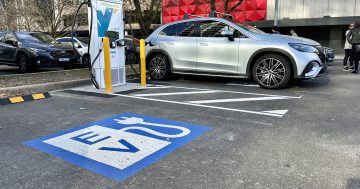
Who should pay for the charge and the charger isn’t an easy question. Photo: James Coleman.

A resident in a Canberra apartment complex had been plugging their electric vehicle into a common-area outlet, effectively sharing the electricity bill with everyone in the building.

Other residents noticed. Complaints followed, and eventually the body corporate pulled the plug.

But that solved only one problem and created a much bigger question: as more Canberrans buy electric vehicles, who should pay to make apartment buildings ready to charge them?

The issue recently sparked a lively discussion in a Canberra community group after a resident said their owners corporation was now considering installing a proper communal EV charger.

The resident stressed they were hardly anti-EV – they hoped to own one themselves one day – but questioned why people without electric cars should contribute towards infrastructure predominantly used by those who had them.

“If the EV owner wants the convenience, the installation and associated costs should be covered by the owner,” the resident argued, also questioning whether scarce visitor parking should be given over to charging bays.

Canberrans, it turns out, have plenty of opinions on the matter.

Some community members firmly backed a user-pays approach. One said owners in their complex could install chargers in their allocated parking spaces at their own expense. Another argued it was unfair to expect the body corporate to pay for installation and maintenance.

Others saw a communal charger more like a gym or another shared facility – something not everybody uses, but which can add value to the building.

And several Canberra complexes appear to have already found a middle ground: share the cost of getting the infrastructure in place, but make EV drivers pay for the electricity they use.

READ ALSO New register reveals exactly which Canberra apartments support EV charging

One resident said their building had operated that way successfully for three years. Another said chargers had been installed in common-area bays with individual users paying for their power.

At another complex, technology has even taken care of the potentially awkward question of whose turn it is. Residents book a charging bay through an app and pay individually.

“This system works very well,” the resident said.

So, if Canberra apartment dwellers are already trying everything from private chargers to communal bays, which model is winning?

There isn’t one.

Alex Boundy, general manager – facilities at Civium, said the answer often depended on the building and how many residents actually owned EVs.

Some owners corporations fund common infrastructure. Elsewhere, individual owners pay to install chargers in their own allocated spaces. A third option splits the bill: the owners corporation pays for the electrical “backbone”, while residents pay for the equipment needed to connect their own parking spaces.

Mr Boundy said when an individual owner funded a charger, it was installed in their allocated parking space.

For buildings where interest was starting to grow, he said the sensible first step was to work out what was technically possible, take the options to owners and gauge demand before spending money.

And the communal charger may not necessarily be the future many imagine.

Mr Boundy said shared chargers were becoming less common as EV owners increasingly used slower “trickle top-up charging” at their own parking spaces rather than relying on a small number of common chargers.

What is becoming more common is the conversation itself.

“The demand is linked to EV ownership uptake which is on the up, partnered with more Canberrans living in apartments than previously,” Mr Boundy said.

“It certainly is par for the course now with regard to talking vehicle charging within apartment buildings.”

Is it as simple as finding a spare outlet? Hardly. While that initial shared-socket approach offered an easy fix, building power is not a free-for-all resource.

Worried your ads are hitting the wrong crowd? Let’s fix that

An ACT Government spokesperson said those power points are managed by the owners corporation under the Unit Titles (Management) Act, and corporations can introduce rules governing their use.

That doesn’t necessarily mean an existing outlet is off limits forever. Devices are available that can measure how much electricity a resident uses and ensure they pay their share – potentially removing one of the biggest causes of neighbourly irritation.

Installing a dedicated charger requires another step.

Whether it is going into an owner’s parking space or onto common property, the installation must be approved by the owners corporation through a special resolution. The government says that permission cannot be unreasonably withheld.

If the charger is connected to the building’s common electricity meter, there should also be a mechanism for the EV owner to repay the corporation for the electricity they consume.

The bigger challenge is avoiding a situation in which every new EV owner arrives with a different proposal, leaving the building with a patchwork of chargers and electrical connections.

The ACT Government is instead encouraging apartment buildings to think ahead and become “EV ready”. In simple terms, that means installing the shared electrical backbone needed to reach every apartment’s parking space. Residents can then add and pay for their own charger when they eventually buy an EV.

For new Canberra apartments, some of that future planning is already built in. Since September 2024, new multi-unit developments have been required to provide EV-ready infrastructure to every residential unit’s car space.

Older buildings face the harder task of retrofitting infrastructure that was never designed to accommodate dozens of cars plugging in overnight.

“Owners corporations can seek free building-specific advice through the ACT Government’s Sustainable Apartments Program, while interest-free loans for EV-ready infrastructure have also been announced and are due to launch,” the spokesperson added.

Which brings the debate neatly back to where it began: one car, one communal power point and a few neighbours wondering why they were helping pay the bill.

The extension cord may have been unplugged, but the question it sparked isn’t going away.

As more Canberrans switch to EVs – and more call apartments home – body corporates will increasingly have to decide whether charging infrastructure is a private convenience or simply the next thing a modern apartment building needs to be ready for.


Free Daily Digest

Want the best Canberra news delivered daily? We package the most-read Canberra stories and send them to your inbox. Sign-up now for trusted local news that will never be behind a paywall.
Loading
By submitting your email address you are agreeing to Region Group's terms and conditions and privacy policy.

Join the conversation

23
All Comments
  • All Comments
  • Website Comments
LatestOldest

We wouldn’t be having this debate at all if we didn’t have electric cars

We wouldn’t be having this debate at all if we didn’t have internal combustion cars.
And you can’t say that the petrol car was already here, because we had viable electric vehicles before we had viable internal combustion engines.

I’d have thought that the simple answer would be to fit a 10A or possibly 15A outlet in each parking space and connect it to that persons individual electricity meter. Perhaps either have it switchable from inside the home or fitted with a key lock so only the particular resident can use it.

If they want faster charger then they have to pay as any homeowner does.

A Nonny Mouse8:04 pm 06 Oct 26

That would be ideal and has been done where it is not a very long run of cable to the distribution board of the individual units. In many buildings, it is simply not practical to bring multiple additional cables through service ducts from 8 floors above. Then you have to do something from a common property supply.

Which apartment will have the first fire

Steven Green8:39 am 01 Sep 26

EVs are much less likely for catch fire that ICE vehicles.

Electric vehicle facts | energy.gov.au https://share.google/YMrqDmWw8WAp6RqI5

A Nonny Mouse11:59 am 31 Aug 26

The ACT branch of the Australian Electric Vehicle Association (AEVA) maintains a list of ‘EV Friendly Strata’ in the ACT. We do this for several reasons:
1) It illustrates the diversity of solutions that have been implemented at different sites. The best option for one site might not be the best way to do charging at a different site. Some can easily wire back to the distribution boards of individual units while others might have no choice but to use common property supplies. There are different ways to do load management to avoid adding to a site’s peak electricity demand. Some owners might prefer to have an interim solution while EV numbers are low with a plan in place for when numbers increase, while others might want to jump straight to their ultimate charging solution.
2) It could be a useful resource for people who own an EV or expect to own an EV who are looking to buy or rent a unit.
3) It provides ammunition for anyone facing pushback from owners claiming that it is all too hard.
To see the listing, search for AEVA and ‘act-ev-friendly-strata-complexes’. Please contact us via that page if you know of a site that we could add.

We live in an apartment complex, and the issue of EC charging has been raised.

More chance of snow at the equator, I think.

The shared cost to retrofit an existing building, for the benefit of a minority, is hardly likely to happen.

Even the concept of a dedicated bay within the complex is difficult. Firstly, assuming there was a means to charge the electricity to the apartment owner’s account was possible, getting access to that charger could be very frustrating if there were more than a couple wanting to use it. The other issue of course is space. Generally, apartment basements don’t have spare space. That space would have been sold as part of an apartment allocation eg 222 apartments sell for more than 221 do.

It’s a similar issue with funding externally space.

Is it reasonable that taxpayers foot the bill? I can’t see too many home owners being prepared to wear the cost of higher rates to fund what is effectively private EV charging in apartments.

I’m not opposed to EVs, but realistically if you move into an apartment complex, and you buy an EV, well prepared to use a public charger. There won’t be any free lunches.

You’d think that would be the case.

However, we own a unit in a complex where a single owner took the entire owner’s corporation to ACAT and then court to force us to pay to retrofit automatic doors.

The complex was never sold as accessible and yet one owner had the rest of us over a barrel. So, our body corporate fees went up accordingly to fit the automatic doors to common areas.

I can see the same thing happening for communal EV chargers

A Nonny Mouse11:44 am 31 Aug 26

Depending on the layout of a strata site, the owners might approve a plan for the incremental addition of charging as required. I agree that shared faster chargers are less convenient than slower charging in one’s own allocated parking space. However, a shared charger could be a reasonable interim measure while EV numbers are low, with a plan to add individual charging once numbers exceed some threshold. The sinking fund could start saving for that so it is not too much expense in any single year.

You can buy a ‘charger’ (EVSE) off amazon for under $300, which you can charge a car from a 10-20amp outlet.
The speed to recharge is given by the charger (which is installed in the car).

The magical thing the charger does is disconnect the mains AC power. It does that to stop sparks when you pull the plug and reduce plug contact wear..
Its designed by americans that don’t have switches on their outlets. Its amazing they get this expensive.

Crime n Punishment1:29 pm 29 Aug 26

Oh boy! It’s amazing this got published.

The device does much more than act as a ‘switch’. It regulates the supply, has thermal load detection and residual current detection.

It’s ‘expensive’ exactly because it does far more that ‘switch’ power off and on.

Andrew Everard3:43 pm 29 Aug 26

Hi Henry, I think what you’re describing is a trickle charging cable. It plugs into a standard 10 Amp power point (unless you have a 15A circuit which would be unusual). Hence the dispute about people using common power points in the basement parking area.

Trickle charging (some people call it granny charging) will only charge your car at 1.8 Kilowatts which will not give you a full charge overnight. Many people want a specialised car charging wall-box installed which will deliver 7KW (or 22KW if you have 3-phase power, also unusual) which gives overnight charging.

The cost is mainly about the safety features of the cable. You can pull the plug end out of the socket without turning off the power first even with a switched outlet. But please don’t. You should disconnect at the car end (there will be a button on your key fob, on the dashboard or on the car’s app).

You can buy the same thing from Bunnings for a similar price. If you buy online make sure you get an Australian approved model. Do NOT buy one with an overseas plug and use a travel adapter.

Daily Digest

Want the best Canberra news delivered daily? Every day we package the most popular Region Canberra stories and send them straight to your inbox. Sign-up now for trusted local news that will never be behind a paywall.

By submitting your email address you are agreeing to Region Group's terms and conditions and privacy policy.