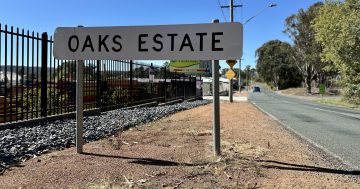


Oaks Estate was originally part of Queanbeyan until 1911, when it was decided the ACT’s borders would follow the Queanbeyan rail line. Photo: James Coleman.
“How much budget money do you need to replace a wobbly handrail on some stairs?”
That’s the question residents of Oaks Estate are asking, even as the ACT Government releases a five-year plan aimed at addressing “community safety” issues in what’s been dubbed “Canberra’s forgotten suburb”.
Oaks Estate is tucked between the Queanbeyan railway line and the Molonglo River, and was originally part of Queanbeyan until the ACT borders were drawn in 1911.
Technically, it’s part of today’s Kurrajong electorate – alongside inner-south suburbs like Ainslie and Braddon – but its isolated location has led to issues over the years with poor public-transport connections, slow emergency-service response times, and few upgrades to infrastructure like roads, footpaths and public buildings.
For instance, the metal handrail along the Queanbeyan River heritage walk has been flagged as unsafe for years, yet no action has been taken.
But the government’s newly tabled Oaks Estate Strategic Plan 2025–2030 promises to change that and finally make the suburb – home to more than 300 residents – a “safer, healthier, and more connected place to live”.
Developed over two months of community consultation, the plan aims to address issues around traffic safety, the lack of signage and footpaths, open antisocial behaviour, roaming dogs, and the high proportion of public housing – up to 47 per cent of the suburb – much of which is considered not fit-for-purpose.
“The noise (loud music, yelling, fights) has been traumatic for myself and my family, the violence with weapons (guns, hammers, machetes) is frightening, and the high traffic of drugs is disturbing,” one resident wrote to the government.
Independent Kurrajong MLA Thomas Emerson, who joined forces with the Canberra Liberals and ACT Greens earlier this year to pressure the government for the plan, welcomed its release.
“Today is a good day for Oaks Estate,” he said.
“Residents will be relieved to see the ACT Government acknowledging the unique challenges they’re facing, and not fobbing them off to Queanbeyan.”
However, Mr Emerson criticised the plan’s “future budget processes” for failing to specify many of the key actions to be taken.
“After decades of neglect, residents deserve confidence that there will be real follow-through for Oaks Estate.”
The plan will “explore opportunities” to not only install new handrails along the river walk, but also upgrade footpaths, improve bus services, clean up public green spaces, facilitate better access to the Oaks Estate Community Hall, expand services to social-housing occupants through non-profits like Vinnies, and roll out mobile veterinary clinics for low-income residents.
ACT Government Minister for Homes and New Suburbs Yvette Berry said the plan was built on “extensive consultation”, with officials meeting with more than 10 per cent of residents over six weeks and gathering feedback online.
“The most powerful message we heard was the strong sense of community within Oaks Estate, with residents knowing and looking out for one another,” Ms Berry said.

Oaks Estate Residents Association Fiona McGregor and Inner South Canberra Community Council chair Colin Walters. Photo: James Coleman.
Yet residents remain wary.
Pointing to the “wobbly handrail” as a case in point, Oaks Estate Residents Association president Fiona McGregor said many of the plan’s proposals have been raised with government agencies repeatedly, without action.
“It’s not like we haven’t raised these things over time,” Ms McGregor said.
“To say that, yes, we’ll consider doing these things, or we’ll investigate doing these things … these matters have been drawn to the government’s attention for a long time.
“Obviously, the Residents Association is appreciative of the support that the Kurrajong MLAs have given us in moving forward to this position of having a strategic plan. We welcome it. But now the devil is in the detail, and how we move forward to implement the things that were said in the listening report – the concerns of the community – remains to be seen.”
Under the new plan, the government will establish an “executive working group” comprising Oaks Estate residents, various government directorates, ACT Policing, and community service providers such as the St Vincent de Paul Society.
Officials will meet with the Residents Association twice a year, provide annual reports to the Assembly, and publish online “traffic light” updates on progress.
Ms McGregor said residents are cautiously optimistic but want action, not just “exploration”.
“We don’t want to see us yet again forgotten in budgetary processes so nothing gets done out here,” she said.
The Oaks Estate Strategic Plan 2025-2030 is available from the ACT Government.