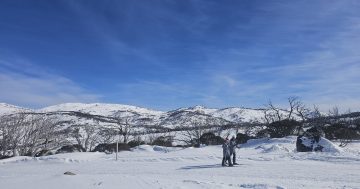
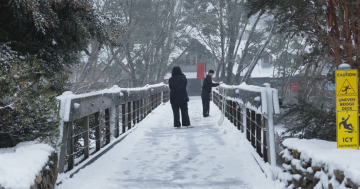
Environmental campaigners say Australia’s alpine regions were omitted from the Commonwealth’s National Adaptation Plan released last year. Photo: NSW Environment and Heritage Department.
For many Canberrans, the Australian Alps are synonymous with winter weekends, ski holidays and snowfields.
But climate scientists and environmental advocates say the shrinking snowpack carries a much bigger consequence for the national capital: the long-term health of the mountain catchments that supply Canberra’s drinking water.
That message has been taken to Federal Parliament, with scientists, alpine communities and Winter Olympians calling for Australia’s first National Alpine Adaptation Plan. They argue that the country’s most climate-exposed landscape has been left out of national planning despite repeated warnings from experts.
Protect Our Winters Australia climate campaigner Elyse Kochman said many people viewed disappearing snow as a problem only for ski resorts.
“The part that often gets missed is that Canberra’s main water supply comes straight from the Australian Alps through the Cotter catchment in Namadgi National Park,” Ms Kochman told Region.
“Those mountain catchments were specifically included in the ACT to supply the federal capital with water.
“So when the alpine region warms and the snowpack shrinks, this is not an abstract problem for Canberra that affects only its skiers and snowboarders, it goes to the heart of the city’s water security.”
Ms Kochman said the Alps supplied close to one-third of the water flowing into the Murray-Darling Basin despite covering only about 1 per cent of its catchment area, making the region critical not only for Canberra but for agriculture, hydroelectricity and communities across south-eastern Australia.
Yet despite that significance, Ms Kochman said, Australia’s alpine regions had been omitted from the Commonwealth’s National Adaptation Plan released last year.
“The government’s own National Climate Risk Assessment warned the future may no longer be able to support alpine ecosystems,” she said.
“That’s the gap. We have a plan for the country’s climate future that skips over one of the most climate-exposed regions we’ve got.”
The group wants that addressed through a National Alpine Adaptation Plan, which would coordinate how governments, scientists, traditional owners, local councils, resort operators and alpine communities respond to a warming climate.
Instead of individual organisations tackling problems separately, Ms Kochman said the plan would provide a national framework to protect ecosystems, water catchments, Indigenous cultural values, mountain communities and industries that depend on the Alps.
“Right now, that burden is being picked up in fragmented and uncoordinated ways,” she said.
“This season shows why that approach can’t hold.”
The timing of the campaign comes after another disappointing Australian snow season.
Instead of consistent snowfall, much of the Alps experienced record warmth through June and July, with rain falling during what should have been the coldest part of winter.
“There was zero centimetres of natural snowfall on the ground at the start of July across much of the Alps,” Ms Kochman said.
“When it’s warm enough to rain rather than snow in July and August, it’s a warning.”
She said rain was particularly damaging because it melted what little snow had accumulated.
Dr Andrew Watkins, a member of the Protect Our Winters Science Alliance, Adjunct Professor at Monash University and a lead author of the National Climate Risk Assessment, said higher temperatures were fundamentally changing Australia’s alpine environment.
“Warmer air means more frequent rain instead of snow, even in mid-winter, while dry conditions during autumn and winter mean less snow.
“Rain is the natural enemy of snow; it eats it for breakfast.”
Protect Our Winters says 2026 marks the fourth poor snow season since 2020. Australia’s snowpack is now at its lowest level in 2000 years, while snow cover has declined by around 30 per cent since the 1950s and ski seasons have shortened significantly across most resorts.
The consequences, campaigners argue, extend far beyond tourism.
Australia’s alpine economy generates more than $3 billion each year and supports more than 12,000 jobs in Victoria alone. More than 30 plant and animal species found nowhere else on Earth depend on alpine ecosystems, while hydroelectricity, agriculture and regional water supplies all rely on healthy mountain catchments.
Social scientist Ruby Olsson, author of Our Changing Snowscapes, said communities in alpine regions were increasingly worried about the future.
“They want to see proactive and meaningful action taken, and they want community voices to be part of the decision-making processes,” she said.
The campaign has also drawn support from Australia’s winter athletes.
Fresh from Australia’s record six-medal performance at the 2026 Milano Cortina Winter Olympics, moguls skier Jackson Harvey said protecting the Alps was about preserving opportunities for future generations.
“It’s the next generation and the one after that that will miss out if we don’t get our act together,” he said.
“I would love for those future groups to have the same opportunities.”
Freestyle skier and commentator Mia ”Miff” Rennie agreed.
“I have seen firsthand how quickly our winters are changing and how quickly we need to respond,” she said.
“I want future generations to feel the magic that we grew up with — the long snow days, the longer seasons, the healthy snowpacks, and a thriving ski community where our winters are not just beautiful, but resilient.”