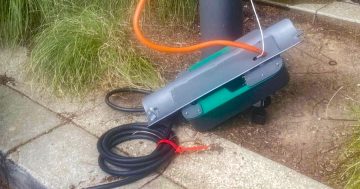
More than 450 streetlights across Canberra have been out for more than 90 days. Photo: Michelle Kroll.
The ACT Government has downplayed the backlog of faulty, unrepaired streetlights across the territory, despite claims from the Liberals that they’re making Canberrans feel unsafe.
During estimates earlier this month, the ACT Government revealed that it is currently working through a queue of 460 faulty streetlights, all of which have been out of action for at least 90 days.
The delayed repairs include a maintenance request dating back to October 2022.
Shadow Minister for Government Services Peter Cain has led the Canberra Liberals’ push for answers as to why it is taking so long to fix the lights.
Mr Cain said broken streetlights are more than a lighting issue, adding that the longer the lights are out, the greater residents’ safety concerns become.
“Canberrans are contacting my office saying they feel unsafe walking their streets at night without working streetlights. We are also hearing concerns about cars and properties being broken into while streets are left in darkness,” Mr Cain said.
“Streetlights are basic infrastructure. People should not have to repeatedly report a broken light and then wait months wondering if anyone is going to fix it.
“The ACT Government’s own answers to my Estimates questions taken on notice now show 460 faults have been unresolved for more than three months, with one dating back to October 2022. How is that remotely acceptable?”
ACT energy provider Evoenergy said it isn’t to blame for the backlog, stating the responsibility for maintenance lies solely with the government.
“Evoenergy does not maintain Canberra’s streetlights. Streetlight infrastructure is owned and maintained by the ACT Government,” a spokesperson said.
“Evoenergy’s role is to supply electricity across the ACT through the electricity distribution network, including for streetlight connections.”
The ACT Government responded to the number of faults, stating they represent only a fraction of the 83,000 streetlights across the ACT.
“As of July 2026, 460 streetlight faults had been open for more than 90 days. This represents approximately 0.55 per cent of the ACT’s streetlight network,” an ACT spokesperson said.
“Streetlight faults are often more complex than replacing a lightbulb. Many faults require fault-finding, electrical testing and site investigations to identify the cause of the outage and, in some cases, multiple repair activities before the streetlight can be returned to service.
“More complex faults can involve underground cabling, electrical supply infrastructure, poles and other streetlight assets, as well as access constraints, traffic management requirements, nearby construction activity or dependencies on third-party infrastructure owners.”
The ACT Government said extended waits often stem from ongoing investigations to identify more complex electrical, cabling, structural or supply issues that require additional work before the streetlight can be returned to service.
Mr Cain responded to the ACT Government’s claims, arguing that the functionality of most streetlights does not excuse the wait times for others that are faulty.
“A broken streetlight does not become acceptable simply because thousands of others are working,” he said.
“Safety isn’t measured in percentages. A streetlight that has been out for three months is a problem regardless of how many others are working.
“Streetlights are there for a reason. When suburban streets, paths and public spaces are left in darkness, people feel less safe at night, and poorly lit areas create opportunities for crime.”
Mr Cain said streetlights aren’t the only public infrastructure that has a backlog.
“The government has previously admitted Fix My Street had 38,000 jobs left open, while average resolution times had reached 99 days,” he said.
“The government’s official response is to tell people to log Fix My Street requests when lights go out. These faults have already been reported. Canberrans have done their part. The problem isn’t Canberrans failing to report faults. It’s the government failing to fix them.
“This is what financial mismanagement looks like when it reaches basic city services. This is the government’s system and the government’s responsibility. Don’t blame Canberrans.”