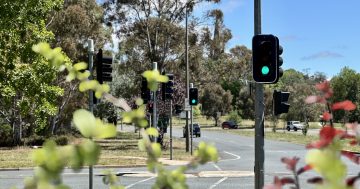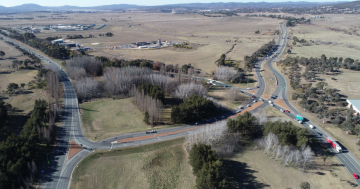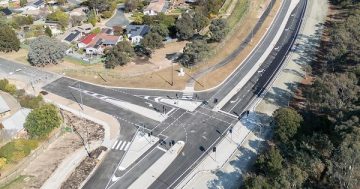

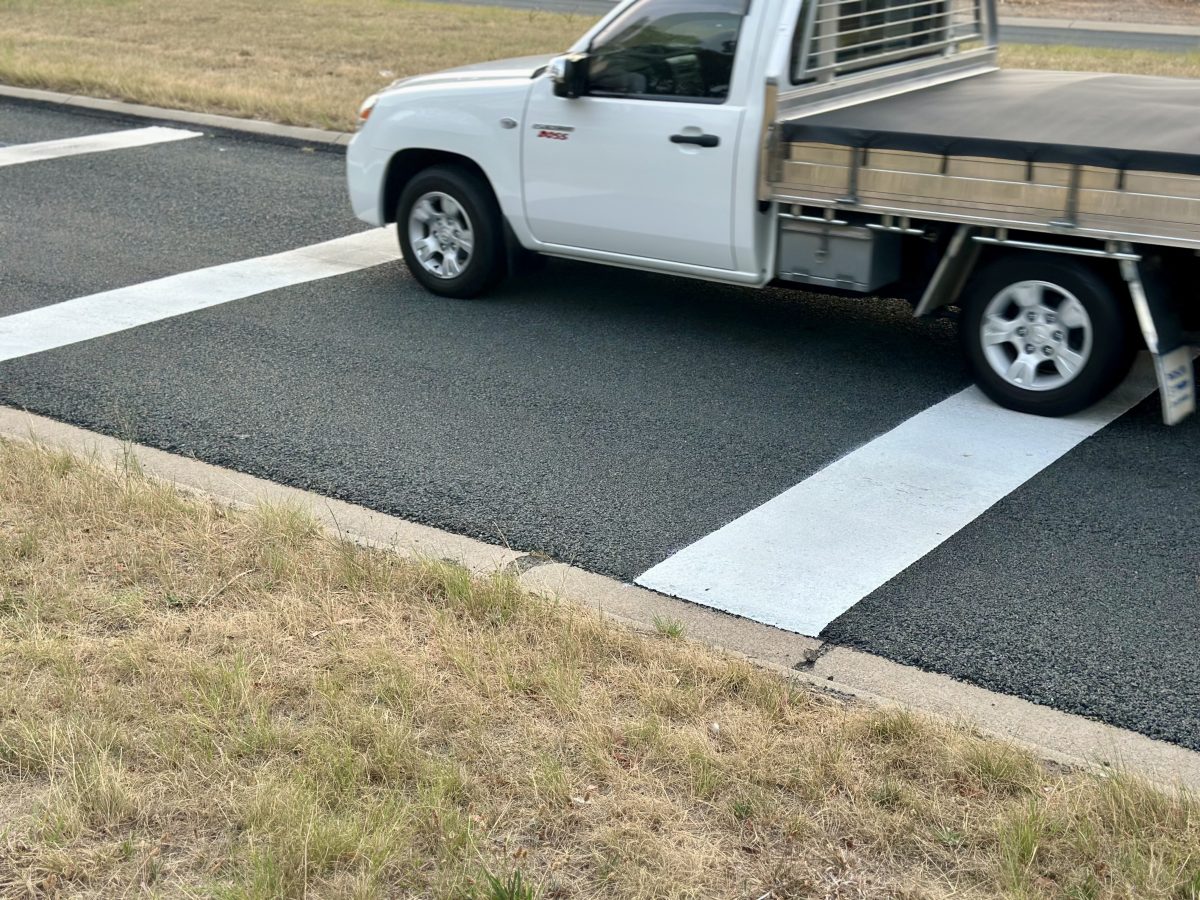
Rumble strips are marching on many of Tuggeranong’s roundabouts. Photo: James Coleman.
The ACT Government is waving the paintbrush big time over Tuggeranong at the moment, laying new “rumble strips” on many of the roads leading up to the district’s main roundabouts.
But is it just a cynical placating of voters in the south, or do these painted white bars actually make roads safer? What are they made of? And why do they take up the full width of the lane, rather than just half of it?
Good news! We have the answers.
What are rumble strips?
The National Transport Research Organisation (NTRO) has offered “innovative research and practical solutions across all modes of transport, including roads, rail, ports and airports” to Australian governments and companies for more than 60 years.
CEO Michael Caltabiano (himself a Southsider) says rumble strips are designed to alter drivers’ perception.
“The technical term is a thermoplastic line marking, so it’s a thermoplastic paint – with a filler in it, usually sand or glass to give it that slight thickness,” he says.
“It’s enough to give a rumble in the steering wheel. As opposed to a speed bump, it’s not designed to be a speed bump and slow traffic that way.”
It’s essentially the same technology used in tactile lane markings on the sides of highways – you know that rumble you feel when you touch the white line. But these are much wider and spaced differently.
“They’re placed in a pattern, where they’re wider spaced initially but become closer spaced as you arrive at the intersection,” Mr Caltabiano explains.
“They designed it so the driver feels a difference, and you get this sense of urgency about doing something differently as you’re coming into a roundabout or usually an uncontrolled intersection, where there are no traffic lights.
“What the rumble strips do is enable perception change.”
Do they work?
“They’re very effective,” Mr Caltabiano says.
“They’re very cost-effective, but they’re also very safety-effective, because it forces the driver to observe and behave differently.
“And the more we can do at those hazardous intersections – and particularly roundabouts – to control speed, to reduce speed on entry, the better.”
A 2006 study by the US Center for Transportation Studies measured driver speeds approaching intersections with and without rumble strips across 400 vehicles.
“We found that, after drivers encountered the first set of in-lane rumble strips, they slowed down earlier on real-world approaches with rumble strips than on real-world approaches without rumble strips,” the study wrote.
“The difference was, on average, 2 mph to 5 mph [3 km/h to 8 km/h]. In addition, speeding outliers were more likely to slow down earlier on approaches with rumble strips.”
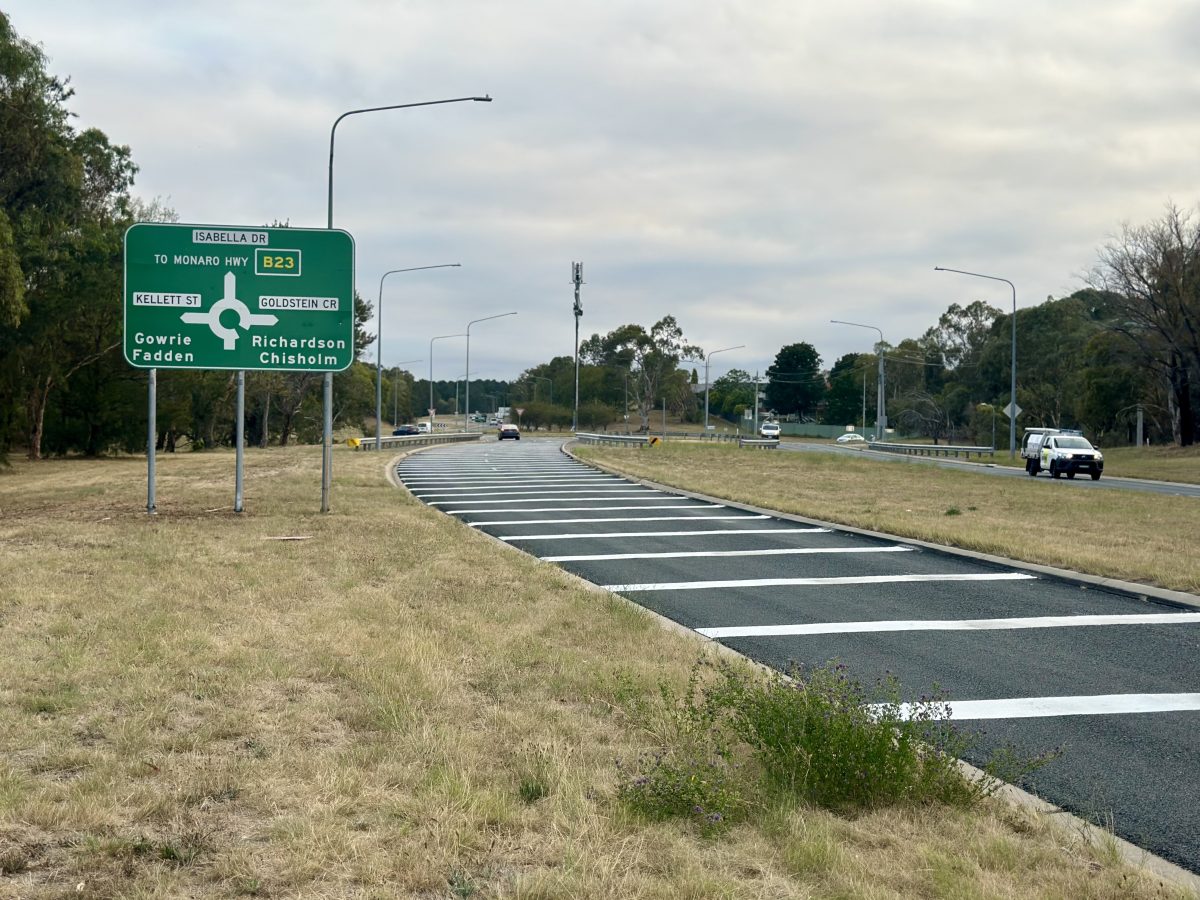
The National Transport Research Organisation says the greater traffic volumes in Tuggeranong are the reason for the strips now. Photo: James Coleman.
However, the government needs to stay on top of maintenance.
“Once you do it, you’ve got to keep it. You have to keep the strips in good order, and that means resurfacing them every couple of years, so there’s a maintenance cost.”
Why are we seeing more of them now?
“Well, I think there are a couple of factors at play,” Mr Caltabiano says.
“Traffic volumes in Tuggeranong are increasing, and as that increases, driver awareness of speed needs as well.”
He praises Canberra’s roundabouts for enabling overall good traffic flow, but this also means drivers approach them at higher speeds than at signalised intersections.
“But if you’ve got queues of five or six cars, your sense of speed coming into those queues needs to change, so the ACT Government has probably reached this critical point where they’re observing behaviours that need to change, and this is a low-cost way of doing it.”
Why do they need to cover the full width of the lane?
Tuggeranong residents will be familiar with this scenario: preparing to exit the Monaro Highway at the Johnson Drive intersection, motorists often move partially into the left lane to avoid the rumble strips in the right lane.
The risk this maneuver poses is why Mr Caltabiano says the white bars need to span the entire lane, rather than just half.
“There’s been 20 years between the two [sets of rumble strips], and we now know full treatment is what’s required – full lane width.”