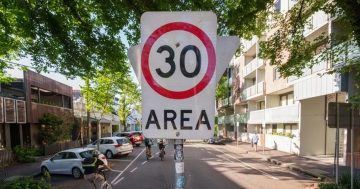
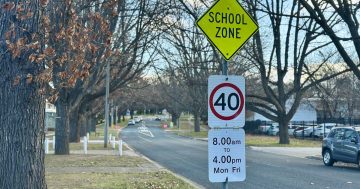
Changing speed limits in Canberra has attracted controversy in the past. Photo: Michelle Kroll.
“The Safe System recognises that people make mistakes, but these mistakes should not cost people their lives.”
This is a key message in the opening of the ACT’s new Road Safety Framework 2026-2031 as the country continues its efforts for zero deaths on roads.
But the Canberra Liberals have expressed concern that the ACT Government will be particularly focused on just one of the framework’s six objectives: what’s labelled “safer speeds”.
Eleven people were killed on Canberra’s roads in 2024 – including five motorcyclists and two cyclists. Four of these people (who were in vehicles) weren’t wearing seatbelts.
In 2025, the ACT’s road toll was nine. The same number of people have already died on Canberra’s roads in 2026.
City and Government Services Minister Tara Cheyne said the message was clear.
“In January and February this year alone, six people lost their lives. This is the highest number for the first two months of the year since self-government,” she said.
“The road toll now stands at nine, equal to the total for all of 2025 in just five months.
“This is unacceptable. A different approach is required. The framework delivers that different approach.”
The 2026-2031 framework is centred around the ‘Safe Systems’ approach and its six objectives: safer roads, safer speeds, safer vehicles, safer people, integrated post-crash care, and effective road safety management.
Vision Zero wants no one to die or be seriously injured on Australia’s roads by 2050.
Ms Cheyne said the new framework would allow the government to measure whether initiatives were actually improving safety, rather than merely recording whether something was delivered.
“[It] establishes a pathway for the ACT’s work in this space over the next six years: better data, clearer accountability, a shared understanding of risk, and targeted action where the risk is highest ultimately creates the foundation for safer ACT roads for all road users,” she said.
“With every death or serious injury on our roads being preventable, this framework strengthens our resolve – as a government and as a community – to reduce the toll, to change behaviour, and to save lives.”
The framework and the Safe System have a focus on interconnected objectives so that “when one part of the Safe System fails, the other parts continue to operate to prevent trauma on our roads”.
The Safer Speeds objective recognises that speed is the “single biggest factor in road deaths in the ACT”.
“[Speed] contributing to around 50 per cent of fatalities over the last five years,” the framework noted.
“Safer Speeds are at the core of a forgiving road transport system that protects all road users, especially the most vulnerable … [and] are essential to reducing road trauma and both the likelihood and severity of crashes.”
The objective is focused across both speed limits that “match the function of the road” (such as its condition, types of vehicles, surrounding infrastructure and its safety record) and speed limit compliance/enforcement (which includes public education).
One long-term action under this objective is for the ACT Government to review all speed limits to ensure “alignment” between Safer Speeds outcomes, travel speeds and the road’s function. It’s expected this work will be completed by 2030-31.
But Shadow Planning and Transport Minister Leanne Castley said the government was already signalling its intention to reduce speed limits across the capital.
“‘Safer Speeds’ [is] a euphemism the Minister is spinning to sound positive [about] something the government knows the community might hate,” she said.
“They don’t intend to make our 80 km/h zones safer by improving the roads, by ensuring they’re better maintained or by lifting the education standard.
“No, they’re talking about an intention to lower speeds.”
Ms Castley argued the Canberra Liberals supported the intentions of Vision Zero but that recent moves by other Labor governments (such as speed limit reductions in Victoria) and other pushes meant it was “clear where we’re headed”.
“Speed limits are a whole lot cheaper for governments than other interventions,” she said.
“If it walks like a duck and quacks like a duck, you can bet Labor will tell you it’s a thoroughbred horse.”
The framework also includes the Safer Roads objective, which focuses on the importance of designing and maintaining infrastructure that minimises the risk of crashes and reduces the severity of injury or the risk of fatality when crashes do occur.
All actions under this objective are labelled as “ongoing”.
The only objectives slated for the short- to medium-term (within 2-4 years) are to develop a central dashboard for reporting ACT road safety data and to develop dedicated ACT Safety Performance Indicators for the framework.
“This will consider our local context in more detail and means we will be better able to track what is working, and report to the community with a greater level of accountability on our progress,” Ms Cheyne said.
Whether this translates into the recommendation that speed limits be lowered remains to be seen.