

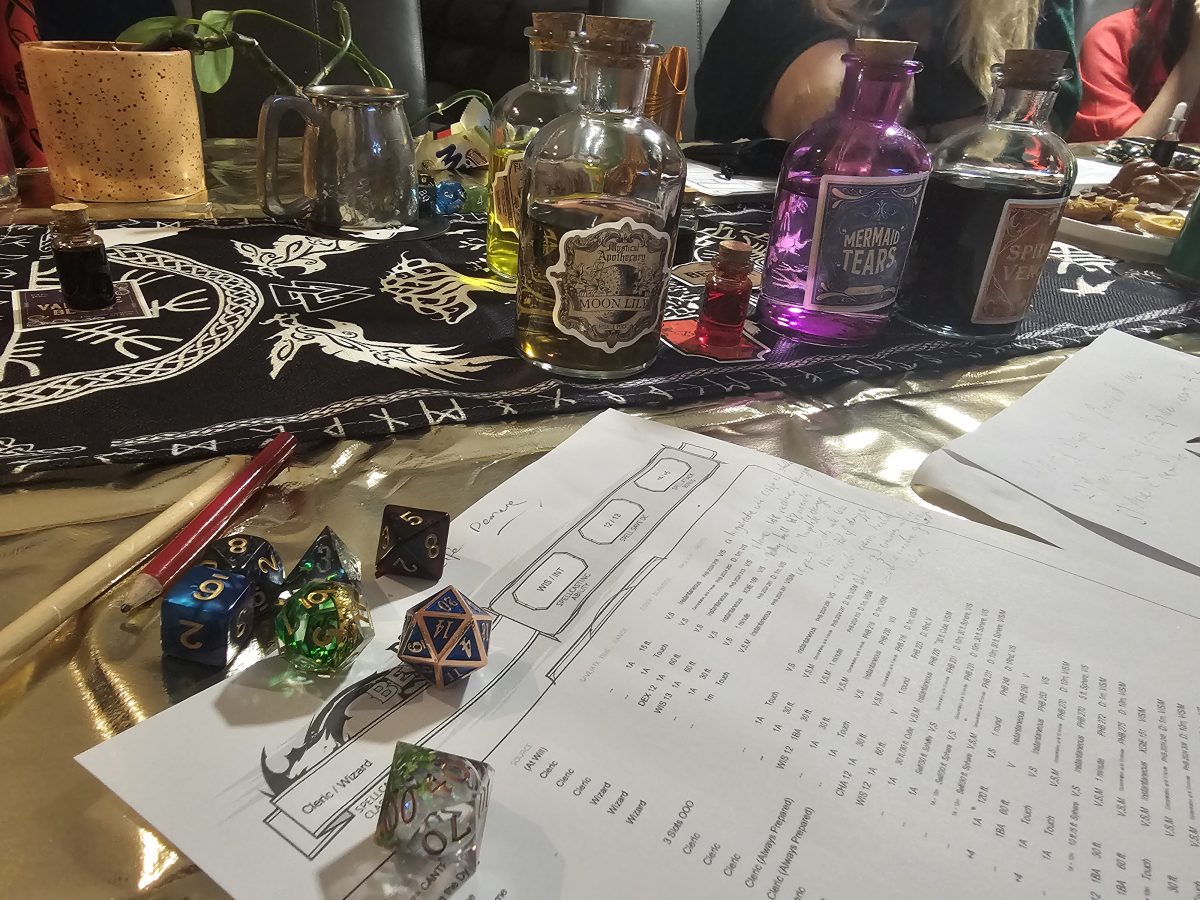
D&D uses seven dice of different shapes and sizes to determine success or failure – and everything in between. Photo: Hayley Nicholls.
Arriving at my friend’s house, I was an innocent civilian entering a heavily fortified dungeon.
Upon leaving – at midnight, after a five-hour session – I had shape-shifted into an acid-fanged spider, mastered the art of necromancy and befriended an Owl Bear.
Such are the possibilities within the boundless multiverse of Dungeons & Dragons.
Five of us ‘noobs’ are here tonight, ready to embark on our first quest.
Our more experienced friend, Laura – tonight known as Fire Sorcerer Kaelith Emberforge – has prepared a visual feast for her band of unwitting adventurers.
Her dining table is bedecked with mountains of colourful dice in strange shapes and sizes, ornate dice-rolling towers and medieval-looking goblets. Our character sheets sit ready for us to assume exciting new identities.
Laura and her husband Steven are D&D veterans. Playing bi-monthly with a regular group, they have been on their current quest (or “campaign”) for over a year.
Steven – potentially the most patient man on earth – is our Dungeon Master for the evening. His job is to narrate our adventure, guiding us through the fantastical world he has crafted.
He does an incredible job of keeping our ragtag group on track, despite our propensity to stray off course due to us having no earthly idea what we’re doing (and perhaps too much mead).
When it comes to Dungeons & Dragons, most of us either know nothing or only what we’ve seen in pop culture references. Typically referenced as the hobby of choice for social outcasts, it’s portrayed as a kind of uber-niche cosplay game for hardcore geeks.
Having completed my first quest, I’m here to tell you – it is exactly that, and more.
Created by two American game designers, Dungeons & Dragons first emerged in 1974 before being ultimately acquired by Hasbro in the 1990s. Though steadily popular, the game has enjoyed a major resurgence in recent years thanks to livestreamed play and nostalgic pop culture touchstones like Netflix’s Stranger Things.
My introduction to this fantasy roleplay game was an incredibly wholesome experience full of supportive people, raucous laughter, creativity and themed snacks. No different to your local book club, except for an elven ear or two (although with the Romantasy genre growing so quickly, cosplay may reach book clubs before too long).
Any intimidation we felt entering the unknown realm of this devoted subculture vanished faster than my character (whose special Mask of the Wild ability meant I could “attempt to hide even when only lightly obscured”).
As our Dungeon Master shepherds us through an intriguing action-adventure quest, we quickly come to understand that though the rules may seem complex, they’re really just scaffolding to support improvisation and play.
For example, as our group crossed the treacherous bog of the Eldermire Swamplands, one of my oldest friends, infamous rogue and petty thief Sable Varr (otherwise known as Hannah), almost sunk beneath the sludge.
Quickly scanning my character sheet inventory, I appeal to our Dungeon Master: “Can I pull her out using my whip?”.
This is where the dice comes in, as our fate is dictated by a combination of luck and light arithmetic.
Combining my dice roll with figures from my character sheet (in this case, strength and dexterity), we find out whether my roguish friend lives or sinks to a sludgy grave. She survives, thanks to a lucky throw.
Later, I try using my whip to defeat a ‘big boss’ style enemy, but a tragically low dice roll means I instead engage in what can only be described as light S&M. Fortunately, too stunned to respond, our enemy misses his turn – so, not a total loss.
Herein lies the fun: Anything is possible, and things can shoot off in unpredicted directions, making for a genuinely exciting adventure.
Bonus: You do it all while sitting in a comfy chair and eating chips.
I defy anyone to say this doesn’t sound like a good time.
So, how can you embark on a D&D adventure?
Your local game stores should stock beginner sets – and some even host campaigns. Pick up a Player Handbook and/or Dungeon Master Handbook to pour over the possibilities.
To look before you leap, check out professional tabletop roleplaying gamers (yes, that’s a thing) Critical Role, Dimension 20 and the Adventure Zone.
Otherwise, dive in via your local Facebook group, like Dungeons & Dragons ACT.
Now, go forth and may fortune favour you!
I say stuff like that now.