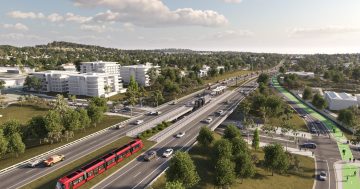
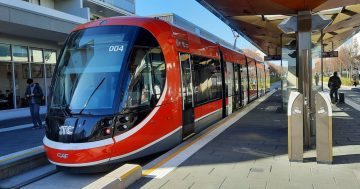
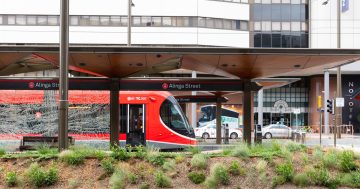
The light rail stage 2A trip – between Commonwealth Park and Alinga St – is expected to take about 9 minutes. Photo: ACT Government.
Trips from Woden to Civic on the chosen light rail stage 2B route are expected to take about 30 minutes.
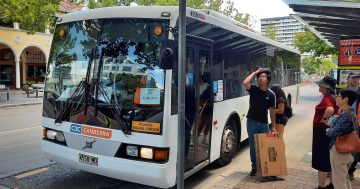
But modelling has suggested taking the bus will take much longer.
Infrastructure Canberra acting director general Anthony Haraldson told budget estimates that while rapid buses currently take about 15 to 20 minutes to complete the trip, future modelling shows light rail will end up being the faster option.
“From our calculations, the buses, which are caught up in the actual road network and congestion … by 2041 you’re going to find full saturation of that corridor [from Canberra’s south] to deal with buses,” he said.
“The congestion in 2041 onwards [shows] buses will be in, essentially, a carpark.
“So that timeframe of 15 to 20 minutes is expected to increase considerably.”
Choosing the State Circle East alignment shaved about 3 to 5 minutes off what a trip through the Barton dogleg was expected to take.
All but one light rail stops have been decided. The one still under consideration is a potential stop in North Curtin (consultation from the Southern Gateway Framework could help make the final decision).
Thanks Claire. Haha, I didn’t have any specific replacement wording in mind. I think you’ve summed it up though. The other stops on the light rail route have been decided, but this potential north Curtin stop is under consideration and the Southern Gateway feedback could help with this specific stop.
When asked how much time each light stop added to a trip, Mr Haraldson said the beauty of light rail was that the “dwell time” of vehicles could be adjusted.
“Intersections can [also] be altered to ensure that gives light rail a clearer path, as it does on Northbourne Avenue,” he explained.
Canberra Liberals leader Mark Parton took issue with the possibility that someone coming from Tuggeranong into the City could face one-way public transport journeys “well in excess of an hour”.
He asked how the ACT Government could justify still running buses if trips were going to take so long.
Transport Minister Chris Steel responded he was “surprised to hear” that Mr Parton was suggesting those bus routes should be “cut”.
“We need more capacity on our public transport network to move more people as our city grows,” Mr Steel said.
“So yes, we’re going to need rapid bus services and light rail to be able to do that.”
Mr Steel said part of Southern Gateway infrastructure planning was about improving the uptake of public transport in the area.
“We are not maximising the public transport options in this area at the moment, and that is a problem as the city grows,” he said.
“We are not planning [just] for today, we are planning for 10, 20, 50 years’ time.”

Rapid buses won’t have dedicated transit lanes for the entire trip from Woden as part of future transport infrastructure plans. Photo: Facebook/PTCBR.
But the rapid buses won’t necessarily have their own transit lanes all the way into the city.
Mr Steel said a separate bus lane would be maintained “as far as possible” but removing another lane from Capital Circle or Commonwealth Avenue would have too much of an impact on the broader traffic network.
Independent Murrimbidgee MLA Fiona Carrick questioned whether all this development would mean the 80 km/h speed limit on Yarra Glen would be reduced.
Mr Steel said that would be part of future deliberations.
But the plan is for light rail to mitigate the impacts of Canberra’s projected population growth on traffic levels.
“We’ve already seen the benefits on stage 1 with traffic volumes reducing in the Northbourne corridor of up to 20 per cent, which is extraordinary,” Mr Steel said.
“We want to see those benefits for the southside as well.”
The plan is still for construction to begin on light rail stage 2B in 2030.
A final decision on the environmental impact statement, an assessment of any conditions from that process, detailed design phase, works approval from the National Capital Authority and Parliamentary approval all need to be achieved before then.

Travel times for stage 2A, from Alinga Street to Commonwealth Park, are expected to be about 9 minutes.
Mr Steel said the vehicles would travel more slowly around Capital Hill as they’re not separated from cars by median strips.
“It is a different traffic environment and a slower traffic environment,” he said.
“So it runs a little bit more slowly just through that area.”
Canberrans can expect to see light rail vehicles on stage 2A from early next year as the testing phase gets underway.
They’ll be laden with sandbags to mimic the weight of passengers.
Testing can take between 9 and 12 months.
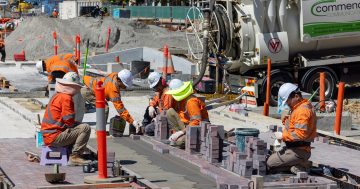
In the meantime, canopies are going up over light rail stops and the first trees have been planted in front of the Sydney and Melbourne buildings.
The green track outside the Melbourne Building is expected to be installed this spring.