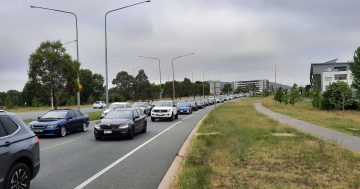


The Woden Town Centre may now have the new CIT campus and an improved bus interchange almost ready to go, but community groups feel much more needs to be done to make Woden vibrant again. Photo: Ian Bushnell.
The Woden Town Centre could once again become a “thriving metropolis”, but not only does a strong vision need to be developed; the community also needs confidence that it’s actually going to be followed.
This was a common theme from various witnesses who appeared before a committee inquiry examining the future of Woden Town Centre on Wednesday (10 December).
Real Estate Institute of the ACT CEO Maria Edwards warned Woden was at a crossroads, where the decisions made now would determine whether the area would develop into a “genuine” town centre or a “high-density dormitory” where residents cycled through “under-sized” apartments and never became part of the community.
“Our members are reporting a significant mismatch between planning intent and market reality,” she said.
Ms Edwards gave anecdotal evidence that many one-bedroom apartments that were for sale off-plan or under development were much smaller than they were almost 10 years ago, with a footprint of about 42 sqm and a small balcony added “solely to meet the 45 sqm threshold” required for a project to receive finance.
“Some new residential apartments being marketed … [are] smaller than hotel-style products designed for temporary stays,” she said.
“One of the agent representatives told me that they couldn’t fit a queen-size bed in some of these new apartments.”
Ms Edwards welcomed investment in Canberra, but that the housing being approved wasn’t giving buyers a choice.
Instead, it was creating “churn”.
The lack of adherence to district strategies and the seemingly block-by-block decisions made on waivers to the Territory plan were raised by community council representatives.
Woden Valley Community Council president Nelson Tang said the character of the area was changing from suburban to an “urban city core” and long-term residents were worried local amenities were being diminished or lost in the name of development and profit.
“What’s clear is that there are competing interests in a changing Woden, and [we] would like to see the government take a greater leadership [role] in advocating for the community,” he said.
“We’re asking for our parks and public spaces to be maintained and, where viable, to be upgraded.”
There have been Woden Town Centre master plans in the past, and there’s also a Woden District Strategy.
But community representatives said they’d been told by developers during consultation events that they weren’t worth the paper they’re written on, given that developers could apply for exemptions.
Curtin Residents Association president Dr Ian Elsum said the first thing the ACT Government needed to do was make the plans and strategies actually matter.
“Make it [so] it does have standing, that people have to comply with this,” he said.
“If the Curtin Master Plan had been implemented, the community would have been really happy. But it hasn’t been. In fact, it’s been violated on several occasions.”
When asked if there was scope for town centre visions to be incorporated into the overall district strategies, Belconnen Community Council chair Lachlan Butler scoffed at the idea.
“Personally, I think the District Strategies are crap,” he said.
“There’s no plan, there’s no strategy … it’s just vague. The District Strategies are sort of meaningless.
“At best, they have a list of things that the government should look into. It’s not a plan.”
Weston Creek Community Council chair Simone Hunter preferred to describe the strategies as “incoherent”, but stressed that if there wasn’t a mechanism to truly make sure they were followed, then they wouldn’t be implemented.
“The planning minister needs to enforce it. The problem that we’ve got is that there’s no enforcement,” she said.
“You can make all the laws and plans and everything that you want, but you have to have … that stewardship over it and make sure that it’s delivered on.
“[Woden] used to be a thriving metropolis. It’s not feeling that way now.”
She stressed that it shouldn’t all fall at the minister’s feet if plans didn’t come to fruition, given the public service machine that also existed.
“There are people who are employed to … get these outcomes, who aren’t elected,” Ms Hunter said.
“The accountability lands within the ACT Government.”
Government representatives are due to appear before the committee inquiry tomorrow (11 December).