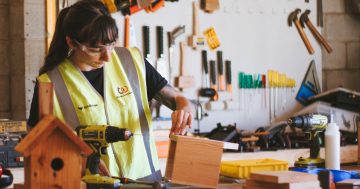
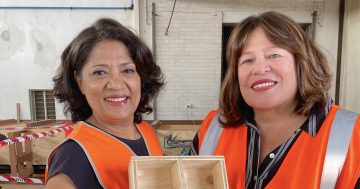
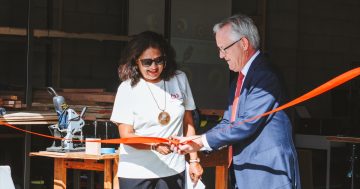
The Women’s Shed Canberra supports women in learning practical skills, building confidence, connecting with others, and improving their wellbeing. Photo: Women’s Shed Canberra.
Women’s Shed Canberra founder Sunita Kotnala faces tough decisions about the social enterprise’s future after her petition for funding appears to have fallen on deaf ears.
In the 2025 financial year alone, WSC supported 590 women through hands-on training and delivered 160 workshops and 504 hours of skills training to 160 members.
This was all achieved through volunteers.
The petition calling for multi-year support to “empower women through trade skills and avoid closure” gained close to 1800 signatures.
But the ACT Government has not acknowledged the call for monetary support.
Instead, Skills, Training and Industrial Relations Minister Pettersson said that Infrastructure Canberra (iCBR) had worked closely with the WSC over the past 18 months to address building improvement and maintenance concerns, addressing what they could “where feasible and within available resources”.
“The operator has recently requested the installation of three-phase power. While this is not a standard feature of the building and is not required for its current approved use, iCBR is considering the request and assessing the associated costs, which are estimated to be approximately $10,000,” he wrote.
“The operator has also raised concerns regarding heating and cooling. Given the nature and age of the building, maintaining ideal temperatures can be challenging.
“iCBR remains committed to working collaboratively with the Women’s Shed Canberra to ensure the facility continues to meet operational requirements and to consider reasonable improvement requests as they arise.”
WSC moved into its permanent home in Greenway in 2024.
Mr Pettersson mentioned women’s participation in the ACT’s construction sector was increasing, crediting initiatives such as the National Skills Agreement and Fee‑Free TAFE and Fee‑Free Construction offerings at the Canberra Institute of Technology (CIT).
Women looking to study in non-traditional areas are considered a priority cohort for the schemes.
“Through these initiatives, projects will be tailored to address the specific challenges faced by women entering male-dominated industries, helping to increase participation, completion and long-term career outcomes in sectors critical to the ACT’s economic growth and housing supply objectives,” Mr Pettersson wrote.
Finally, Mr Pettersson encouraged WSC to be part of consultations for the ACT’s next plan for women and gender equity.
“Community spaces like the Women’s Shed Canberra are important in bringing women together to not only develop their confidence to participate in community, but contribute to the change they want to see,” he said.
“We trust this information is useful in terms of the broader objectives of the Women’s Shed Canberra.”

The Women’s Shed Canberra offers flexible chances to learn carpentry skills, upholstery, how to use power tools, and drop-in sessions to keep skills fresh. Photo: Women’s Shed Canberra.
They’re all hollow words to Ms Kotnala.
“It’s just a very standard government response … saying nothing, giving nothing,” she said.
“But we haven’t yet received a definite ‘no’ and, as a friend of mine used to say, if it’s not a definite ‘no’ then it’s still a ‘yes’.”
WSC recently received two grants – DEWR Local People Local Jobs funding for the Shipping Container Makeover Project and funding under the Canberra Collaborative and ACT Women’s Participation Grant 2026 for Upholstery Skills for Migrant Women.
This means it has funding to survive until 20 June 2027.
But beyond that, its survival is in doubt.
“We cannot run anything without a fee – $20,000 here and $20,000 there [for programs] isn’t even enough for tool replacement and ongoing operational expenses,” Ms Kotnala said.
“If, by February or March next year, it’s obvious to us that we can’t find the investment we need to continue, I guess we’ll look at closing down.”

Ms Kotnala acknowledged the fee-free options for women to learn the skills she’s providing.
But she said not everyone wanted to become a fully fledged tradie; rather, some women wanted to be self-reliant, be part of the circular economy, and access the flexibility to learn skills that aren’t necessarily available through formal education.
She also took issue with Mr Pettersson’s suggestion that iCBR had been responsive to issues with the Greenway site – where WSC has operated on a commercial lease since 2024.
“iCBR has not provided us with a single thing we have requested in the past two years,” Ms Kotnala said.
“Whatever work has been done, we have paid for it.”
This has included supplying their own extra powerpoints for installation and paying for mowing services. A water connection was recently extended to the kitchen, but there are no taps or sinks to allow women to grab a drink during workshops.
“We really can’t continue if certain infrastructure needs aren’t fulfilled,” Ms Kotnala said.
As she awaits the decision on whether a committee will inquire into the petition (given the number of signatures), she’ll just keep advocating and working with local MLAs.
“To expect someone else to come and take it over in its current form … is not possible,” Ms Kotnala said.
“I know many enterprises die a natural death – hopefully we’re not one of them.”