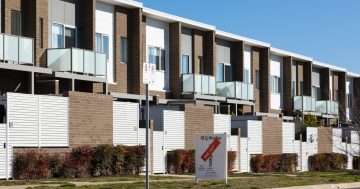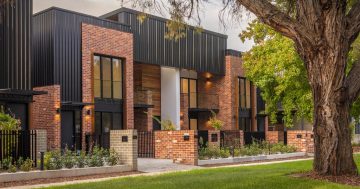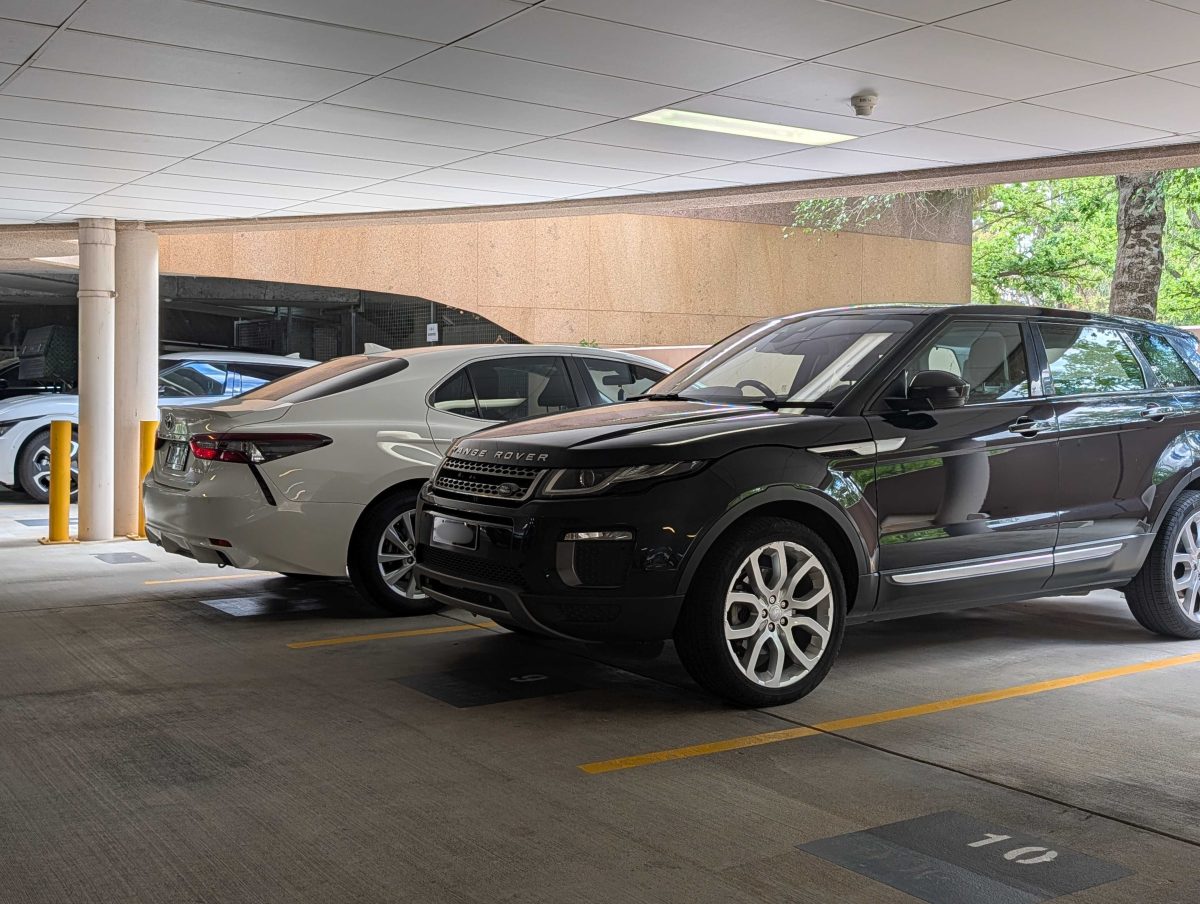
Are there too many car parks underneath our building? Photo: Region.
Getting rid of minimum car park requirements in apartment buildings could free up land to build 600 more homes in Canberra over the next five years, at the expense of about 4000 spaces.
That’s according to a new Grattan Institute report that argued there’s a mismatch between the country’s various parking mandates and what’s actually needed.
“Many apartment dwellers do not want or need car parking,” the report stated.
It’s suggested that parking requirements (minimum and maximum) should be removed for new housing developments, on-street parking should be better managed through permit schemes or time limits, and car spaces should be “unbundled” from homes so buyers can have greater choice about which amenities align with their needs.
“Minimum parking requirements push supply well above what many residents either want or need,” the report stated.
“The result is a glut of vacant spaces across Australian cities.”
It doesn’t recommend that governments remove rules mandating the minimum number of accessible car parks for people with disabilities.
Canberra wasn’t among the cities examined in depth for the report, but it did state that abolishing off-street parking requirements for new housing would reduce the number of car spaces being built as part of ACT housing developments by 4000.
It stated it would also save $340 million in “unwanted parking” construction costs and free up workers to build an equivalent 600 homes in Canberra between 2026-27 and 2030-31.
“Basement excavation can add months to an apartment build, and time is expensive,” the report stated.
“If the workers, equipment and materials used to build these parking spaces were deployed elsewhere, they could build more than 9000 extra homes [across Australia] over five years.”
Civium Facilities Management general manager Alex Boundy couldn’t see the idea taking off in the ACT.
“It’s a spread-out city, with a very unreliable public transport system, and the fact of the matter is, especially with lots of public servants with car parking arrangements and Canberrans being outdoorsy people … there is no spare parking,” he said.
“Canberrans own cars.”
Under proposed missing middle changes, RZ1 and RZ2 land would see a reduction in minimum car parking rates.
Currently, there must be 1 parking space per single-bedroom dwelling, 1.5 spaces per 2-bedroom dwelling, 2 parking spaces for each dwelling with 3 or more bedrooms, and one visitor space per 4 dwellings.
The reform proposed one parking space per dwelling, plus an additional 1 space per five 2-bedroom dwellings, plus an extra space for every dwelling with 3 or more bedrooms, and no requirements for on-site visitor parking.
“A reduction in minimum car parking rates intends to balance the desire to achieve more housing, achieve on-site amenity and limit unreasonable impacts to the street and neighbourhood,” an ACT Government document outlined.
“Car parking [would be] considered through the development assessment process, with the acceptable rate of parking considered on a case-by-case basis.”
Mr Boundy said whenever he tried to work with apartment stratas trying to install shared EV chargers or other communal spaces, the room simply wasn’t there.
“In the city, no buildings are flush with spare parking spaces,” he said.
“I’d argue some residents would even want more.”
Mr Boundy could see how no underground car parks could make apartment buildings faster and cheaper, but questioned whether a desirable result would be achieved on the other side.
“We’ve got thousands of vacant apartments in Canberra as it is … I feel like not having a car space would disincentivise people from buying apartments,” he said.
“All roads are leading to more units, off the back of the [Federal] budget … and a lot of land release in the ACT is for medium to high density.
“I can’t see [this idea] being viable in Canberra at this time.”
Property Council ACT and Capital Region executive director Ashlee Berry wasn’t as dismissive about the idea, but said it would have to be targeted.
“Canberra isn’t London or inner Sydney, but there are parts of the city, for example, town centres, light rail corridors and well‑serviced inner areas, where a more flexible approach to parking would make sense,” she said.
“The key is about matching parking to location – less where public transport, jobs and services are close, and more where people are still car‑dependent.”
More flexible parking rules are attractive to Canberra developers, given parking is one of the most expensive and complex parts of a build.
Structured or basement parking can add between $50,000 and $100,000 per apartment.
Ms Berry advised against the assumption that removing minimum spaces would mean no parking at all.
“It means letting the market decide – many buyers in Canberra will still want a car space, particularly outside the inner north and south, but downsizers, renters, smaller households may be happy to trade parking for a lower price or better location,” she said.
“Give buyers that choice and don’t force every apartment to carry the cost of a space.”
Overall, Ms Berry said changes to mandatory parking rules were worth considering.
“Mandatory parking rules were designed for a different era when every household was expected to own multiple cars,” she said.
“If we’re serious about delivering more homes in Canberra, we need to make sure every dollar and every worker is going into housing, not building car spaces that sit empty.”