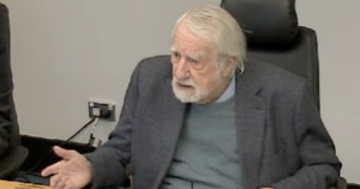
Integrity Commissioner Michael Adams KC (centre – with the office’s CFO Scott Hickey and CEO Judy Lind) said lobbying was the focus of an ongoing investigation. Photo: Screenshot.
The ACT’s Integrity Commissioner says it would be “unreal” to think unions haven’t tried to influence other Territory procurement processes, but there’s no evidence to suggest they succeeded.
Michael Adams KC was asked during budget estimates about pressure from the CFMEU on procurements in the wake of the Operation Kingfisher report.
When asked by ACT Greens Yerrabi MLA Andrew Braddock whether Canberrans could have confidence similar conduct or influence didn’t occur for other projects, Mr Adams simply responded: “You can’t.”
“If they did it in one case, and they thought it was legitimate, why would you not suppose they attempted the same in other cases?” he answered.
“That doesn’t mean [any other attempt] was always a successful conversation … the point, I think, is [this type of interaction] was seen as everyday, business as usual, and an accepted thing.”
Canberra Liberals leader Mark Parton more pointedly asked if Mr Adams thought this was the first such attempt by the CFMEU.
“Oh, I don’t think so. That would be unreal,” Mr Adams responded.
Mr Adams explained the issue here was that Manteena was “singled out” by the union to not receive the tender for the Campbell Primary School modernisation project.
“What happened here was the senior members of the [CFMEU] actually sought out the delegate in charge of procurement and told him that he did not wish for Manteena to succeed,” he explained.
“There was actual involvement [by the CFMEU], actual threat … [and now] the threat’s there, isn’t it?
“What happens at the next procurement if the CFMEU is unhappy with you? Nothing has to be said.”
Where to draw the line between presenting interests to political parties and exerting extreme pressure is the focus of a current Integrity Commission investigation into lobbying.
Mr Adams said it was “clear” such communications from all sorts of bodies were happening every day.
“You need to have those communications, but how do you control them to ensure they’re appropriate?” he asked.
Improvements have already been made to the ACT’s procurement processes, given this project was also the focus of an Auditor-General report.
Mr Adams felt further training for public servants was needed about the process, despite work that’s already been done to explain the rules with greater clarity.
“It’s one thing to have it in a document, it’s another thing to actually bring it to people’s active attention,” he said.
He also questioned why the government should be informing interested parties about the identity of tenderers during a procurement process.
As for how long it took for Operation Kingfisher to produce its final report, Mr Adams said it was not purely a resourcing issue.
The Integrity Commission is funded to hire 26.8 full-time equivalent positions.
Mr Adams said the nature of the office’s investigations meant asking how long one would take was like asking how long is a piece of string.
“We start with a reasonable suspicion of corrupt conduct … and we’re looking for where things go,” he explained.
“You have quite a number of false trails that double up, iterative processes, matters that you think aren’t important that six months down the track become important, and vice versa.
“Throwing more resources at it doesn’t actually help because, in the end … [all information has] got to come to one mind.
“It takes the time that it takes.”
Operation Kingfisher, for example, started in March 2021. It examined more than 1.8 million digital records, analysed more than 6500 documents, took evidence from 30 witnesses, and the transcript of evidence of all examinations totalled more than 3827 pages.
For that reason, the public shouldn’t expect firm timelines on the completion of the Commission’s 12 other pending investigations, including the Phillip Pool development.
“Until you actually lift up a rock, you don’t know what’s underneath,” Mr Adams said.
The findings of serious corrupt conduct from Operation Kingfisher have been referred to ACT Policing and the Director of Public Prosecutions.
In light of the Operation Kingfisher findings, Public Service Minister Rachel Stephen-Smith confirmed that Chief Minister Andrew Barr had requested a “quick review” into whether other major procurement processes had been compromised.
“If anybody is aware of any issues of integrity or lack of probity in a procurement process, they should be raising that,” she said.
“People should be reporting and escalating these issues, making public interest disclosures if necessary, and going to the Integrity Commission if it’s a matter of integrity rather than poor process.”