
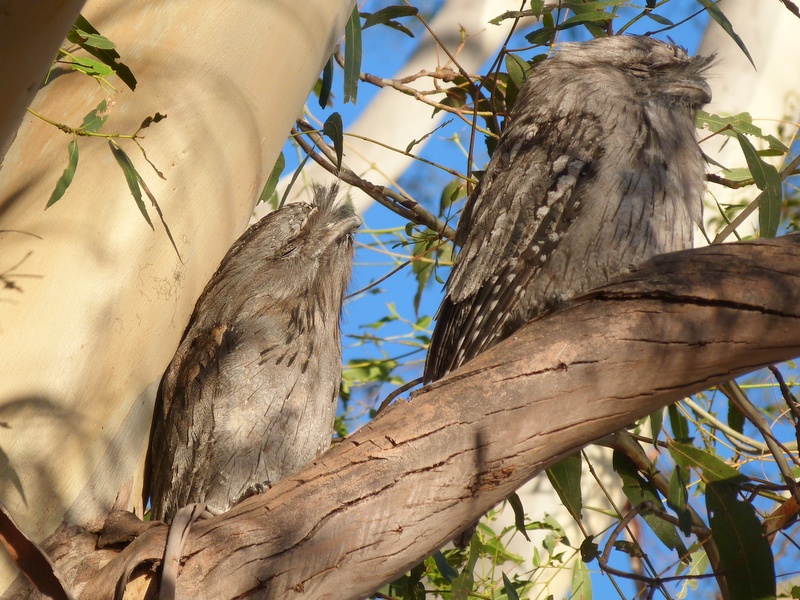
A Tawny Frogmouth pair by the Murrumbidgee – their plumage is beautifully camouflaged to match cracks in tree bark, but these two haven’t chosen the best branches for it. Photo: Ian Fraser.
Every other year Birdlife Australia (Australia’s peak non-profit bird conservation body) and Guardian Australia run a light-hearted poll to elect Australia’s favourite bird, raise awareness and generally have fun. (Light-hearted certainly, but more than 300,000 votes were received!).
This year’s winner, the Tawny Frogmouth, comprehensively beat the Western Australian contender Baudin’s Black-Cockatoo into second place in the final round of the complicated voting.
It must have been a relief to the frogmouth, having been runner-up in the previous three polls.
This delightful Australian bird, fairly common in Canberra suburbs, is often referred to as an owl. But it’s not very closely related to them despite some similarities which are inevitable in two birds evolving to hunt at night.
An owl’s eyes are on the front of a flat face, like ours, while a frogmouth’s are on the sides of its head, like those of most other birds.
Another evident characteristic is a head that seems too big for the rest of them.
The Tawny Frogmouth can be difficult to spot. Photo: Ian Fraser.
An owl’s feet are powerful with very sharp claws like a hawk, for catching larger prey – birds and small mammals. A frogmouth however doesn’t catch food with its feet at all, so they are small and quite weak. They rely on a broad shallow beak (I guess it is a bit like a frog’s mouth) to scoop up smaller goodies from the ground, mostly insects but also mice and frogs.
They perch on fence posts or low branches to keep watch, and glide down to seize their dinner. They’ve found roadsides are good open spaces to search, but this habit unfortunately makes them vulnerable to cars at night.
You’ll find 16 species of frogmouth, from India to Australia, but our Tawny is unique – the only one not to live in rainforests. Most of those species are hard to find but the Tawny Frogmouth is found throughout Australia from the deserts to the coast – wherever there are trees, except for the interior of rainforests.
It is quite comfortable in suburbia, living in every Australian city, and almost certainly the most familiar night bird to most urban people. I know of Canberrans who’ve had them come regularly to lighted windows at night to hunt moths and other night-flying insects.
Its monotonous soft low-pitched ‘oom oom oom (etc!)’ call can often be heard on spring or summer nights, outside in Canberra or in your favourite campground. It is often referred to as ‘mopoke’ or ‘morepork’ but this in no way reflects the call, as has been claimed, and arises from confusion with the Boobook, a common Australian owl and the ‘real’ mopoke.
One of the most remarkable and familiar aspects of Tawny Frogmouths is their extraordinary camouflage. The grey-brown plumage is darkly streaked and resembles cracks in tree bark to a surprising degree.
To complete the disappearing trick when they think they’ve been seen, they will flatten their feathers to head and body and sit completely still and rigid like a dead branch end. If you approach, they will open their eyes to very narrow slits and if necessary turn their head incrementally to watch what you’re doing. Even when out in the open, they can be ridiculously hard to spot like this.
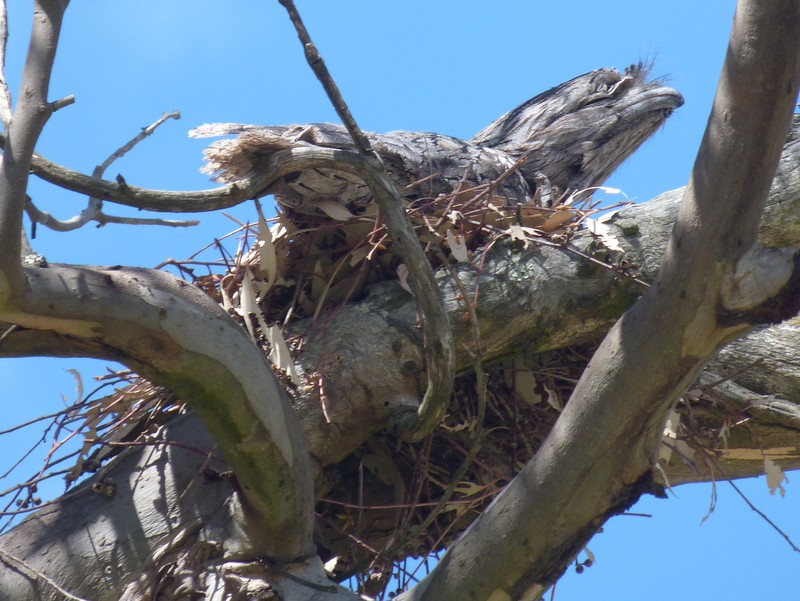
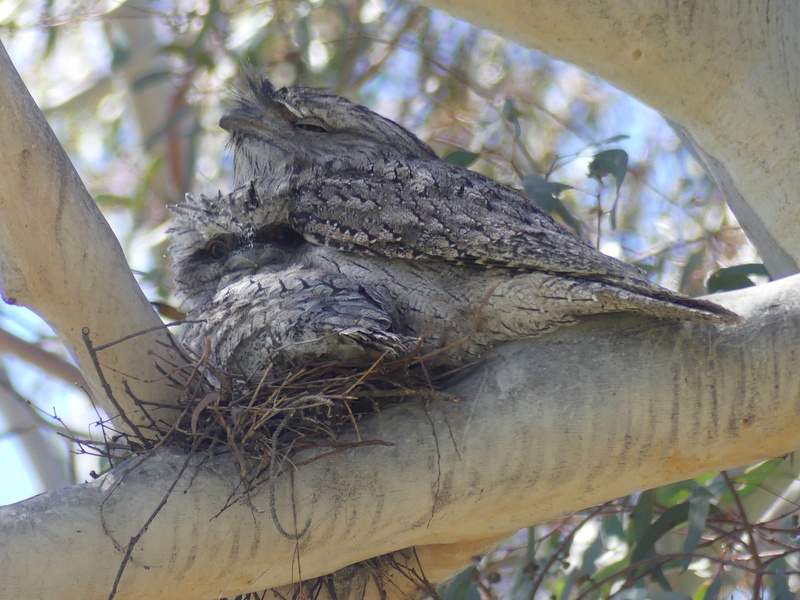
A Tawny Frogmouth and big chick in Weston Creek (it left the nest the next day). Photo: Ian Fraser.
The nest is very basic, just a thin lattice of twigs and thin sticks usually placed across a branch fork to form an apparently pretty precarious platform. There are usually two eggs. The eggs and chick are brooded by one or other parent round the clock. The brooding parent is fed by the other during the night. Sometimes they will use an old nest of another species – I’ve seen one using an abandoned chough’s mud nest at Mulligans Flat Nature Reserve in north Canberra.
There’s a pair that seems to nest regularly in trees around an oval near us in Weston Creek, so you can potentially find them breeding now anywhere in Canberra where there are big enough trees.
Tawny Frogmouths make excellent neighbours and I celebrate their time in the limelight as Australia’s favourite bird, for this year at least. I don’t think it will go to their heads.
Ian Fraser is a Canberra naturalist, conservationist and author. He has written on all aspects of natural history, advised the ACT Government on biodiversity and published multiple guides to the region’s flora and fauna.