

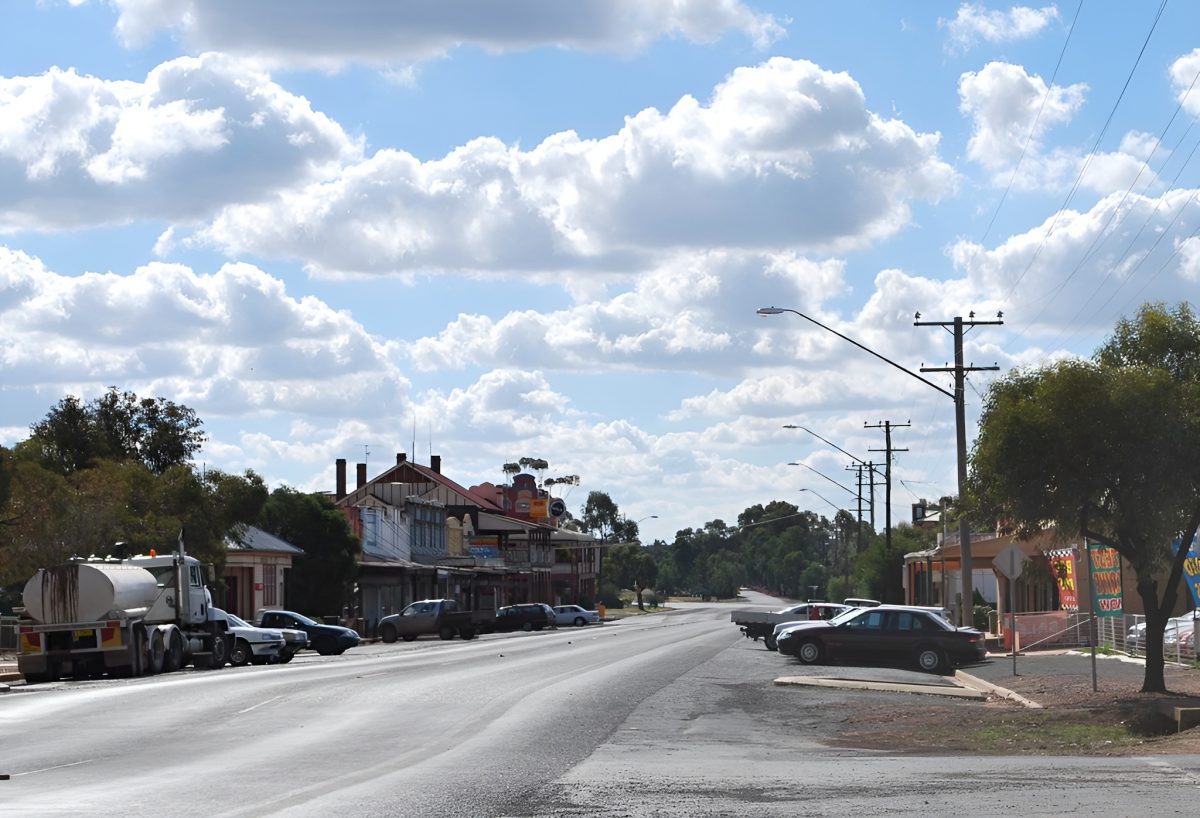
The large farming property is near the small town of Barmedman. Photo: Wikipedia.
The Supreme Court has dismissed an accountant’s claim for a greater share of his deceased father’s $20 million farming estate, after the final will left the vast majority of his wealth to his other son.
However, the judge made provision for a third sibling and only daughter in the family to get an extra $300,000 out of the estate.
The final will
According to the published judgement, third-generation farmer Wayne Bushell died in 2021 while owning 3011 hectares of farmland near Barmedman and Temora.
Shortly before his death, he sold his entire farm to his youngest child Abe, who was working on the family farm. Wayne sold Abe the property for $13 million but structured it so he would only have to repay $1.2 million. The remainder of the purchase price was to be a “gift” to Abe.
According to his final will, Wayne’s other son James and his only daughter Hannah, who had both moved away to pursue other professions, were allocated $600,000 each payable over five years. Abe was left with the entire family farm, which was estimated to be worth more than $20 million.
Claims of ‘no favourites’ pledge
James and Hannah contested the final will in court, arguing that the amount left to Abe “dwarfed” what they each received. They argued their father Wayne had promised throughout their childhood that there would be “no favourites” and the farm would be equally split three ways, and that they had made life decisions based on these promises. They alleged that the final will was a “serious departure” from what their dad had told them for decades.
James said he declined a partnership opportunity with KPMG overseas and returned to Australia to help his father manage his financial assets.
Hannah said she turned down job opportunities outside the Riverina to be close to her family for several years.
James recalled discussions during his childhood in which his father said: “Eventually the farm will be split evenly between you three. There will be no favourites, it will all be split equally. No one will be left out. But you must go away and earn a qualification and get off-farm experience before you can come back.”
Hannah said her father told her: “Whatever we do we do equally. This includes the farm. There will be no favourites. That’s how your mum and I have set it up in our wills – everything is to be split equally.”
Promises ‘not binding’
However, Judge James Hmelnitsky largely dismissed these arguments, saying these promises were not binding agreements.
“In my view, even though I can accept that Wayne said the things which Hannah recalls him saying, I cannot accept that a reasonable person in Hannah’s position would have understood his words as being binding promises from which he was not entitled to depart, regardless of how things might turn out for either of them,” he said.
Judge Hmelnitsky also noted that James had been estranged from his father since 2015 and that Hannah had fallen out with Wayne in 2014.
The court was also told Wayne made several wills throughout the course of his life, the last one in May 2021, which appointed son Abe and his accountant Peter George as executors and formed the basis of this judgement.
Outcome
Judge Hmelnitsky said James was in a good financial position in his life and the final will made “adequate provision” for him but not for his sister Hannah.
“Hannah’s financial needs are relatively greater than James’s, in that she is the main income earner in a family of four which includes two young children,” he said.
While dismissing James’ claim outright, he ruled that Hannah should receive $300,000 further provision out of the estate.
The judge invited Hannah and Abe to make submissions on how these funds should be transferred before the case is finalised.
Original Article published by Oliver Jacques on Region Riverina.