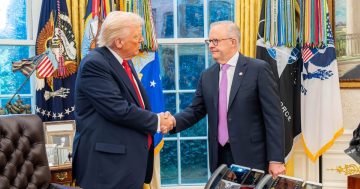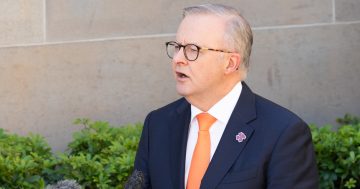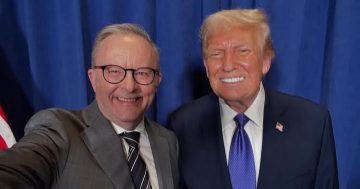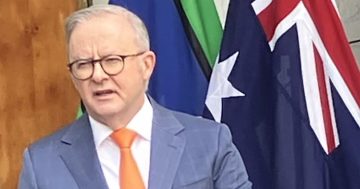

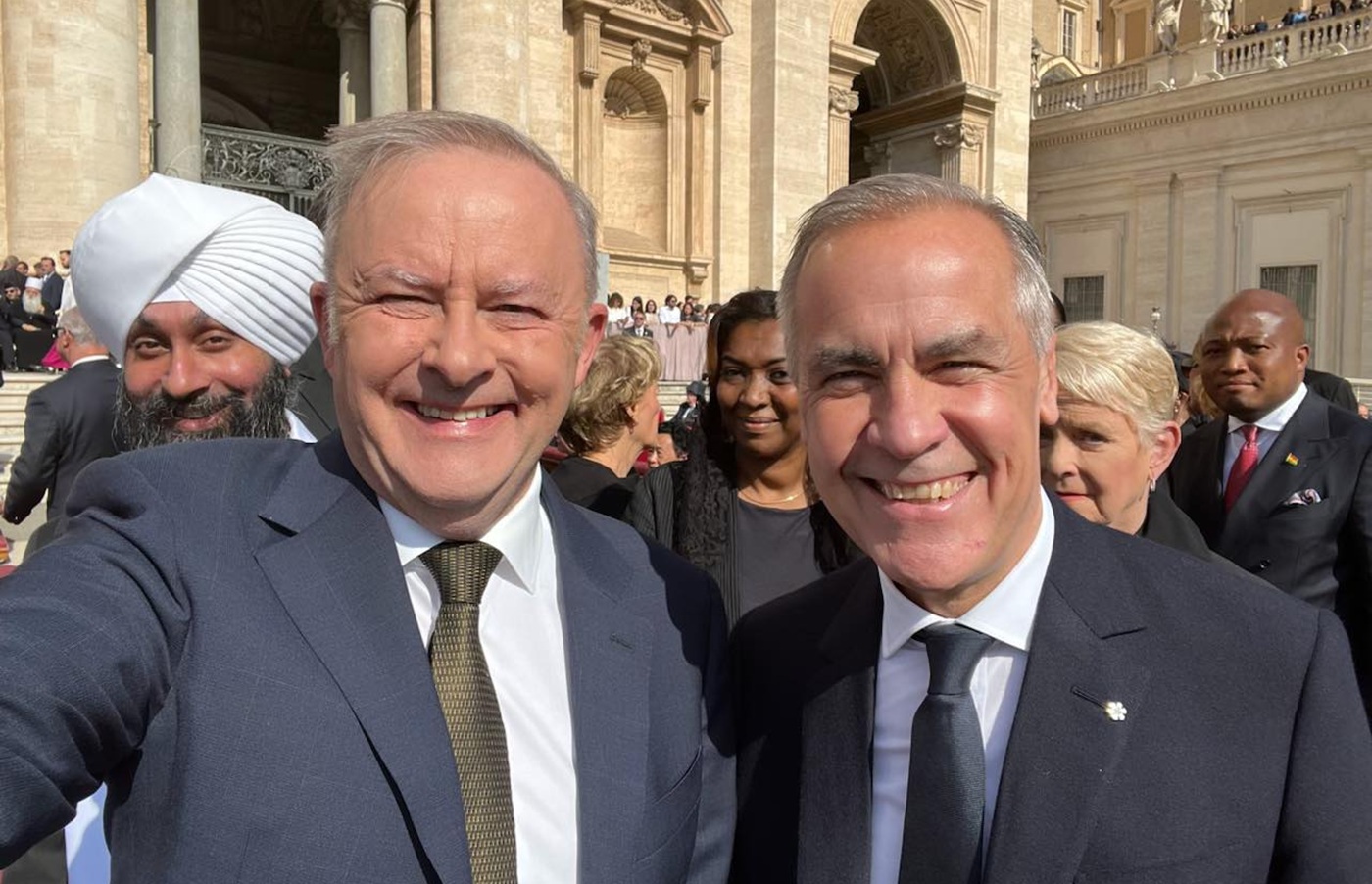
Prime Ministers Anthony Albanese and Mark Carney at last year’s Papal Inauguration in Rome. Photo: Anthony Albanese Facebook.
Prime Minister Anthony Albanese has announced that his Canadian counterpart Mark Carney will visit Australia and address Parliament in March.
Mr Carney is fresh off his powerful speech to the World Economic Forum earlier this month where he denounced unilateralist policies and the use of tariffs as coercion, and called for greater engagement and cooperation between the world’s middle powers.
In a new podcast published on 27 January, the Australia Institute said if the Trump administration had killed off what remained of the postwar international order, Mr Carney’s speech was its “eulogy”.
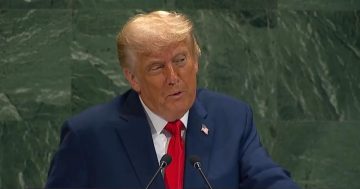
Despite not mentioning the US or its President Donald Trump in his speech, Mr Carney has been widely applauded for pushing back against Mr Trump’s increasingly belligerent and coercive policies and utterances, and for providing realistic economic and strategic alternatives. As a result, has been riding a wave of domestic and international popularity.
Mr Albanese, speaking on the ABC TV’s Insiders program on Sunday (25 January), reiterated his support for increased multilateralism, and said Australia was engaged with like-minded countries about many issues.
“My friend Mark Carney will visit Australia and give an address to the Parliament in March,” he said.
“We are very much engaged with our partners overseas. And we do have a shift in the way that international politics is being played, with a greater engagement from middle powers.
“That’s something I spoke about when I addressed the UN. We need greater cooperation as we see the world changing in its dynamic.”
Asked about Mr Carney’s WEF speech, Mr Albanese said he agreed with his key points.
“I agree with him, and it’s consistent with what I said at the United Nations and with our engagement as well with middle powers,” he said.
“That’s why I’ve engaged with the Canadian PM, but others as well in our region, it’s so important.
“Australia can play a really important role given our role as a Commonwealth nation. We’re a member of APEC, we’re a partner with ASEAN, we’re an important leader in the Pacific Island Forum.
“All of this means that when you look at the global architecture, the role that we can play in our own region and around the world is of a stabilising force at a time where, quite frankly, there is a lot of turbulence and turmoil in the world.”
Mr Carney’s international stocks have been further bolstered by Mr Trump’s withdrawal of his invitation to Canada to join his so-called Board of Peace to rebuild Gaza.
“Dear Prime Minister Carney,” Mr Trump wrote on Truth Social. “Please let this Letter serve to represent that the Board of Peace is withdrawing its invitation to you regarding Canada’s joining, what will be, the most prestigious Board of Leaders ever assembled, at any time.”
So far, not one Western liberal democracy has signed up to the Board of Peace, other than the US.
And while Australia has been invited, Mr Albanese has been non-committal.
“It’s unclear what the objectives of this are, which is why we will give it further consideration,” he told Insiders.
“My government is one that always has an orderly, considered approach to all of our policy, including our international engagement.”
While he has been careful to not directly criticise Mr Trump or his policies, Mr Albanese did say the President’s characterisation of the role played by NATO and allied nations in the Global War on Terror following the 2001 9-11 terror attacks on New York City and Washington, DC, was “unacceptable”.
Mr Trump claimed in an interview late last week that NATO had never come to the aid of the US, and he downplayed the contribution allied nations made in the war — despite allies losing nearly 1000 soldiers during the conflict, including 47 Australians — by claiming they mainly served in support roles.
“Those 47 Australian families who will be hurting by these comments, they deserve our absolute respect, our admiration, for the bravery that was shown by 40,000 Australians who served in Afghanistan,” Mr Albanese said.
“They were certainly on the frontlines in order to, along with our other allies, to defend democracy and freedom and to defend our national interests. They deserve our respect.”
When pressed, Mr Albanese said while he wouldn’t “give a running commentary on all of President Trump’s comments”, what the US leader had said was “entirely not appropriate” and “completely unacceptable”.
Original Article published by Andrew McLaughlin on PS News.