

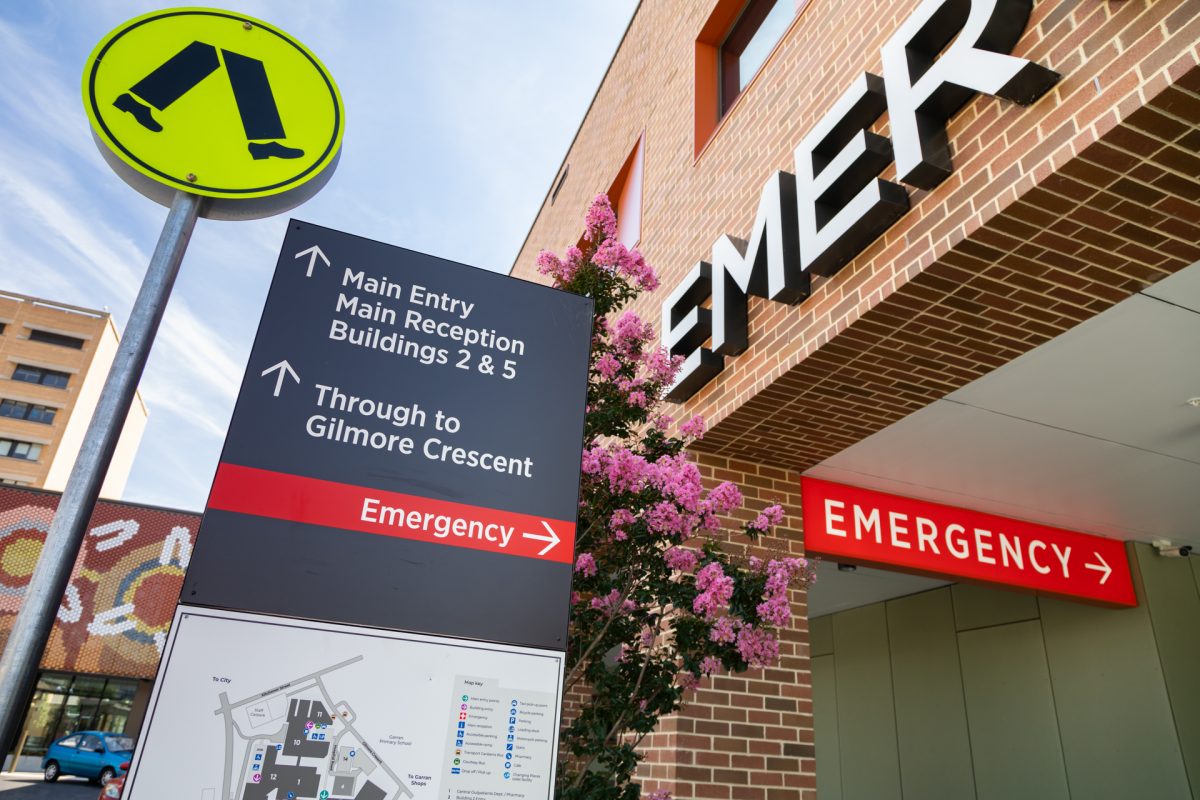
Canberra’s public hospitals will receive millions in extra funding over five years from the Federal Government. Photo: Michelle Kroll.
The ACT will receive an injection of $4.1 billion over five years as part of a landmark agreement struck with the Commonwealth.
This includes an additional $557 million in public hospital funding and an extra $150 million over the next two years to address challenges that smaller jurisdictions face when delivering health services.
State and territory leaders and health ministers have been battling the Federal Government for years to reach this point, calling for more support to address pressures on their public health systems.
After a National Cabinet meeting on Friday (30 January), Anthony Albanese announced his government would provide $25 billion in additional funding to public hospitals over five years.
“The agreement represents one of the most significant national reforms in living memory,” he said.
“It is a major step forward in addressing the pressures that are there on our precious health and aged care systems … ensuring their sustainability into the future.”
The funding includes the Commonwealth share of estimated hospital activity from 2026-27 to 2030-31, totalling $24.4 billion through the National Health Reform Agreement’s hospital base funding, and more than $600 million in additional Commonwealth investment in the public hospital system.
This means Commonwealth funding for state-run public hospitals will reach a record $219.6 billion from 2026-27 to 2030-31.
ACT Chief Minister Andrew Barr described the outcomes reached as a “way forward”.
“We are pleased the Commonwealth has acknowledged the pressure in meeting our future hospital and public health demands, particularly for a smaller jurisdiction like the ACT where it costs more to run a health system,” he said.
“We will continue to work with the Commonwealth Government and all states and territories over the longer term to ease pressure in all aspects of our health system.
“We have advocated strongly for two years to have this acknowledged, and we welcome the agreement, which will now more equitably fund hospitals in the ACT.”
The Australian Medical Association has also welcomed the “long overdue” funding boost, but said that, without further reform, it won’t be enough to meaningfully improve hospital performance.
“Our own modelling would suggest that today’s announcement alone will not be enough to stop the decline in hospital performance, with patients waiting too long for emergency surgery, longer waits for essential surgery and ambulance ramping,” AMA President Dr Danielle McMullen said.
“The additional funding will make a difference, but it is unlikely to reach the 45 per cent of total costs by 2030 that the AMA has been calling for on behalf of our doctors and their patients.
“It will be critical for states and territories to ensure they lift their own funding levels as well.”
Dr McMullen pointed out that there was still no mention of reaching a set percentage of Commonwealth funding, when it would be reached, and whether the cap on growth would be scrapped to “give hospitals the extra headroom they need to meet community demand”.
“It’s clear that while we welcome the extra funding secured through years of advocacy, the detail of the new agreement will show if genuine improvement is going to be possible for our hospitals as patients have been waiting long enough.”
The Canberra Liberals also want to see the fine print.
Leader Mark Parton said he wanted proof the agreement would strength frontline health services.
“The ACT Health Minister must explain how this funding will genuinely improve emergency wait times, surgery backlogs, and workforce pressures, not just prop up a struggling budget,” he said.
“The ACT Government [also needs] to now find efficiency in health delivery. Simply spending more money won’t address the underlying cost pressures that are ravaging the ACT budget.”
Additional reforms to disability supports were also part of the deal.
States and territories will increase the escalation rate of their contribution to the NDIS in line with actual scheme’s growth (capped at 8 per cent from 1 July 2028), with a review point in 2030-31.
The Commonwealth and the jurisdictions will work to limit annual NDIS cost increases to 5 to 6 per cent.
The Thriving Kids rollout across the states and territories has been slightly delayed to October, and full implementation is expected by 1 January 2028.
“$2 billion will be matched to deliver Thriving Kids as the first phase of Foundational Supports, with the Commonwealth providing $1.4 billion of its contribution to support states,” Mr Barr said.
“The ACT, along with all jurisdictions, is committed to improving the health outcomes for all Australians and putting the NDIS on a sustainable pathway.”