

Early childhood community groups are supporting a call for an Early Childhood Nutrition Hub to be set up in Canberra. Photo: James Coleman.
Nutrition Australia ACT is leading the call for the Territory to set up an Early Childhood Nutrition Hub, stating there’s a “clear disconnect” between the government’s policy ambition and lived reality.
The latest Australian Early Development Census (AEDC) data from 2024 ranked the ACT second-last in the country when it comes to physical health and wellbeing.
Just 68.7 per cent of children surveyed were defined as being developmentally on track in this metric – which has been steadily decreasing from 76.3 per cent since 2009 – while 17.4 per cent were deemed “developmentally at risk” and 13.8 per cent “developmentally vulnerable”.
This means that developmentally on-track children can “almost always cope with the school day”, are generally independent, have excellent motor skills and have adequate energy levels.
Developmentally vulnerable children experienced several challenges that interfered with their “ability to physically cope” with the school day (such as dressing inappropriately, frequently being late, hungry or tired), are usually clumsy and may have “fading energy levels”.
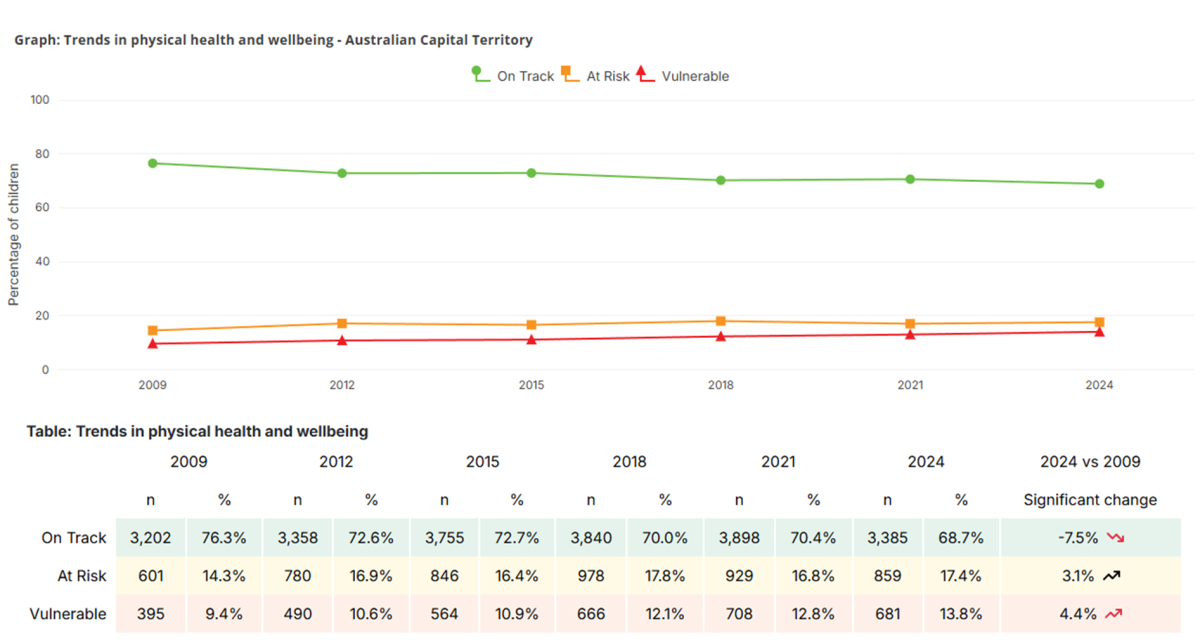
The latest data shows the percentage of the ACT’s children’s physical health and wellbeing are the second worst results in the country. Photo: AEDC.
Nutrition Australia ACT CEO Leanne Elliston said it was clear there needed to be stronger early intervention in the health of Canberra’s children.
“The importance of nutrition in the first five years of life to children’s physical health, brain development and life-long wellbeing is well established,” she said.
“Yet even in a small, highly educated and well-resourced jurisdiction, the ACT lacks a clear, coordinated and funded framework to support early childhood nutrition.”
The ACT Government has the Best Start for Canberra’s Children: The First 1000 Days Strategy but Ms Elliston said coordinated, funded nutrition support was a “critical window” that was being missed, hence why Nutrition Australia was calling for such funding in its submission for the 2026-27 ACT Budget.
“A government-funded ACT Early Childhood Nutrition Hub would help bridge the gap between strategic intent and coordinated implementation of public health nutrition programs and services, supporting families and early childhood education and care services,” she said.
“Acting early is both a public health imperative and a smart investment in the future wellbeing of Canberra’s population.”
The call to improve children’s physical health and wellbeing has been echoed by several community groups.
Canberra Mothercraft Society president Tish Mercieca said poor dietary intake among children was cause for “serious concern”.
“Providing access to a central hub offering evidence-based programs designed and delivered by accredited practising dietitians will significantly educate parents and care providers on the key nutritional principles underpinning maternal and child health, benefiting families,” she said.
Perinatal Wellbeing Centre CEO Dr Yvonne Luxford said the first two years of life were a critical window where nutrition, maternal mental health and child development were deeply interconnected.
“For many mothers experiencing anxiety or depression, a coordinated Early Childhood Nutrition Hub would provide practical, trusted support alongside wellbeing services, helping families build healthy foundations during a vulnerable and formative period,” she added.
Given more than half of ACT children aged up to five years attend daycare and preschool settings, the budget submission also calls for regular menu assessments, educator training and online support for ECEC services.
Early Childhood Australia (ECA) said it was important to support services in providing nutritious, age-appropriate food options for young children.
“The early years are when we lay the foundations for life-long health and wellbeing and establish healthy attitudes and eating habits,” ECA CEO Samantha Page said.
“This time is critical in preventing problems such as obesity and tooth decay down the track and providing support to families with challenges, such as food refusal, before they become engrained.”
The ACT Government is already trialling free breakfast and lunch three days a week at five public schools and has committed to expanding the program to up to 20 schools.
It also has the The First 1000 Days Strategy, along with several preventative health programs such as the pilot INFANT (Infant Feeding, Active Play and Nutrition) program for first-time parents and delivers the Food&ME eLearning course to teachers and educators.
An ACT Government spokesperson said Canberra Health Services’ Maternal, Child and Family Health (MACH) Service supported early childhood nutrition through assessment, advice and early help.
“They also guide parents on offering healthy food and routines, while letting children choose what and how much to eat. MACH nurses and/or midwives provide practical, evidence‑based guidance on breastfeeding, formula and mixed feeding, tailoring support to each family,” the spokesperson said.
“Nutrition advice is included at every developmental check for a baby. For toddlers, guidance covers family meals, routines, cup use and creating positive mealtime environments.”
ACT public schools have to comply with a food and drink policy, while early childhood education and care services are required to provide nutritious food and drinks suitable for each child’s dietary needs.
“All school canteens are subject to an annual canteen menu review to ensure compliance. Nutrition Australia ACT are contracted to undertake this work, which includes site visits,” the government spokesperson said.
“During audits and assessment and rating visits, Children’s Education and Care Assurance (CECA) reviews menus [in early childhood settings] to check they include fresh fruit and vegetables and restricted levels of processed food.”
The Australian curriculum also contains teaching about basic nutrition for children from preschool to Year 2.