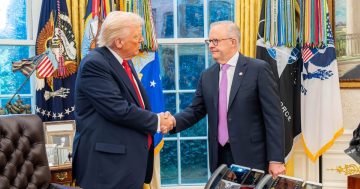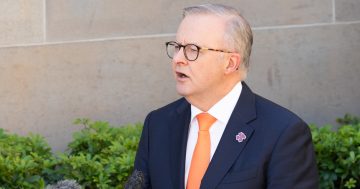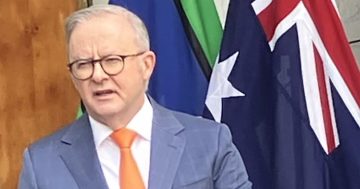

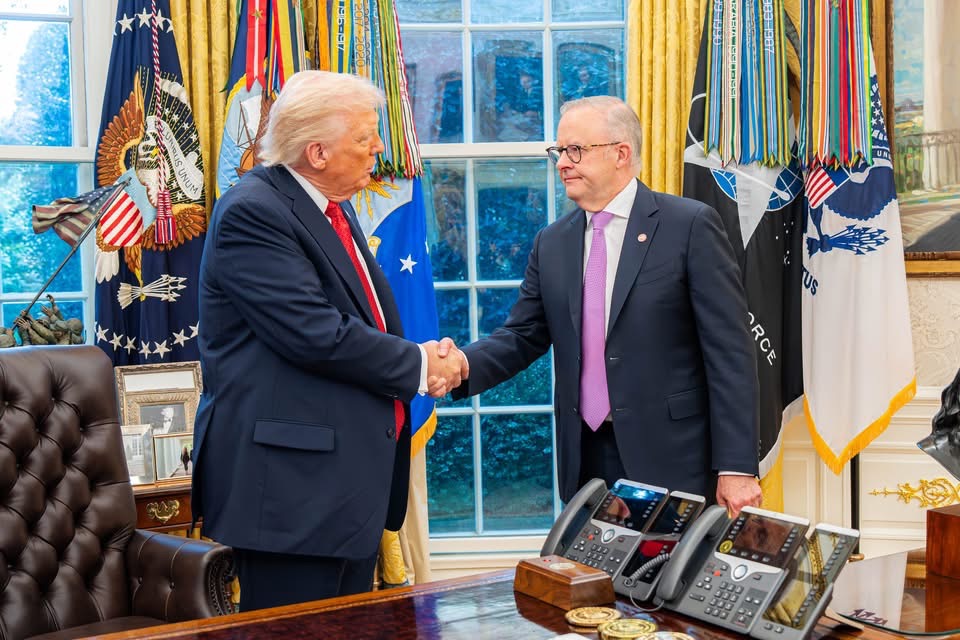
With friends like him … US President Donald Trump greets Prime Minister Anthony Albanese. Photo: Facebook.
How many Canberrans might get caught up in Trumpworld’s latest bout of border insecurity?
Quite a few, one suspects.
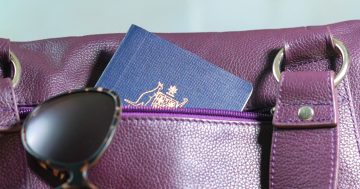
Australians wanting to visit the United States will now have to disclose information about their social media use over the past five years, email accounts, phone numbers and extensive family history to the Department of Homeland Security before being approved for travel.
Ever since King Donald returned to the White House, there have been reports of tourists and other visitors to the US, including Australians, being denied entry after having to hand over their phones and their data examined for any “unfriendly” comments.
That’s now being taken to a new level for 42 countries listed on the US visa waiver program, which enables citizens to apply through the Electronic System for Travel Authorization (ESTA), if they are travelling to America for 90 days or fewer.
That could be problematic for people who live and work in a politically active and aware city such as Canberra. Students, academics, political operatives (even on the conservative side), journalists, commentators — there would be plenty who could have said, heard or viewed something that might be deemed offensive these days to US authorities.
Even public servants who professionally avoid social media but have strong views about what is happening in the US or other places, such as Gaza, and express them privately in text messages, emails and other private forums could be captured.
The move ramps up the risk of a holiday or study or business trip being over before it starts.
There has already been a downturn in visitors to the US and this will only make matters worse.
US leaders often say America has no greater friend than Australia, but this and other events make you wonder why we still want to be friends.
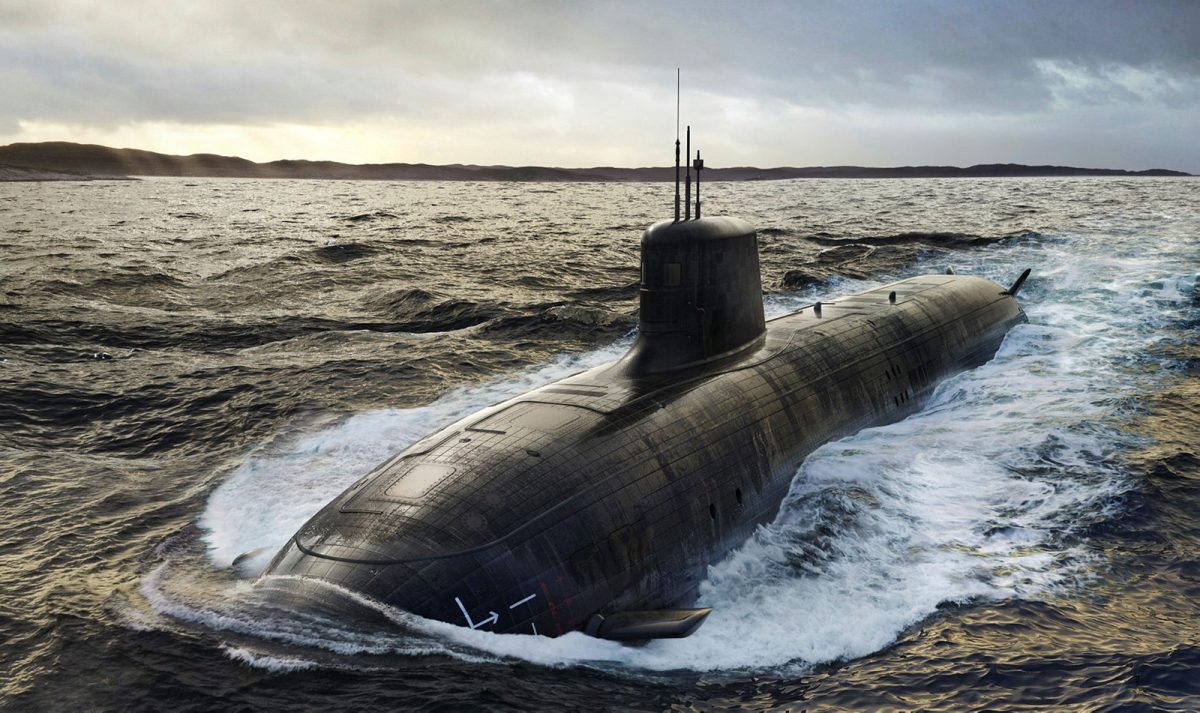
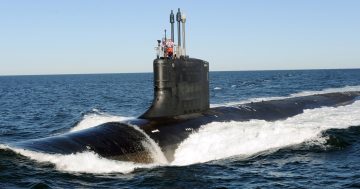
Just how much will AUKUS cost? Image: ADF.
Even when the US was conducting its dubious wars in Vietnam and Iraq, and interfering in other countries, there remained some sense of community of interest as part of the liberal democratic family with familiar cultural traditions and a history of fighting side-by-side.
Not to mention our digestion of and affection for American culture over the decades.
The warning signs were there in Trump’s first stint as President, but now in this dark new MAGA version of the US unfolding before us, it is like discovering the cool guy you used to hang around for safety ain’t so cool and is more than a bit scary.
Not only are Australians subject to this new chilling fiat that has more in common with the more blatant authoritarian regimes around the world, but the US’s 2025 National Security Strategy makes it clear that under Trump, no ally can feel secure.
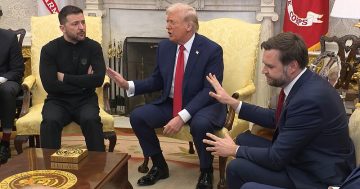
All year the world has seen the disgraceful treatment of Ukraine and the cosying up to the Russian dictator Vladimir Putin in a bid to force an unjust peace on the invaded country and reap the benefits of renewed business with Russia.
This also has implications for another US ally, Taiwan, and in turn Australia.
The new National Security Strategy also berates weak European leaders and gives succour to the far right in language that has no place in any liberal democracy and, despite NATO, fails to see Europe as an equal partner.
Where does Australia sit in all this as it marches further into the dizzyingly expensive AUKUS alliance that may or may not give us a submarine capacity that could well be obsolete by the time it is delivered?
Is it all just an expensive protection racket?
Will this increasingly transactional, gangster-like America that has wielded tariffs against friend and foe, and seems happy for it and the authoritarian powers Trump admires to carve up the world into spheres of influence, stand by Australia?
Only if it serves a strategic purpose. And possibly not even then, given the erratic and capricious nature of the man and his administration.
Caught between our biggest trading partner and major ally, Australia is walking a tightrope and hoping that Trump will be a passing aberration, and normal service can be resumed.
But many Australians are feeling increasingly uncomfortable with Trump’s America, which in this iteration is being transformed at a rapid pace by an administration that this time around is armed with a plan.
The pillars of a free society — fair elections, the rule of law, freedom of association — are all under attack. Who would have thought that people, including citizens, would be whisked off the street by masked agents simply for looking different from white Americans?
Whether Canberrans will want to travel there or not, or what requirements are imposed as part of America’s new intolerance, the bigger issues at play are how long Australia, with its cherished liberal democratic traditions, can stomach what has happened to our old friend.
The model perhaps is to agree to disagree, as we do with the country that has so enriched us but is perceived as our main security threat. Especially while we have something that the US wants, such as rare earths.
The tragedy is that, for all its flaws, America still means a great deal to Australia, but right now, that America is hard to find.