


The ACT Government has two whole-of-government diversity, equity and inclusion employment targets. Photo: Michelle Kroll.
The ACT Auditor-General has found “considerable effort” will be needed for the ACT Public Service to reach its whole-of-government diversity, equity and inclusion employment targets but the overarching policy it’s working with is out-of-date.
The overarching ACT Public Service Respect Equity and Diversity Framework (also referred to as the RED Framework) was first implemented in 2010, but it doesn’t refer to current responsibilities and legislation or frameworks, strategies and plans developed since 2015.
ACT Auditor-General Michael Harris said while there were many other strategies, policies, frameworks and plans at whole-of-government and directorate levels, there wasn’t a single roadmap or source of truth to allow for their effective implementation.
“More effective performance and accountability arrangements are needed to ensure the principles and practices of diversity, equity and inclusion are implemented across the ACTPS,” he said.
The ACT Public Service has two whole-of-government employment targets: to have three per cent of its workforce to identify as an Aboriginal and/or Torres Strait Islander person by 2026 and for nine per cent of its workforce to identify as having a disability as part of the ACT’s Disability Strategy 2024-2033.
At the time of the report’s publication (14 January, 2026), the percentage of Aboriginal and/or Torres Strait Islander employees in the ACTPS is 2.0 per cent (on par with being representative of the broader population) and the percentage of employees with a disability is 3.0 per cent (in the general population, 22.1 per cent of women live with a disability, as do 18.9 per cent of men).
The target for employees with a disability includes people who are neurodivergent, but this data isn’t being specifically collected.
The government doesn’t have employment targets for other groups, such as LGBTIQA+, people from culturally and linguistically diverse (CALD) backgrounds, women, older workers, younger workers, veterans or specifically neurodivergent people.
The Auditor-General’s report recommended these be established.
“Inclusion of people with lived experience in policy and practice development and decision-making is central to better practice diversity and inclusion,” it stated.
“[However] consultation within the ACTPS and with the community has been generally effective.”
Examination of the State of the Service Reports between 2019-20 and 2024-25 showed the employment of Aboriginal and/or Torres Strait Islander people hadn’t changed over that time.
“Without growth the target of three per cent of Aboriginal and/or Torres Strait Islander people employed in the ACTPS by 2026 is at risk,” the report noted.
The mean salary of both Aboriginal and/or Torres Strait Islander and CALD employees has been “consistently lower” than the ACTPS average since 2019-20.
The employment of people with a disability only rose 0.2 per cent.
The audit noted the reports relied on human resources data, but that data from the 2023 ACTPS Employee Survey indicated that 7.0 per cent of staff identified as a person with a disability.
Another recommendation was for the Chief Minister, Treasury and Economic Development Directorate to establish mandatory workplace diversity training requirements for all staff (with refresher courses every two to three years), plus require all managers, supervisors and ACTPS staff involved in recruitment to undergo diversity, equity and inclusion training.
“Training requirements are set by directorates and this has resulted in inconsistency in practice across the ACTPS,” the report noted.
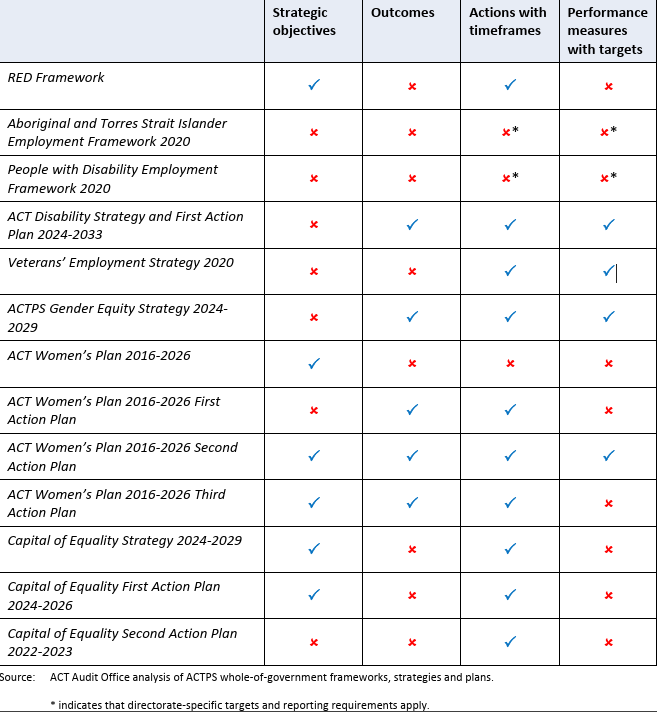
Accountability arrangements for cross-agency frameworks, strategies and plans relevant to diversity, equity and inclusion. Photo: ACT Auditor-General.
It also recommended ACT Government agencies clearly identify strategic objectives and outcomes, actions with timeframes for implementation and performance measures with targets when developing future frameworks, strategies and plans for diversity, equity and inclusion initiatives.
The report noted the Chief Minister, Treasury and Economic Development Directorate had recognised the need for a “more cohesive approach” and an overarching strategy for ACTPS inclusion and belonging.
“The principles of diversity, equity and inclusion seek to recognise and include the unique differences, contributions and needs of staff in the workplace that is fair and equitable and allows them to participate in decision-making,” the report noted.
“This needs to be progressed as a matter of priority.”