


The median age of mothers and fathers has steadily risen over the past decade. Photo: Claire Fenwicke.
Australian parents are waiting a little longer to have children as the average age of mothers and fathers rose again last year.
According to data released this week by the Australian Bureau of Statistics (ABS), 2024 continued a trend of parents delaying the decision to have children.
The median age of mothers was 32.1 years and 33.9 year for fathers, both up from a decade ago when it was 30.9 for mums and 33 for dads.
The ABS’s head of demography, Beidar Cho, said the figures showed a slow but steady increase in the median age of parents over the previous 10 years.
“But in the decade before 2014, the median age of mothers and fathers only rose by 0.3 years for mothers and 0.2 years for fathers,” she said.
“This shift toward older parenthood reflects broader social changes and economic shifts. This includes things like more time spent in education such as university and TAFE and higher workforce participation by women.
“It also shows evolving patterns in how and when people choose to start families compared to previous generations.”
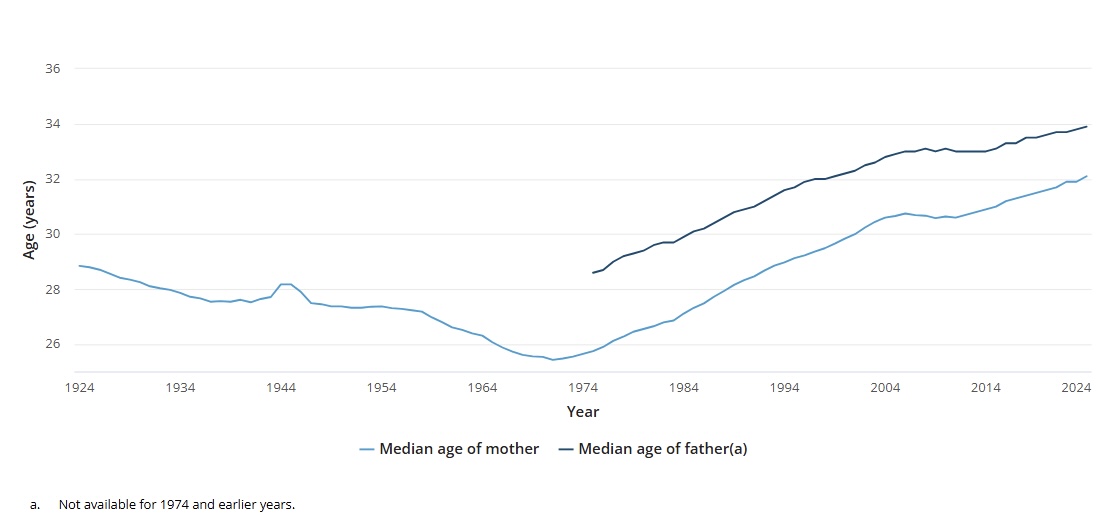
The median age of Australian parents keeps rising. Image: ABS.
The nation’s fertility rate still sits significantly below what is regarded as the “natural replacement” rate of 2.1, considered the ideal figure to maintain the population’s ongoing future.
The “natural replacement” rate hasn’t been reached in Australia since the mid 1970s.
The fertility rate fell below 1.5 babies per woman in 2024; the ACT recorded the lowest rate of 1.3. The Northern Territory had the highest rate at 1.6.
Registered births in Australia rose to 292,318 in 2024, up by 5320 births or 1.9 per cent.
ACT leads household spending
ABS statistics released recently also showed household spending rose 0.1 per cent in August, according to seasonally adjusted figures.
This follows rises of 0.4 per cent in July and 0.5 per cent in June.
Household spending grew in five of the eight states and territories in August.
The ACT (+2.9 per cent) and Tasmania (+0.6 per cent) recorded the largest growth rates, while the Northern Territory (-1.2 per cent) had the biggest fall.
Five of the nine spending categories rose in August.
This was led by transport, which rose 0.8 per cent, driven by Western Australia and the ACT.
Miscellaneous goods and services also rose 0.8 per cent.
The largest falls in spending came in recreation and culture (-0.9 per cent) and alcoholic beverages and tobacco (-0.9 per cent).
In annual terms, miscellaneous goods and services (+8.9 per cent) and health (+8.0 per cent) recorded the largest growth rates in the 12 months to August.
Services spending was 8.1 per cent higher than August 2024, while goods spending was up 2.5 per cent.
Lauren Binns, ABS head of business statistics, said the small rise in August was the fourth increase in a row and marked a spending increase in 10 of the last 12 months.
“Through the year growth remained elevated. Household spending was 5.0 per cent higher than the same time last year,” Ms Binns said.
“Households spent more on booking airline travel and accommodation services during August.
“This contributed to a 0.5 per cent rise for services spending. In contrast, goods spending fell 0.2 per cent.”
Monthly business turnover fell 2.2 per cent in August this year (seasonally adjusted), the largest drop since April 2023 with falls across nine industries over the month.
ABS head of business statistics Tom Lay said the biggest drop came in the utilities sector, but with good reason.
“The electricity, gas, water and waste services division dropped 14.1 per cent as wholesale electricity and gas prices fell following strong rises in the previous month,” he said.
“Other notable industry falls were in manufacturing, down 5.8 per cent, information media and telecommunications, down 3.7 per cent, and mining, down 1.9 per cent.”
Business turnover, however, was 4.5 per cent higher in August 2025 than in August 2024; 11 of the 13 industries measured reported rises over the last year.
In trend terms, the 13-industry aggregate for business turnover rose 0.3 per cent in August, the 12th consecutive month of growth.