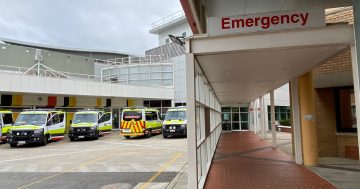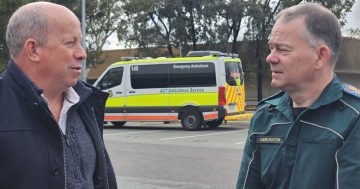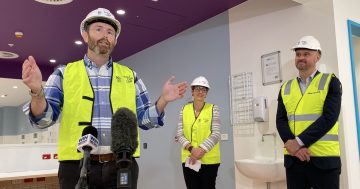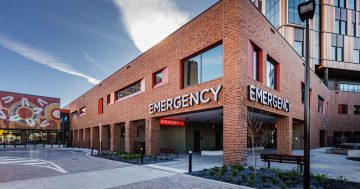

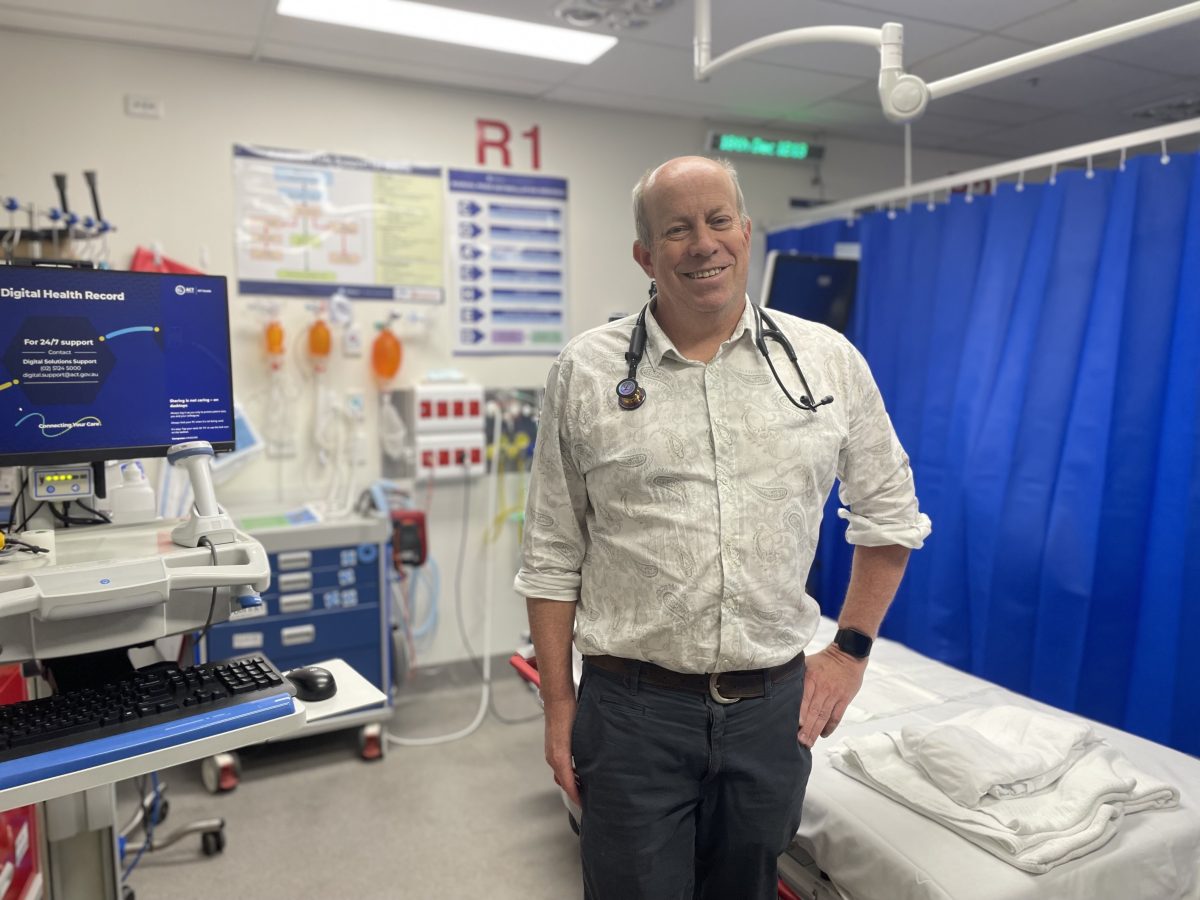
Dr Mike Hall knows all about the disaster preparations and planning that goes on behind the scenes for Canberra’s emergency departments. Photo: Supplied.
They’re the worst case scenarios – an influx of sick people because of a mass trauma event, a disease pandemic or extreme weather – but usually our emergency departments are more overwhelmed by sporadic emergencies and people seeking treatment for less urgent issues.
But that doesn’t mean emergency departments (EDs) aren’t prepared for the sky to fall.
North Canberra Hospital senior emergency department doctor Dr Mike Hall sometimes feels like they’re too prepared – but that’s the point.
“I think the people of the ACT are planners, if anything, we’re over-planners [and] at times you might argue that we overmanage risk,” he said.
“Disaster medicine is one of those really tricky things … because to some extent, how far do you go in workshopping and it’s a matter of the consequence versus the risk.”
Take the recent heatwave which coincided with Canberra’s Summernats Festival.
Only seven or eight patients arrived across the city’s two public emergency departments specifically labelled as seeking help for heat-related illnesses over the three days. Given upwards of 200 people can present at the EDs each day, this didn’t create a great impost on services.
But the hospitals were still ready for the worst.
“We did a reasonable amount of planning for this heatwave, so we looked at our fluid stocks, we brought extra fridges into ED so we could keep fluids cool, we workshopped if we were to get large numbers of patients with severe heatstroke [where you need a lot of ice packs],” Dr Hall explained.
“Hospitals have a small number of ice machines that we usually put on sprained ankles, so we had to look at our stock and we were tracking the nearby service stations that were open, and had some eskies in the ED.
“Literally, what the plan was going to be was sending someone down to the service stations and buying some big bags of ice, which sounds like we should be better than that, but in many ways it’s a pragmatic response.”
Hospitals are constantly workshopping potential scenarios that could put a strain on the system and, given only a limited amount of resources can be safely stored at one time, considering ways to utilise community resources to provide support is one way to overcome that barrier.
Each response needs to be customised to the event, be it a big music festival or a sporting event.
“[For example] for Split Milk, number one, you’ve just got a huge number of people, so you can have any form of presentations from that,” Dr Hall said.
“You have to presume there’s gonna be some issues with drug and alcohol behaviour, so you think about, what do we stock in terms of antidotes? Do we have ICU bed capacity … if there was a panic and you’ve got multiple people trying to exit through a single exit, you can have an injury pattern from that.
“For the mountain bike festival down in Batemans Bay just before Christmas, we were planning around the potential for multiple trauma patients … and it’s not uncommon in large extreme events to get patients with low sodium levels, which can present with seizures and acute confusion, so we go over our protocols for how to manage that.”
More planning goes into possible health risks and trauma from seasonal events.
While Canberra and the Capital region doesn’t experience the same level of risk from thunderstorm asthma (at least, not on the same levels as the Murrumbidgee area or Melbourne), planning is still done to ensure there’s enough capacity to deal with an influx of people suffering respiratory symptoms.
The snow season brings with it the risk of collisions, from single vehicle to large buses.
There’s even a plan if a plane carrying 200 people were to crash in the area.
Wait times in Canberra’s EDs can get a hard rep, but Dr Hall said if a catastrophe was to occur, people should feel confident the system’s ready to ramp up.
“Our services are trained and resourced to a very high level,” he said.
“We can’t always [be at that level] on a day-to-day basis, we have to balance financial costs, sustainability of rosters, other things, but every service is designed to say: what can it do, what can it ramp up, how do we accelerate that and we have communication systems and other things in place for all of that.
“Fundamentally we are here for the critically ill and we are here to be a resource when these [bigger] things happen.”
But that doesn’t mean you still shouldn’t seek help if you need it.
“There’s a large capacity for us to divert patients [such as to nurse-led walk-in centres] … we’re proud of that,” Dr Hall said.
“That’s what public acute care is about, is that we’re there for everybody all of the time, regardless of the sprained ankle, or the bus crash, or the bushfire, or the heat emergency.”