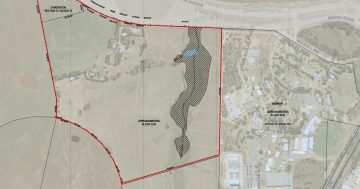

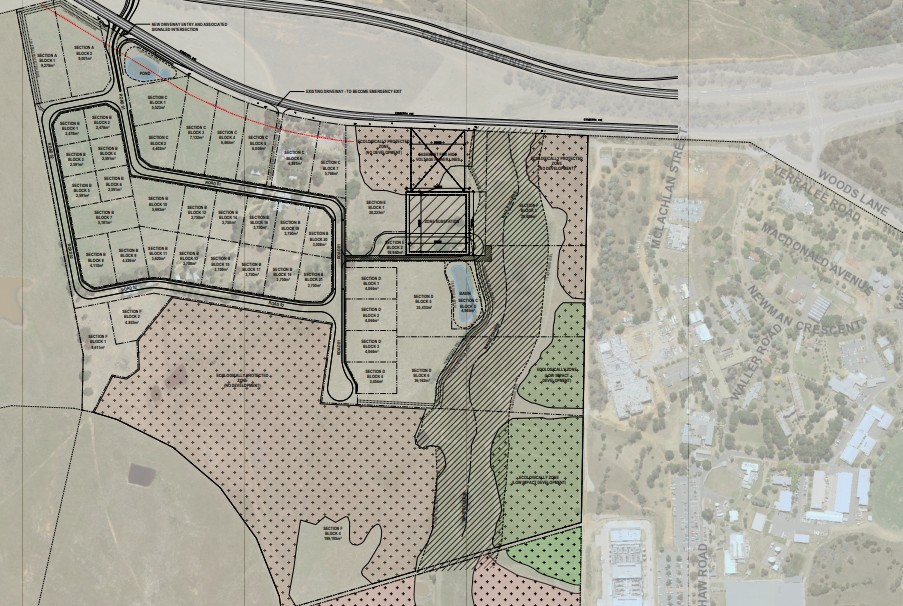
Symonston Business Park proposed subdivision. Image: DNA Architects.
A proposal for a major business park in Symonston is facing opposition on multiple fronts, including that it threatens endangered grassland and animals.
In July, Sustainable Data Resource Pty Ltd, whose director is Canberra developer Peter Micalos, lodged a development application proposing the subdivision of a 56-hectare, NUZ1 – Broadacre Zone site at 722 Canberra Avenue.
The DA also sought to add a long list of uses to the Crown lease for the light industrial/commercial Evolution Business Park that would deliver 80,000 sqm of industrial leasable floor area and a data centre.
The proponent has now lodged an amendment prepared by Canberra Town Planning in response to multiple representations opposing the development and to a request for more information from the Territory Planning Authority.
The amendment proposes a subdivision into 44 smaller lease blocks instead of the seven ‘Superblocks’ originally proposed, realignment of a ring road, changes to areas to be handed back to the ACT Government, fewer lease uses, landscape updates and withdrawal of signage.
It also includes a lengthy document responding to the ACT Conservation Council and the Friends of Grassland concerns about the proposal’s “significant indirect impacts” on one of the nation’s most important grassland remnants and on several grassland threatened species, as well as species such as the Striped Legless Lizard and Golden Sun Moth.
The original DA said ecologically protected areas would be excluded from development, and the amendment says new surveys of the land will be done, but the groups say the proposed development will also impact adjoining blocks.
ACT Conservation Council Executive Director Simon Copland said the two groups were not satisfied with the proponent’s response.
Mr Copland said the site was inappropriate for light industrial development, being next to one of the last areas of natural grassland in Australia, a critically endangered ecosystem.
“This is the northern enclave of a nationally important grassland, and while it may not necessarily be the best part of that grassland, these kind of developments have major impacts on the adjoining sites but also on the site itself,” he said.
“The fundamental concern here is the location for such a project.”
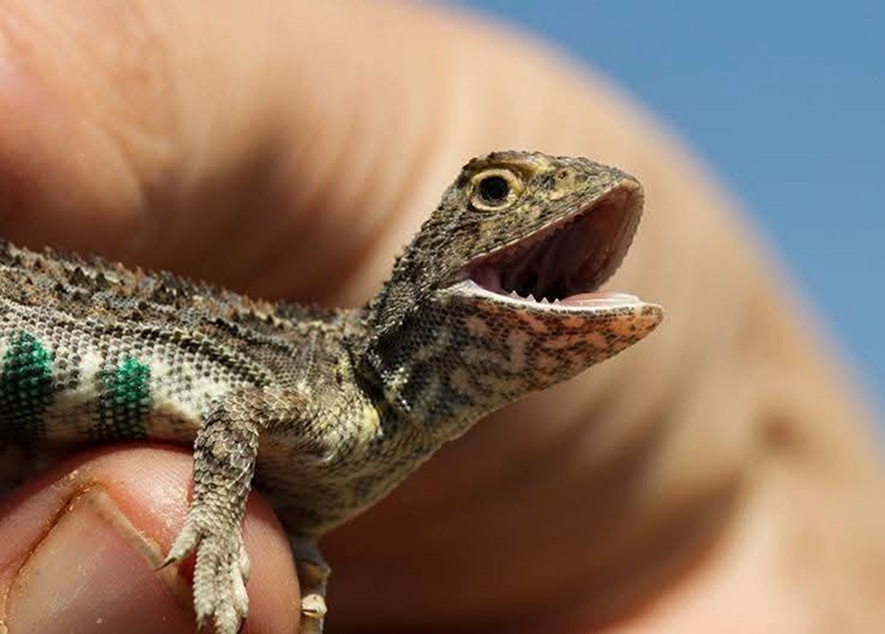
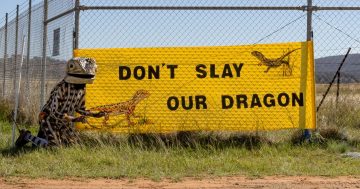
The site could become a habitat for the Canberra Grassland Earless Dragon, says the Conversation Council. Photo: Facebook/ACT Government.
Both the Council and FOG have made a further representation detailing the environmental concerns and the proponent’s inadequate documentation.
“It’s going to have significant environmental impacts, and it also just doesn’t seem to be prepared well enough to be able to face proper scrutiny, and so we think on both of those facts it should just be rejected,” Dr Copland said.
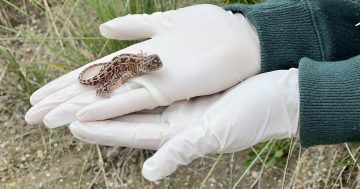
He suggested that the site could be regenerated as habitat for species such as the Canberra Grassland Earless Dragon.
“The ACT Government earlier this year invested just over $4 million into the breeding programs for the Canberra grassland earless dragon, which is one of the most threatened species in the ACT,” Dr Copland said.
“But we’ve always said that you can’t just have a breeding program without having habitat for them to go into, and this is a clear space where there’s opportunity to regenerate habitat so that we can have more grasslands for these species to live in.”
Dr Copland said there also needed to be more discussion about the environmental impacts of data centres, especially those involved with artificial intelligence.
The ACT Heritage Council also did not support the proposal, saying an up-to-date Cultural Heritage Assessment was required, particularly for Aboriginal artefacts. This was provided by Past Traces in September, which recommended mitigation strategies.
Canberra Airport was unsupportive because it is under a flight path, as was Icon Water, due to a lack of an earthing study and the site of proposed tree plantings.
The proponent notes in response that the current proposal is for subdivision, layout and lease variation, not for any construction.
The Conservator of Flora and Fauna, TCCS, the National Capital Authority and the Planning Authority all sought more information.
Mr Micalos is also involved in The Markets mixed-use residential development in Belconnen.