

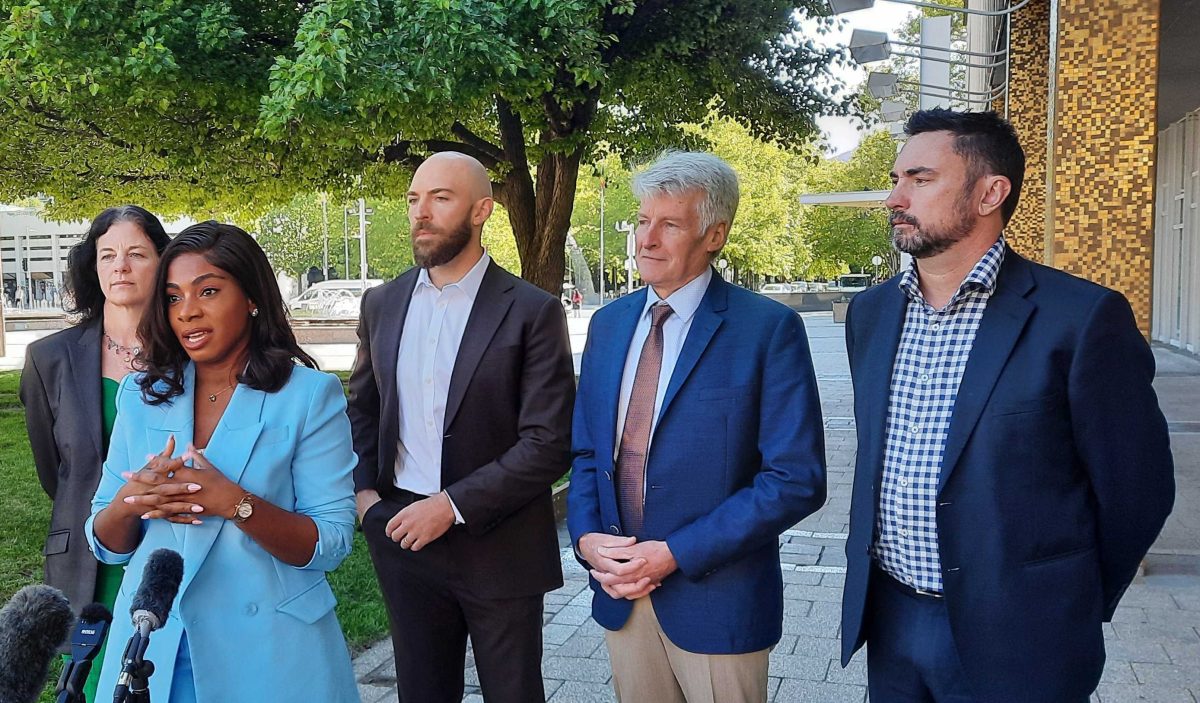
Liberal Chiaka Barry (at microphone), with MLAs Jo Clay and Thomas Emerson, and Frank Keighley and parent Jim Gilchrist. Photos: Ian Bushnell.
Non. Nyet. Nein. Nahi. Whatever way you say it, Education Minister Yvette Berry is saying no to a call for the Education Directorate to plug a hole in the delivery of senior secondary school language courses.
The service gap has come about due to the demise this year of CIT Solutions, which in 2024 took over the Year 11 and 12 courses offered by the Canberra Academy of Languages, run by Frank Keighley, a former college principal, since 2017.
Mr Keighley says the Directorate could easily adopt the Academy model – which offered after-school classes in a central, accessible location – as a turnkey solution for little cost, and submitted a detailed proposition to Ms Berry in November.
CIT, which says teaching languages is not a priority, will honour existing student enrolments so they can complete Year 12 but will not take on any new enrolments in 2026.
This will leave Year 10 students hoping to continue their language studies in the lurch when they reach Year 12 if their local college does not offer their particular language.
That’s the case for a Canberra High student who has spent a decade studying French, including a six-month exchange to France last year.
Her father, Jim Gilchrist, has been lobbying Ms Berry and MLAs, and launched a petition that has garnered nearly 600 signatures.
Liberal MLA Chiaka Barry took the issue into the Legislative Assembly on Thursday (4 December), calling for a more structured approach to language education, with support from Green Jo Clay and Independent Thomas Emerson.
But while Ms Berry acknowledged the importance of language studies and the advocacy of Mr Gilchrist and Mr Keighley, she would not support the Directorate picking up the CIT Solutions program despite the government having a Language Education Action Plan.
Mr Gilchrist said this meant his daughter and some of her friends would be dropping a subject they loved because Lake Ginninderra College did not offer that language.
He said the options offered by Ms Berry were not practical. These include enrolling out of area at Dickson College, enrolling in two colleges and travelling to classes, or enrolling in NSW distance education.
These were choices his daughter shouldn’t have to make, Mr Gilchrist said.
He said it was outrageous to suggest she attend distance education, the worst possible way to teach a language.
“That’s fine if you’re in Alice Springs, but if you’re living in the nation’s capital to be offered that, quite frankly, it was offensive,” Mr Gilchrist said.
Enquiries about dual enrolments were met with laughter from principals.
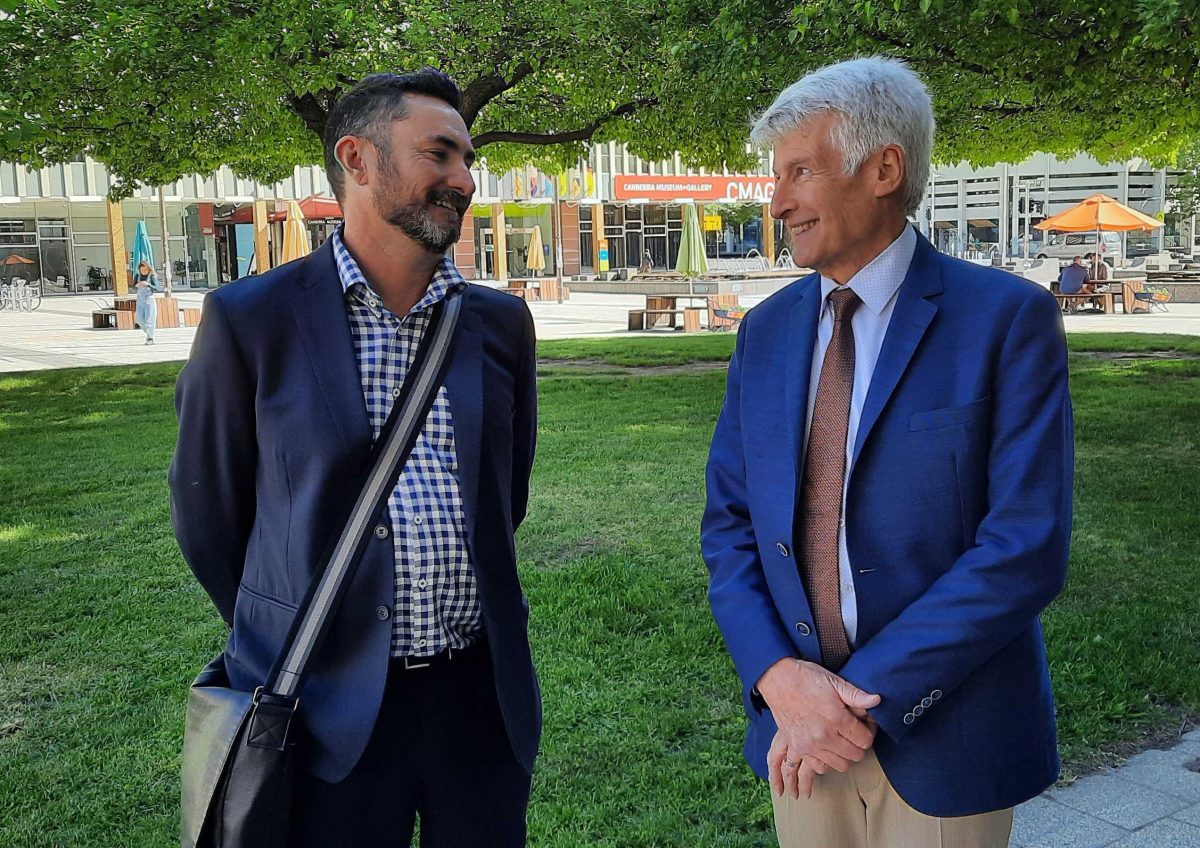
Jim Gilchrist and Frank Keighley say the Directorate’s options were impractical and inequitable.
Mr Keighley said the Academy model suggested was simple, affordable and achievable.
It would cost about $250,000, but some of that could be recovered by a fee.
He said it would also be a practical way of dealing with the difficulties of recruiting language teachers.
“This model has access to the whole catchment of the teacher workforce in the ACT after school hours, and all it requires is for a day school principal to say, ‘yes, I approve you to go and do this evening class’ and deliver those classes in the evening program,” Mr Keighley said.
“So in all of our time we never failed to get a teacher for the programs we wished to deliver with the Canberra Academy of Languages, and the same can’t be said for every day school because it’s a competitive market.”
Ms Berry told the Assembly that CIT Solutions had 47 students on their books, but Mr Keighley said the program had flown under the radar in the past two years with little marketing, and a re-established Directorate program could expect 100 to 200 students.
He said the ACT, WA and Tasmania were outliers in this space, with the other jurisdictions’ education departments offering programs similar to the suggested model.
At stake was the ability to equitably maintain language education in the ACT.
“If we’re not fostering that capacity in language skills and in intercultural understanding, then we are missing out on things that are really essential for the ACT and its role as a national capital,” Mr Keighley said.
“But the other thing to remember about the ACT is that it’s not just the national capital; it’s also a multicultural community.
“We have a lot of skills resident in our communities, and they should be fostered and maintained as well, so there are huge opportunities here. We should be on the front foot with this, not on the back foot.”
Ms Barry, who speaks more than one language, said it was important that in a world-class city like Canberra, children have equitable options.
“As someone who is multilingual myself, I understand the importance of being multilingual,” she said.
“I understand the opportunities it presents … My daughter studied French and Japanese, and I just want kids to have that as well.”
Ms Barry moved a motion in the Assembly on Thursday calling on the minister to ensure that all students who wish to study languages at Year 11 and 12 level in 2026 are proactively contacted and provided options to do so.
It also called for the development of a long-term language-learning strategy and the expansion of the range of languages offered.
Ms Barry told the Assembly that agencies such as Foreign Affairs and Trade relied on Australians with strong bilingual and multilingual skills.
“It is a competitive advantage that we should be nurturing, not eroding,” she said.
Labor did not oppose the motion, but Ms Berry would not commit to replicating the CIT Solutions or Academy program.
“The Education Directorate will continue to explore ways to strengthen and deliver the continuity of language education pathways across school years, with consideration for flexible delivery models, and teacher recruitment partnerships,” she told the Assembly.