

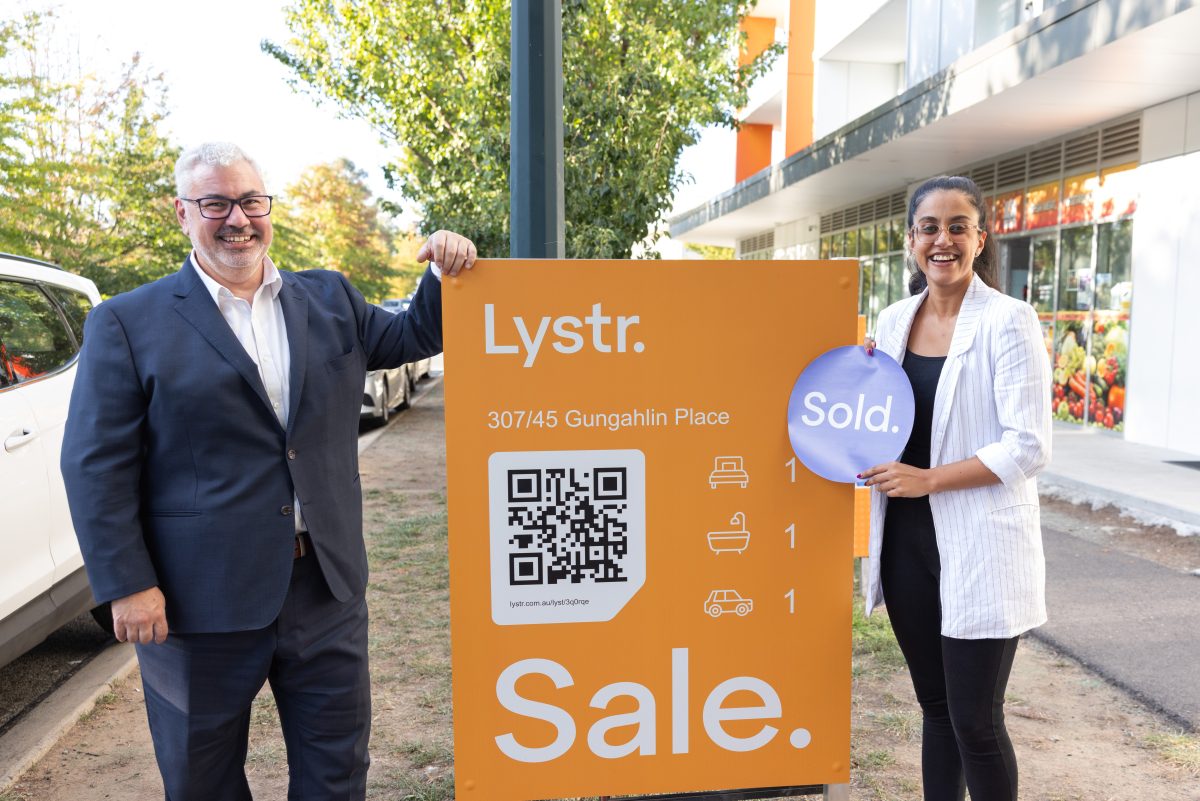
Chris Scullin (Lystr CEO) with Dinah — the first person to buy a property using Lystr. Photo: Lystr.
Selling your home is likely the biggest financial decision you’ll ever make, but it can be a confusing and intimidating process
From pressure tactics to opaque pricing and “buyer urgency” that may or may not be real, the traditional real estate playbook can leave sellers feeling like passengers in their own sale.
But one real estate industry disruptor says there are ways to dodge these old tricks.
Chris Scullin is the CEO and founder of Lystr, a revolutionary platform that gives sellers complete visibility and control during the sales process, embracing radical transparency while still being supported by an agent.
Chris says not all real estate agents are untrustworthy, but Lystr doesn’t exist because of the good ones.
“There are some tactics employed by less scrupulous sales agents,” he says. “Whether you have a good agent or bad, Lystr exists to make it a moot point. These tactics can’t thrive in transparency.”
If going down the traditional route, certain questions can bring more transparency, starting when agents are trying to win the sale.
“If you go to multiple agents for appraisals, in theory, they’re working from the same market data, but you might notice fluctuations,” Chris says.
“Some agents inflate the appraisal price. Make sure they provide a comparative market analysis and evidence to back it before locking into a 90-day contract. Once you’re there, unlike with Lystr, you’re a captive customer.”
Lystr licensee Kirsty Bohane advises sellers to ask about the expected turnaround time.
“Ask for their estimation of days on market to achieve the appraisal price,” she said. “Market forecasts change – in what timeframe is that price achievable?”
Questionable tactics exist at the other end too, with agents sometimes fabricating other potential buyers to apply pressure.
“That might seem great for a seller, but as top real estate coach Tom Panos says, if they are prepared to lie for you, they are prepared to lie to you,” Chris says.

Lystr’s most recent results speak volumes about an owner’s ability to oversee the sale of their own property. Image: Lystr.
Chris also advises being wary of agents who push for auctions.
To start with, recent Cotality data shows Canberra’s auction clearance rates sit just below 70 per cent. But evidence shows not all agents report auctions that were “passed in” or “withdrawn ” (ie, were sold but did not meet their reserve), which can inflate the clearance rate above the actual market performance.
Evidence also suggests properties listed without a price — common in auction campaigns — receive significantly lower engagement than those with a clear price.
And while the typical four-week auction is billed as an intensive, short-term strategy designed to create a sense of urgency and maximise competition, Chris challenges that wisdom.
“If market time is 60 days, does four weeks really give the property enough coverage and the market enough time to identify the property’s true value?” he says.
“In my experience, auctions are good for agents, not necessarily sellers. Agents can be in and out in 30 days and collect a commission for four weeks of work.”
Financial incentives for agents may also misalign with seller outcomes.
“If an agent working on 2.2 per cent commission gives half back to their principal, every $10,000 added to the sale is just $100 in their pocket,” he said.
“$10,000 might be a big win for the seller, but $100 hardly motivates an agent — they’re better off selling quickly and moving on.”
Since its launch, Lystr has already guided sellers through the process with transparent, fixed-price packages that they can tailor to suit, taking on as much or as little of the selling process as they want.
Some have achieved above their appraisal price and all have paid a fraction of the traditional agent’s commission.
Chris says this challenges the assumption that professional agents always negotiate higher sale prices.
“The jury is out on whether that’s true and accounting for fees, the net outcomes of professional versus private sales are even less certain,” he says.
“The truth is nobody can tell your property’s story better than you, given the chance to do it with the right guidance.”
For more information, visit Lystr.