
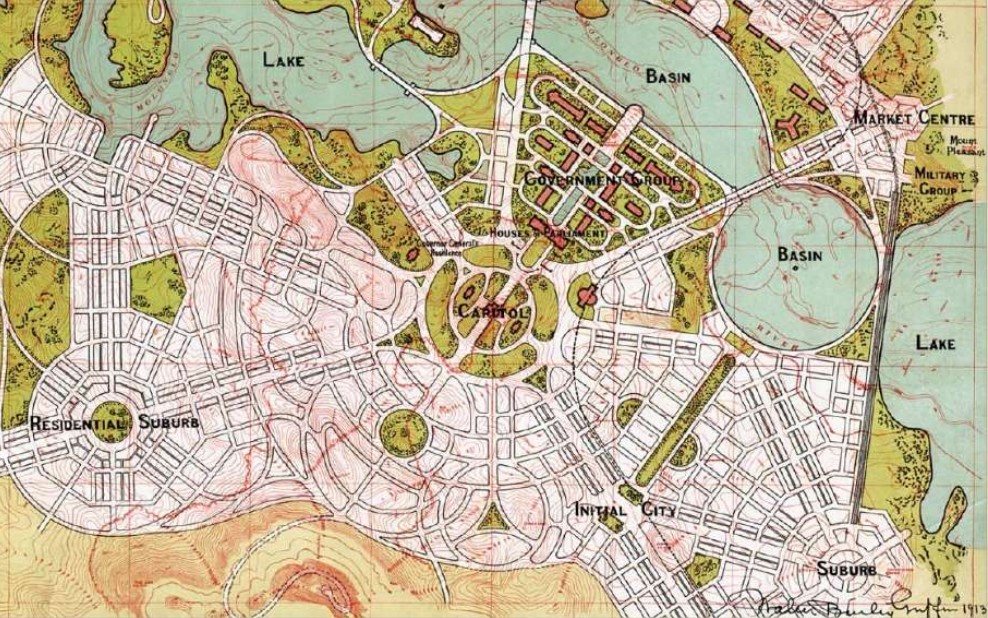
Walter Burley Griffin, ‘Canberra, Federal Capital of Australia, Preliminary Plan’, October 1913 (detail). The round point that is the subject of DA102 is clearly marked as ‘Suburb’ of the ‘Initial City,’ not ‘Gateway’. Image: National Archives of Australia.
A world authority on the Griffins has lashed the National Capital Authority for rewriting history and failing to provide a detailed case for proposed planning changes to allow high-rise buildings around Hume Circle in the inner south.
Emeritus Professor James Weirick of UNSW has made a submission to the National Capital Plan Draft Amendment 102 – Hume Circle Precinct (DA102).
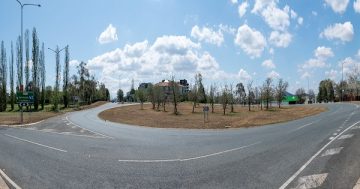
DA102 would allow areas around the Hume Place roundabout to be rezoned to allow residential apartment buildings up to 15 storeys high.
Professor Weirick says the revitalisation of the Hume Circle Precinct is long overdue.
“Unfortunately, DA102 does not achieve this. Neither the Draft Amendment itself, nor its background paper, demonstrates a credible integration of land use, transportation and urban form,” he says.
“The problem with DA102 in its current form has resulted from inadequate research, site analysis, urban design and approval process.”
He calls the approach fundamentally flawed and one that would give developers carte blanche.
The NCA says DA102 would enable the development of the Griffins’ unrealised eastern gateway to Canberra, fulfilling the original intent of the Griffin Plan for a radial street design and enabling the renewal of a Hume Circle Precinct, converting an area of light industry to a mix of residential and commercial uses.
But Professor Weirick says Walter Burley Griffin never envisaged Hume Circle as a gateway but as a central part of a suburb, underwhich a suburban and interstate rail line would run.
He says Walter alone designed it in 1913 as a revision of the original plan to accommodate the wishes of the Departmental Board, which had been building Canberra according to its plan, not the Griffin Plan, since 1912.
“What has been built at Hume Circle over the years, and what is proposed by the NCA in DA102 today, is a caricature of the Griffin concept,” Professor Weirick says.
“The work of ‘the Griffins’ should not be evoked to give this caricature legitimacy or credibility.”
He says a principle of the Griffins’ winning entry was that Australia’s new capital did not need to have tall buildings.
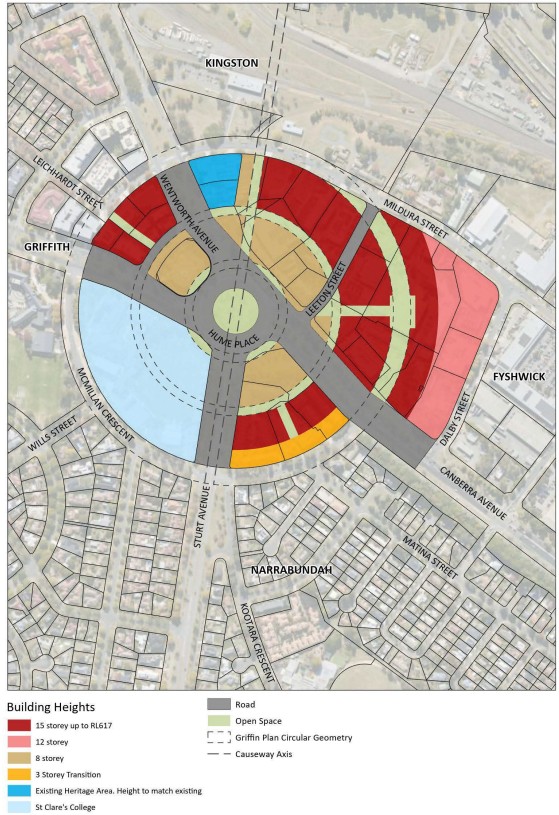
The building heights spread from DA102. Image: NCA.
Professor Weirick says that Walter made clear that the principle of horizontal building masses was integral to the city’s spatial qualities, land-use patterns, transportation and communication networks, open-space systems, landscape, amenities, health, beauty, and national significance.
“No cluster of tall buildings is shown on the far periphery of the city, marking a ‘gateway’. This was not a Griffin concept, and to infer that it was, as DA102 implies, is deeply misleading.”
Professor Weirick says the NCA, in its supporting Background Paper, provides no site analysis, no civic survey, and little other information, including existing and future traffic volumes for such a busy intersection.
He says DA102 presents a pattern of building heights up to 15 storeys high as a fait accompli.
“As demonstrated in the City around London Circuit, developers will push their schemes to this height limit, successfully challenging any idea of restricting buildings of maximum height to limited ‘gateway’ locations on aesthetic grounds,” Professor Weirick says.
“DA102, if approved in its current form, will give developers carte blanche to do this.”
Professor Weirick says the NCA is delaying codification of design quality, leaving new homes at risk of compromising residents’ living experience and failing to be adaptable or flexible for future needs.
“This does not inspire confidence. The NCA should have codified design standards for Canberra apartments decades ago,” he says.
“The approach adopted by the NCA to architectural design in this instance, and urban design overall – ‘trust us, the details will come later’ – is fundamentally flawed.”
Professor Weirick says the approval process for National Capital Plan amendments is the wrong way round and has a record of failure.
He says detailed ‘urban design frameworks’ need to form the basis for statutory controls, not statutory controls forming the basis for ‘urban design frameworks’.
His recommendations urge DA102 to be withdrawn and re-worked as an ‘urban design framework’ based on sound historical research, rigorous site analysis, a rigorous civic survey, and effective public consultation.
Statutory controls then need to be proposed to implement the ‘urban design framework’ and submitted to the Federal Minister for Regional Development, Local Government & Territories with the recommendation that this Draft Amendment to the National Capital Plan in revised form – robust, detailed, defensible – be placed before the Joint Standing Committee on the National Capital and External Territories for Parliamentary review.